
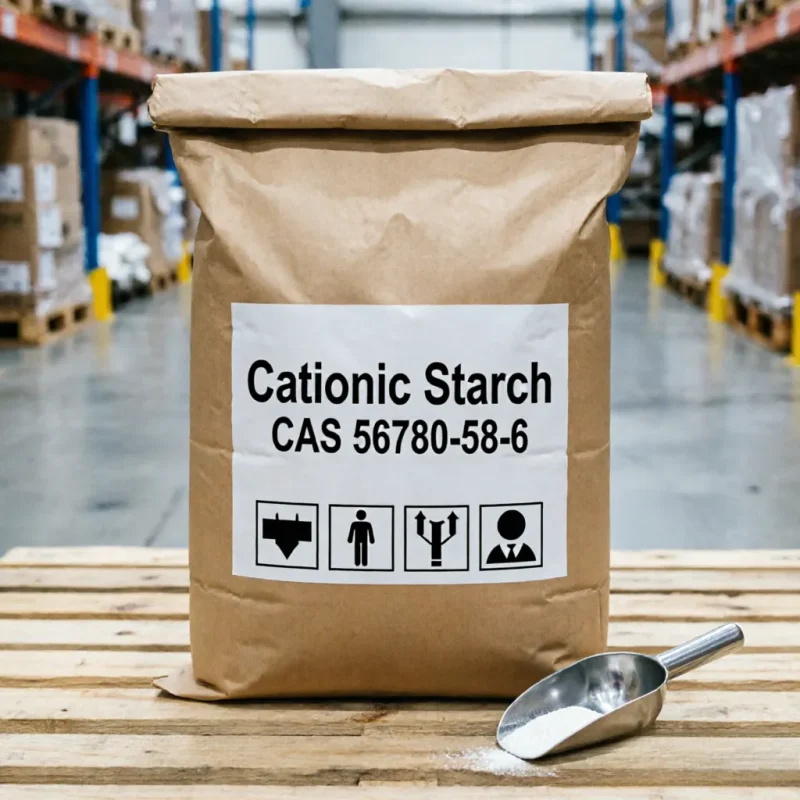
Industrial Grade Cationic Starch (CAS 56780-58-6)
Industrial Grade Cationic Starch is a quaternary ammonium modified starch polymer supplied as white to off-white free-flowing powder. Its permanent positive charge ensures strong electrostatic adsorption onto negatively charged cellulose fibers and fillers, making it the standard wet-end additive for paper retention and drainage, textile sizing, and wastewater flocculation. Each shipment includes COA, TDS, and SDS.
- CAS No: 56780-58-6
- Synonyms: Cationic starch, Quaternary ammonium cationic starch, 2-Hydroxy-3-(trimethylammonio)propyl starch ether
- EC Number: 260-978-4
- Molecular Formula: Modified starch backbone with –OCH2CH(OH)CH2N+(CH3)3Cl- groups
- Molecular Weight: 10⁵ – 10⁷ Da (Polymer)
- Appearance: White to off-white free-flowing powder
- Degree of Substitution (DS): 0.02 – 0.05 (Customizable up to 0.1)
- Packaging: 25 kg (55 lb) woven PP bag with PE liner; 1,000 kg (2,200 lb) jumbo bag. Custom packaging available upon request.
- Main Applications: Papermaking retention/drainage aid, textile warp sizing, wastewater flocculant, adhesive binder
Introduction to Industrial Grade Cationic Starch
Industrial Grade Cationic Starch is produced by etherifying native corn or potato starch with 3-chloro-2-hydroxypropyltrimethylammonium chloride, introducing permanent quaternary ammonium cationic groups onto the glucopyranose units. In papermaking systems, the positively charged starch chains adsorb irreversibly onto anionic cellulosic fibers, fines, and fillers via electrostatic attraction, creating bridges that flocculate the furnish and dramatically improve retention on the wire.
The primary processing advantage is its pH-independent cationic charge. Unlike amphoteric or anionic starches, the quaternary ammonium groups remain fully ionized across the entire pH 4–10 range, ensuring consistent performance even when wet-end chemistry fluctuates. The critical storage risk is hygroscopicity and microbial spoil: once exposed to humid air, the powder absorbs moisture, forms hard lumps, and can develop sour odors from bacterial fermentation. Store bags on pallets in a dry warehouse below 35 °C (95 °F) and reseal the PE liner immediately after opening.
Key Features of Industrial Grade Cationic Starch
- Permanent cationic charge. The quaternary ammonium nitrogen carries a positive charge independent of pH, guaranteeing reliable adsorption onto negative fibers even in alkaline papermaking (pH 7.5–8.5).
- Superior retention and drainage. High molecular weight chains bridge fines and fillers into larger flocs, increasing first-pass retention by 10–25% and reducing white water solids load.
- Dry and wet strength enhancement. Cationic starch forms hydrogen bonds with cellulose, improving internal bond strength, tensile index, and reducing linting and dusting during printing.
- Renewable and biodegradable. Derived from natural starch, it breaks down in biological wastewater treatment plants without generating toxic residues, unlike synthetic polyacrylamide alternatives.
Industrial Grade Cationic Starch Chemical & Physical Properties
| Property | Value |
|---|---|
| Molecular Formula | Modified starch with quaternary ammonium groups |
| Degree of Substitution (DS) | 0.02 – 0.05 (Standard paper grade); up to 0.10 for high-charge applications |
| Nitrogen Content | 0.15% – 0.40% (Kjeldahl method) |
| Thermal Behaviour | Gelatinizes at 65–75 °C (149–167 °F) in water; powder decomposes above 200 °C (392 °F). |
| Solubility in Water | Dispersible in cold water; forms viscous colloidal paste upon heating above gelatinization point. Insoluble in organic solvents. |
| pH (5% aqueous dispersion) | 4.5 – 7.0 |
| Moisture Content | ≤ 14.0% |
| Whiteness | ≥ 85% |
| Heavy Metals (as Pb) | ≤ 10 ppm |
| Sulfur Dioxide (SO2) | ≤ 50 ppm |
Applications of Industrial Grade Cationic Starch
Papermaking wet-end chemistry: Cooked at 2–5% consistency in a jet cooker at 95–105 °C (203–221 °F), then diluted to 0.5–1.0% and added to the thick stock or fan pump. Dosage 0.5–1.5% against dry pulp. Improves filler retention (CaCO3, clay), accelerates drainage on the forming fabric, and boosts dry tensile strength.
Textile warp sizing: Used at 10–30% on weight of yarn for cotton/polyester blends. The cationic groups improve adhesion to synthetic fibers and reduce fluff shedding during high-speed weaving. Desizing is easily achieved with amylase enzymes.
Wastewater treatment flocculant: Dosed at 5–50 ppm in primary clarifiers or dissolved air flotation (DAF) units. Neutralizes negatively charged suspended solids, colloids, and anionic trash, reducing turbidity and COD load in mill effluent.
Adhesives and binders: Incorporated into corrugated board starch adhesives (Stein-Hall process) to increase tack and bonding strength to linerboard, and used as a binder in paper tube and honeycomb board manufacturing.
Storage & Safety Precautions for Industrial Grade Cationic Starch
- Storage: Keep tightly sealed in a dry, ventilated warehouse below 35 °C (95 °F). The powder is hygroscopic; exposure to humidity causes caking, reduces flowability, and promotes microbial growth (sour odor). Do not store directly on concrete floors; use pallets and keep away from exterior walls. Reseal the PE liner after each use.
- Safety: Classified as non-hazardous. Starch dust may cause mild mechanical irritation to eyes and respiratory tract. Wear standard dust masks and safety goggles when transferring or cooking. In case of dust cloud, ventilate the area.
- Transport: Industrial Grade Cationic Starch is Non-DG under IATA/IMDG/ADR. Not a marine pollutant. Standard 25 kg (55 lb) bags or 1,000 kg (2,200 lb) jumbo bags ship in standard dry containers. Protect from rain and moisture during loading/unloading.
- QC note: Verify Nitrogen content via Kjeldahl distillation and cationic charge demand via Polyelectrolyte Titration (PCD/colloid titration) upon receipt. A sour or musty odor, visible black specks, or hard lumps exceeding 5% of the bag indicate moisture ingress or microbial contamination—reject such lots.
Industrial Grade Cationic Starch FAQ
Q: What is Degree of Substitution (DS) and how do I choose the right grade?
A: DS represents the average number of hydroxyl groups substituted per glucose unit. For standard paper retention, DS 0.02–0.04 is sufficient. For highly filled systems or alkaline papermaking with high anionic trash, choose DS 0.05–0.08 for higher charge density. Higher DS increases cost but improves electrostatic neutralization.
Q: How should I cook cationic starch to avoid viscosity loss?
A: Disperse powder in cold water at 3–5% consistency, then heat to 95 °C (203 °F) and hold for 20–30 minutes. Avoid excessive shear after gelatinization; high-shear pumping can break polymer chains and reduce retention efficiency. Dilute with cold water immediately after cooking to prevent retrogradation.
Q: Can cationic starch be used together with anionic dyes or optical brighteners?
A: Direct mixing causes precipitation and loss of both additives. Add cationic starch and anionic colorants at separate points in the system, allowing sufficient dilution and retention time between addition points. Alternatively, use a high-DS grade to minimize interference.
Related products
Manufacturer & Exporter Since 2006
Get Tailored Chemical Raw Material Solutions — Reply Within 1 Hour
Factory-direct pricing, stable high-purity supply and complete compliance documentation for your industrial formulations.
- 1000+Products
- 200+QC Protocols
- 7–15Days Delivery
- Factory-Direct Pricing
- COA / TDS / SDS Included
- Free Samples for Testing
- 40+ Export Countries
Request a Free Quote
Our engineers reply within 1 hour during GMT+8 business hours.
Please include in your inquiry:
- Product name or CAS number
- Required quantity
- Destination country or port
- Preferred packaging