
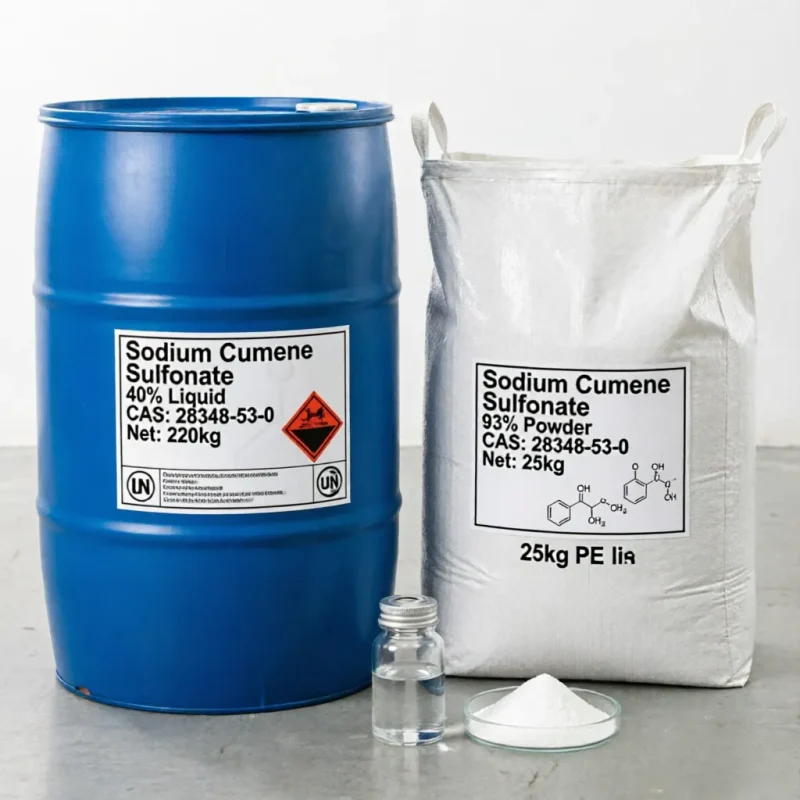
Sodium Cumene Sulfonate (SCS) CAS 28348-53-0
Sodium Cumene Sulfonate (SCS) is a high-efficiency hydrotropic solubilizer available as 40% aqueous liquid or 93% spray-dried powder. Its short hydrophobic cumene tail and strong sulfonate head grant exceptional compatibility with anionic, nonionic, and amphoteric surfactant systems, preventing phase separation and gel formation in concentrated detergent formulations. Core uses include liquid laundry detergents, hard-surface cleaners, agricultural adjuvants, and textile auxiliaries. Each shipment includes COA, TDS, and SDS.
- CAS No: 28348-53-0
- Synonyms: Sodium isopropylbenzene sulfonate, Sodium 2-phenylpropane sulfonate, Cumene sulfonic acid sodium salt
- EC Number: 248-966-6
- Molecular Formula: C9H11NaO3S
- Molecular Weight: 222.24 g/mol
- Appearance: 40%: colorless to pale yellow clear liquid; 93%: white to off-white powder or flakes
- Active Matter: 40% ± 1% (liquid) / 93% ± 1% (powder)
- Packaging (40% Liquid): 200 kg (440 lb) HDPE drum; 1000 kg (2204 lb) IBC tote. Custom packaging available upon request.
- Packaging (93% Powder): 25 kg (55 lb) multi-wall kraft paper bag with PE liner; 500 kg (1102 lb) FIBC jumbo bag. Custom packaging available upon request.
- Main Applications: Detergent solubilizer, industrial cleaner hydrotrope, pesticide formulation aid, textile wetting/leveling agent, paper deinking dispersant
Introduction to Sodium Cumene Sulfonate
Sodium Cumene Sulfonate (SCS) is the sodium salt of cumene (isopropylbenzene) sulfonic acid, classified as a short-chain alkylbenzene sulfonate hydrotrope. Unlike conventional surfactants that form micelles, SCS operates below its critical micelle concentration (CMC ~120 g/L) to disrupt intermolecular association between longer-chain surfactants, thereby solubilizing incompatible ingredients and maintaining single-phase clarity in concentrated liquid formulations. At 2–8% active addition, it prevents cloudiness, layering, and viscosity spikes caused by high electrolyte loads or mixed surfactant incompatibility.
The 40% liquid grade is preferred for direct blending into aqueous detergent systems, while the 93% powder grade suits dry-blend applications and export scenarios where freight cost per active kilogram is critical. Storage risk differs by form: the liquid grade freezes below 0 °C (32 °F) and may require gentle warming before pumping; the powder grade is hygroscopic and cakes above 70% RH. Store liquid in sealed HDPE containers at 5–40 °C (41–104 °F); store powder in moisture-barrier bags below 35 °C (95 °F).
Key Features of Sodium Cumene Sulfonate
- Superior hydrotropic solubilization. At 3–5% active addition, SCS maintains optical clarity in formulations containing > 20% combined surfactant (SLES + AEO + CAPB) and > 5% inorganic electrolyte, eliminating phase separation during 12-month shelf storage.
- Broad surfactant-system compatibility. Fully miscible with anionic (SLES, LAS, MES), nonionic (AEO-9, APG), and amphoteric (CAPB, BS-12) systems without neutralizing foam or compromising detergency.
- Viscosity moderation without thickener conflict. Reduces excessive viscosity in high-solids liquid detergents by 30–50%, improving pumpability and pourability while remaining compatible with salt-thickening and polymer-thickening mechanisms.
- Electrolyte tolerance booster. Allows formulators to raise NaCl or sodium citrate levels for cost optimization without triggering turbidity or gelation, particularly valuable in hard-water regions.
- Rapid biodegradation. OECD 301B ready biodegradability > 90% in 28 days, meeting EU Detergent Regulation (EC) 648/2004 and US EPA Safer Choice hydrotrope criteria.
Sodium Cumene Sulfonate Chemical & Physical Properties
| Property | 40% Liquid | 93% Powder |
|---|---|---|
| Molecular Formula | C9H11NaO3S | |
| Molecular Weight | 222.24 g/mol | |
| Active Matter | 40% ± 1% | 93% ± 1% |
| pH (as supplied / 5% aq.) | 6.0 – 8.0 | 7.0 – 9.0 |
| Density (20 °C / 68 °F) | 1.10 – 1.15 g/cm³ (68.7 – 71.8 lb/ft³) | Bulk ~0.55 – 0.70 g/cm³ (34.3 – 43.7 lb/ft³) |
| Solubility in Water | Freely soluble in all proportions; soluble in methanol and ethanol; insoluble in hexane and toluene. | |
| Thermal Behaviour | Stable to 100 °C (212 °F); freezes below 0 °C (32 °F). | Decomposes > 300 °C (572 °F); no sharp melting point. |
| Inorganic Salts (as Na2SO4) | ≤ 2.0% | ≤ 3.0% |
| Color (Gardner / Klett) | ≤ 2 (Gardner) | ≤ 30 (Klett, 10% aq.) |
| CMC (Critical Micelle Concentration) | ~120 g/L (hydrotrope mechanism, not classical micelle former) | |
Applications of Sodium Cumene Sulfonate
Liquid laundry detergents and dishwashing liquids: Add 2–6% (active basis) to solubilize high-load surfactant blends (SLES + LAS + AEO-9) and prevent turbidity when electrolyte (NaCl, sodium citrate) exceeds 4%. Maintains pourable viscosity at 25 °C (77 °F) and prevents gel-layer formation at 5 °C (41 °F) cold-storage conditions. Compatible with enzymes (protease, amylase) and optical brighteners.
Industrial and institutional (I&I) cleaners: Use at 3–8% in alkaline degreasers (pH 12–14, NaOH 5–15%) to solubilize nonionic surfactants and prevent cloud-point precipitation above 60 °C (140 °F). Also effective in acidic toilet bowl cleaners (HCl or citric acid systems) to maintain single-phase clarity.
Agricultural formulation adjuvant: Incorporate at 1–5% in SL (soluble liquid) and SC (suspension concentrate) pesticide formulations to improve active ingredient dissolution, enhance leaf-surface spreading, and stabilize emulsion systems against Ostwald ripening during 54 °C (129 °F) accelerated storage tests.
Textile wetting and leveling agent component: Blend at 5–15% into textile auxiliary concentrates to improve compatibility of anionic wetting agents with cationic dye-fixing agents in jet-dyeing processes. Reduces foam build-up compared to conventional hydrotropes in high-shear padding mangles.
Paper deinking flotation aid: Add at 0.5–2.0% to alkaline flotation deinking systems (pH 9–10, NaOH/Na2SiO3) to disperse detached ink particles and prevent redeposition onto recycled fibers, improving ISO brightness by 2–4 points.
Storage & Safety Precautions for Sodium Cumene Sulfonate
- Storage (40% Liquid): Keep in sealed HDPE drums or IBC totes at 5–40 °C (41–104 °F). Protect from freezing; if solidified below 0 °C (32 °F), gently warm to 20–30 °C (68–86 °F) with drum heaters or warm water circulation—do not exceed 50 °C (122 °F). Avoid prolonged storage above 40 °C (104 °F) to prevent slow color darkening.
- Storage (93% Powder): Keep sealed in original kraft bags with PE liner at 5–35 °C (41–95 °F), relative humidity below 65%. The powder is hygroscopic; exposure above 70% RH causes caking within 48 hours. Do not store near strong acids or oxidizers. Shelf life 24 months unopened.
- Safety: Not classified as hazardous under GHS. The 40% liquid is a mild eye irritant (Category 2B); the 93% powder may cause transient respiratory irritation if inhaled as dust. Wear safety glasses and nitrile gloves during transfer. For bulk powder handling, use N95/P2 dust mask and local exhaust ventilation.
- Transport: Sodium Cumene Sulfonate is Non-DG under IATA/IMDG/ADR. No UN number, no packing group. Liquid: ship in standard 200 kg drums or IBC totes in dry containers; ensure drum bungs are oriented upward. Powder: ship on shrink-wrapped pallets; protect from rain and container condensation during sea transit.
- QC note: Verify active matter by two-phase titration (liquid) or gravimetric drying (powder, 105 °C / 221 °F, 2 h). Check pH within specification. For liquid grade, confirm clarity (no haze) at 25 °C (77 °F); slight cloudiness at 5 °C (41 °F) is reversible upon warming. Reject if color exceeds Gardner 3 (liquid) or Klett 40 (powder).
Sodium Cumene Sulfonate FAQ
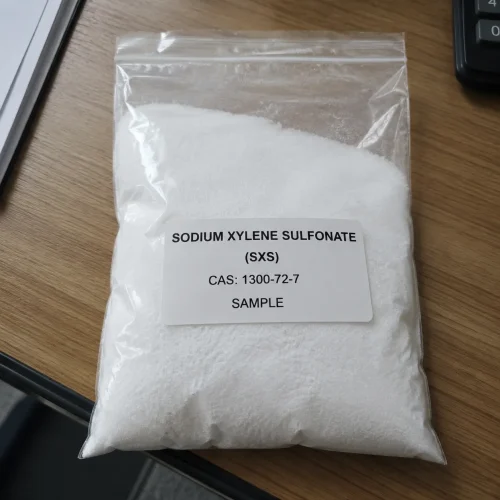
Q: How does Sodium Cumene Sulfonate compare to Sodium Xylene Sulfonate (SXS) as a hydrotrope?
A: Both are effective hydrotropes, but SCS (cumene = C9 hydrophobe) provides stronger solubilization power per unit mass than SXS (xylene = C8 hydrophobe). SCS typically requires 10–20% lower dosage to achieve equivalent clarity in high-electrolyte systems. SCS also exhibits better compatibility with nonionic surfactants at elevated temperatures (above 50 °C / 122 °F), making it preferred for I&I alkaline cleaners.
Q: The 40% liquid drum arrived frozen solid in winter transit. Is the product damaged?
A: No. Freezing is a reversible physical change for the 40% aqueous solution. Slowly warm the drum in a heated warehouse (20–30 °C / 68–86 °F) or use a certified drum band heater set below 50 °C (122 °F). Once thawed and gently mixed, the hydrotrope retains 100% performance. Do not use open flames or steam lances directly on HDPE drums.
Q: Should I choose the 40% liquid or 93% powder grade for my formulation?
A: Choose 40% liquid if your process involves direct aqueous blending (liquid detergents, I&I cleaners)—it requires no dissolution step and integrates inline. Choose 93% powder if you manufacture dry-blend products, need lower freight cost per active kilogram for long-distance export, or require precise gravimetric dosing in solid formulations. Both grades deliver identical hydrotropic performance on an active-matter basis.
Related products
Manufacturer & Exporter Since 2006
Get Tailored Chemical Raw Material Solutions — Reply Within 1 Hour
Factory-direct pricing, stable high-purity supply and complete compliance documentation for your industrial formulations.
- 1000+Products
- 200+QC Protocols
- 7–15Days Delivery
- Factory-Direct Pricing
- COA / TDS / SDS Included
- Free Samples for Testing
- 40+ Export Countries
Request a Free Quote
Our engineers reply within 1 hour during GMT+8 business hours.
Please include in your inquiry:
- Product name or CAS number
- Required quantity
- Destination country or port
- Preferred packaging