
n-Butyl Acetate CAS 123-86-4
n-Butyl Acetate is a medium-evaporating ester solvent supplied as colorless transparent liquid with characteristic fruity odor. Its balanced evaporation rate and excellent solvency for nitrocellulose, acrylic resins, and polyurethane systems make it the primary workhorse for coatings, printing inks, and adhesive manufacturing. Each shipment includes COA, TDS, and SDS.
- CAS No: 123-86-4
- Synonyms: Butyl ethanoate, n-BuAc, Acetic acid n-butyl ester, Butyl acetate
- EC Number: 204-658-1
- Molecular Formula: C6H12O2
- Molecular Weight: 116.16 g/mol
- Appearance: Colorless transparent liquid, fruity odor
- Purity (GC): ≥ 99.5%
- Boiling Point: 126 °C (259 °F)
- Flash Point: 22 °C (72 °F) closed cup
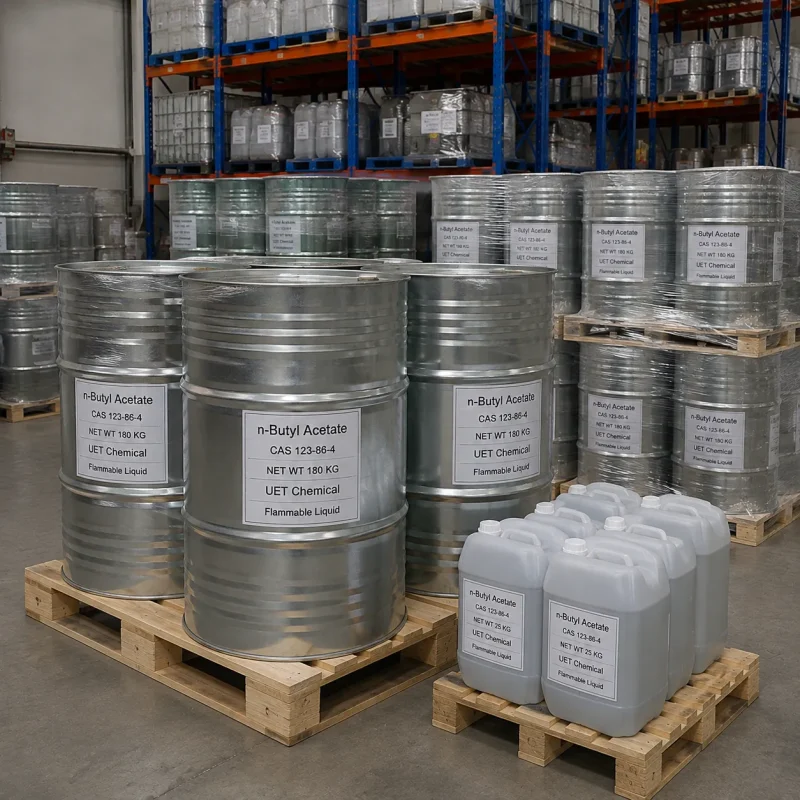
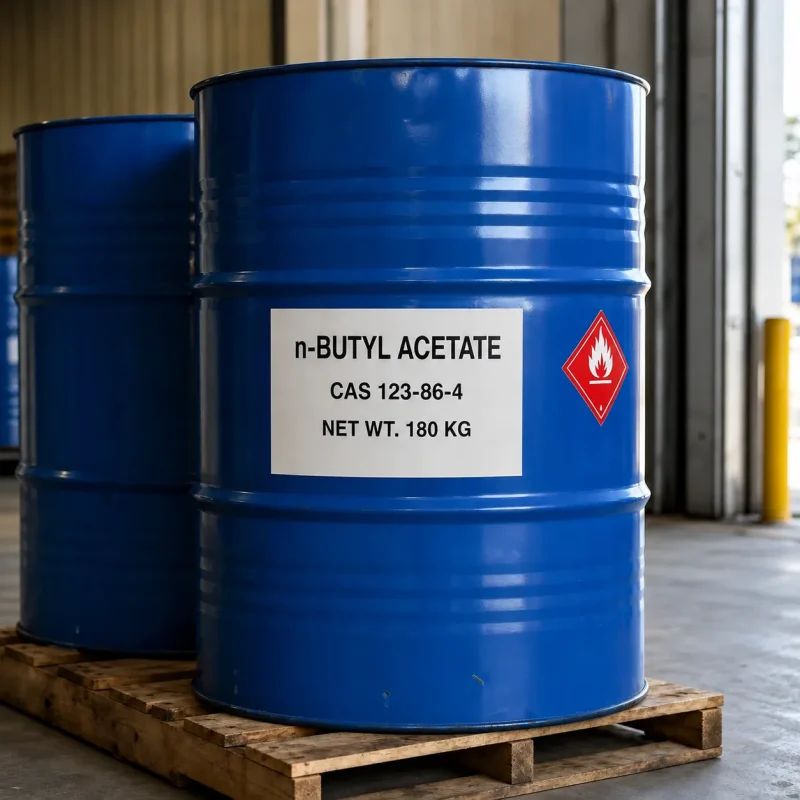
- Packaging: 200 kg (440 lb) galvanized steel drum; 1000 kg (2200 lb) IBC tote; ISO tank bulk. Custom packaging available upon request.
- Main Applications: Coatings and paints solvent, printing inks, adhesives, pharmaceutical extraction, leather finishing
Introduction to n-Butyl Acetate
n-Butyl Acetate is a medium-evaporating ester solvent produced by the acid-catalyzed esterification of n-butanol with acetic acid. It features strong solvency power for nitrocellulose, acrylic resins, alkyd resins, and polyurethane binders, while maintaining a balanced evaporation profile that prevents film defects. Coatings manufacturers, printing ink producers, and adhesive formulators consume the bulk of global output, utilizing it as the primary active solvent or a key blending component.
The primary processing advantage is its reference-standard evaporation rate (1.0), providing optimal flow-out and leveling in spray and roll coatings without blushing, cratering, or solvent pop. The critical storage risk is moisture ingress and hydrolysis. If exposed to humid air or stored with damaged seals, the ester slowly hydrolyzes back to acetic acid and butanol, increasing acid value and causing internal drum corrosion. Store drums tightly sealed in a cool, dry warehouse below 25 °C (77 °F) and inspect drum bungs for tightness upon receipt.
Key Features of n-Butyl Acetate
- Balanced evaporation rate for coatings. Evaporates at a controlled, intermediate rate (relative rate 1.0), allowing adequate open time for film leveling while preventing sagging on vertical surfaces and solvent entrapment in thick films.
- Excellent solvency for nitrocellulose and acrylics. Fully dissolves nitrocellulose lacquers, thermoplastic acrylic resins, and two-component polyurethane systems at high solids content without requiring aromatic co-solvents.
- Low toxicity profile vs aromatic solvents. Replaces xylene and toluene in reformulated coatings and inks, reducing VOC aromatic content and improving workplace safety without sacrificing drying performance.
- Consistent batch-to-batch performance. Supplied at ≥ 99.5% purity with acid value ≤ 0.01 mg KOH/g and water content ≤ 0.1%, ensuring no catalyst poisoning in moisture-cure urethane systems or acid-sensitive pigment dispersions.
n-Butyl Acetate Chemical & Physical Properties
| Property | Value |
|---|---|
| Molecular Formula | C6H12O2 |
| Molecular Weight | 116.16 g/mol |
| Boiling Point | 126 °C (259 °F) |
| Flash Point | 22 °C (72 °F) closed cup |
| Auto-Ignition Temperature | 420 °C (788 °F) |
| Density / Specific Gravity | 0.880 – 0.884 g/cm³ at 20 °C (68 °F) |
| Solubility in Water | 0.7 g / 100 mL at 20 °C (68 °F); miscible with most organic solvents. |
| Evaporation Rate | ~1.0 (n-butyl acetate = 1.0 reference) |
| Vapor Pressure | ~13.3 hPa (10 mmHg) at 25 °C (77 °F) |
| Acid Value | ≤ 0.01 mg KOH/g |
| Water Content (Karl Fischer) | ≤ 0.10% |
| Purity (GC) | ≥ 99.5% |
Applications of n-Butyl Acetate
Coatings and Paints: Serves as the primary solvent in nitrocellulose lacquers for furniture and automotive refinish, providing excellent flow-out and preventing blushing in humid conditions. Blended with fast-evaporating solvents (ethyl acetate) for spray applications and slow solvents (cellosolve acetate) for brush grades.
Printing Inks: Used as the main carrier solvent in gravure and flexographic inks for food packaging films. Its moderate evaporation rate prevents dry-back on printing cylinders while allowing rapid drying on substrate, critical for high-speed press runs above 200 m/min.
Adhesives and Sealants: Formulated into contact adhesives, pressure-sensitive adhesives, and laminating adhesives. Dissolves natural rubber, SBR, and acrylic adhesives uniformly, providing controlled tack development and clean machine application without stringing.
Pharmaceutical Extraction: Employed as an extraction solvent in antibiotic production (penicillin, erythromycin) and vitamin purification, where its selective solubility and low water miscibility enable efficient liquid-liquid separation without emulsion formation.
Storage & Safety Precautions for n-Butyl Acetate
- Storage: Keep tightly sealed in original galvanized steel drums or IBC totes in a cool, dry, well-ventilated warehouse below 25 °C (77 °F), away from ignition sources and direct sunlight. Moisture ingress causes hydrolysis, raising acid value and corroding drum interiors. Inspect bung seals upon receipt; any acetic acid odor around the closure indicates seal failure.
- Safety: Classified as GHS02 (Flame) and GHS07 (Exclamation Mark). Highly flammable liquid and vapor (Flash Point 22 °C / 72 °F). Causes drowsiness or dizziness at high vapor concentrations. Wear nitrile gloves, safety goggles, and use explosion-proof ventilation during drum decanting. Ground all drums and receiving tanks to prevent static discharge.
- Transport: Classified as Class 3 Flammable Liquid, UN 1123, Packing Group II under IATA/IMDG/ADR. Must be shipped in UN-certified packaging with proper hazard labels. Not a marine pollutant. Segregate from oxidizers, strong acids, and strong bases during transit.
- QC note: Verify GC purity (≥ 99.5%), acid value (≤ 0.01 mg KOH/g), and Karl Fischer water content (≤ 0.10%) upon receipt. If the acid value exceeds 0.05 mg KOH/g or the liquid exhibits a sharp vinegar odor, hydrolysis has occurred during transit—reject the lot immediately.
n-Butyl Acetate FAQ
Q: How does n-Butyl Acetate differ from sec-Butyl Acetate and iso-Butyl Acetate?
A: All three are isomers of butyl acetate but have different evaporation rates. n-Butyl Acetate evaporates at the reference rate (1.0), sec-Butyl Acetate is faster (~1.3), and iso-Butyl Acetate is slightly faster (~1.2). For spray coatings requiring maximum flow-out time, n-Butyl Acetate is preferred. For rapid-drying gravure inks, sec-Butyl Acetate may be substituted.
Q: The drum arrived with increased internal pressure or slight bulging. Is it safe to use?
A: Pressure buildup indicates hydrolysis has occurred—moisture ingress converted ester to acetic acid, which corroded the steel drum and generated hydrogen gas. Do not open near ignition sources. Test acid value before use; if above 0.05 mg KOH/g, reject the lot. Prevent recurrence by storing drums upright in dry conditions below 25 °C (77 °F).
Q: Can n-Butyl Acetate directly replace xylene in my coating formulation?
A: Not directly. n-Butyl Acetate is a polar ester solvent with different solubility parameters than non-polar xylene. It dissolves nitrocellulose and acrylics well but may not fully solvate alkyd resins or certain pigments that xylene carries. Reformulation with co-solvents (e.g., adding 10–20% aromatic solvent or adjusting resin solids) is required for direct substitution.
Related products
Manufacturer & Exporter Since 2006
Get Tailored Chemical Raw Material Solutions — Reply Within 1 Hour
Factory-direct pricing, stable high-purity supply and complete compliance documentation for your industrial formulations.
- 1000+Products
- 200+QC Protocols
- 7–15Days Delivery
- Factory-Direct Pricing
- COA / TDS / SDS Included
- Free Samples for Testing
- 40+ Export Countries
Request a Free Quote
Our engineers reply within 1 hour during GMT+8 business hours.
Please include in your inquiry:
- Product name or CAS number
- Required quantity
- Destination country or port
- Preferred packaging