
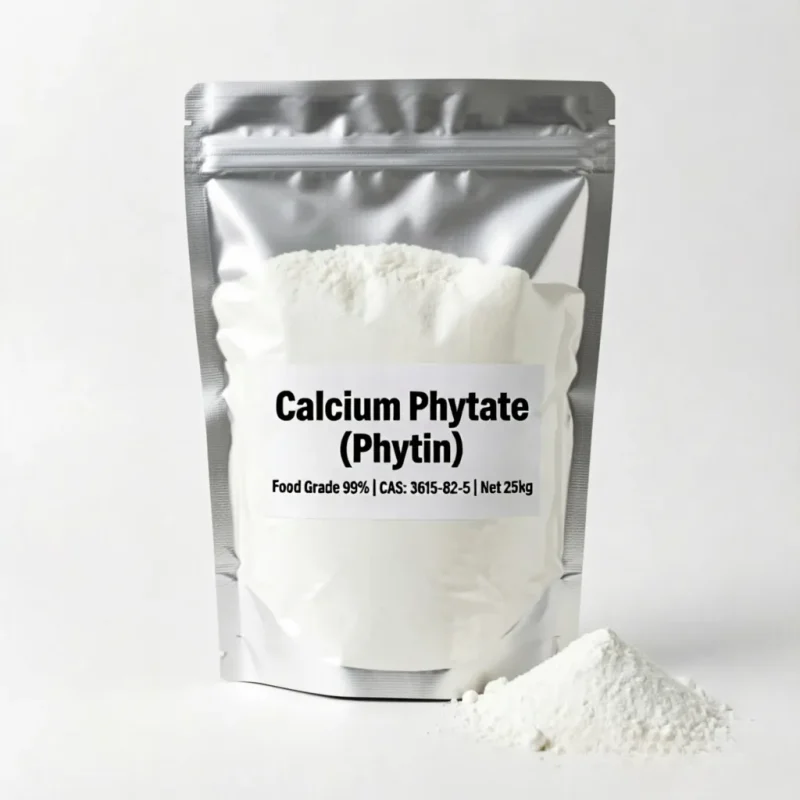
Calcium Phytate (Phytin) CAS 3615-82-5
Calcium Phytate (Phytin) is a naturally derived organic calcium and phosphorus complex supplied as white to off-white amorphous powder. Extracted primarily from rice bran or corn steep liquor, its unique inositol hexaphosphate structure provides strong metal-chelating and antioxidant properties. Core uses include nutritional supplements, cosmetic active ingredients, and the industrial synthesis of inositol. Each shipment includes COA, TDS, and SDS.
- CAS No: 3615-82-5
- Synonyms: Phytin, Calcium inositol hexaphosphate, Phytic acid calcium salt
- EC Number: 222-794-6
- Molecular Formula: C6H12Ca6O24P6
- Molecular Weight: 888.3 g/mol
- Appearance: White to off-white amorphous powder
- Assay (Organic Phosphorus): ≥ 32.0%
- Packaging: 25 kg (55 lb) fiber drum with PE liner; 25 kg (55 lb) woven PP bag with PE liner. Custom packaging available upon request.
- Main Applications: Nutritional fortification, cosmetic antioxidant, inositol synthesis precursor, food preservative
Introduction to Calcium Phytate (Phytin)
Calcium Phytate (Phytin) is the calcium salt of inositol hexaphosphoric acid, widely obtained as a byproduct of agricultural processing like rice bran oil extraction or corn wet milling. It serves as a biocompatible source of organic phosphorus and a potent natural chelator. The pharmaceutical, cosmetic, and fine chemical industries consume the bulk of global output, utilizing it to formulate bone-health supplements, anti-aging skincare, or as the foundational raw material for hydrolyzing into high-purity Myo-inositol.
The primary processing advantage is its dual functionality as a bioavailable mineral source and a heavy-metal scavenger, preventing oxidative rancidity in lipid-rich formulations. The critical storage risk is moisture absorption and acidic degradation. If exposed to high humidity, the amorphous powder will clump; if exposed to acidic environments (pH < 4), the calcium bonds break down, releasing free phytic acid and compromising its stability. Store drums in a dry, climate-controlled warehouse below 25 °C (77 °F) and reseal the PE liner immediately after use.
Key Features of Calcium Phytate
- Bioavailable organic mineral source. Delivers organically bound calcium and phosphorus, offering superior intestinal absorption and lower gastrointestinal irritation compared to inorganic calcium salts.
- Potent natural antioxidant. The hexaphosphate ring strongly chelates pro-oxidant transition metals (like Fe²⁺ and Cu²⁺), preventing lipid peroxidation in food emulsions and cosmetic creams without synthetic additives.
- Tyrosinase inhibition in cosmetics. By chelating the copper ions required for tyrosinase activity, it effectively suppresses melanin synthesis, serving as a gentle, plant-derived skin-brightening agent.
- Essential inositol precursor. Acts as the primary industrial starting material for the acid-hydrolysis production of Myo-inositol, a critical intermediate for pharmaceuticals and advanced battery electrolytes.
Calcium Phytate Chemical & Physical Properties
| Property | Value |
|---|---|
| Molecular Formula | C6H12Ca6O24P6 |
| Molecular Weight | 888.3 g/mol |
| Thermal Behaviour | Decomposes above 200 °C (392 °F) without melting; releases water and phosphorus oxides. |
| Density | Bulk density approx. 0.50–0.70 g/cm³ (31–43 lb/ft³). |
| Solubility | Insoluble in water and organic solvents; soluble in dilute mineral acids (HCl, HNO3). |
| pH (5% aqueous suspension) | 6.0 – 7.5 |
| Organic Phosphorus (as P) | ≥ 32.0% |
| Heavy Metals (as Pb) | ≤ 10 ppm |
| Arsenic (as As) | ≤ 3 ppm |
Applications of Calcium Phytate
Nutraceuticals and Pharmaceuticals: Formulated into tablets and capsules as a central nervous system tonic and bone-strengthening supplement. It provides a balanced, non-irritating source of organic phosphorus for treating neurasthenia and supporting skeletal health.
Cosmetics and Personal Care: Dosed at 0.5–2.0% in serums and emulsions. It acts as a natural preservative booster by chelating trace metals that degrade active ingredients, and as a skin-brightener by inhibiting copper-dependent tyrosinase.
Food Preservation and Stabilization: Added to edible oils, meat products, and wine to prevent oxidative rancidity and color fading. It sequesters iron and copper ions that catalyze lipid degradation, extending shelf life cleanly.
Industrial Inositol Synthesis: Subjected to high-temperature acid hydrolysis and neutralization to yield Myo-inositol, which is further purified for use in pharmaceuticals (e.g., PCOS treatments) and lithium-ion battery research.
Storage & Safety Precautions for Calcium Phytate
- Storage: Keep tightly sealed in a cool, dry warehouse below 25 °C (77 °F). The powder is hygroscopic and will form hard lumps if exposed to humid air. Keep away from strong acids, which will decompose the salt into free phytic acid. Stack pallets away from exterior walls.
- Safety: Classified as non-hazardous (Food/Pharma Grade). Wear standard dust masks and safety goggles when handling dry powder to avoid respiratory and eye irritation. Wash skin with water after contact.
- Transport: Calcium Phytate is Non-DG under IATA/IMDG/ADR. Not a marine pollutant. Standard 25 kg (55 lb) drums or bags ship in standard dry containers. Ensure container doors are sealed to prevent ocean moisture ingress.
- QC note: Verify Organic Phosphorus content via spectrophotometric or titrimetric analysis upon receipt. If the powder exhibits severe caking or an acidic odor, it has suffered moisture ingress or contamination—reject the lot.
Calcium Phytate FAQ
Q: How does Calcium Phytate differ from Phytic Acid?
A: Phytic acid is the highly acidic, free protonated form that strongly chelates minerals and can inhibit nutrient absorption. Calcium Phytate is the neutralized, insoluble calcium salt, making it stable, non-irritating, and suitable as a direct dietary calcium/phosphorus supplement.
Q: Can it be used as a direct preservative in water-based cosmetics?
A: Yes, but with caution. Because it is practically insoluble in neutral water, it must be pre-dissolved in a small amount of dilute acid or formulated into emulsions where it can act as a metal chelator to protect sensitive active ingredients from oxidative degradation.
Q: Why is it the preferred raw material for manufacturing Myo-inositol?
A: It is a concentrated, naturally occurring byproduct of the agricultural industry (rice bran/corn). Hydrolyzing the hexaphosphate ester bonds of Calcium Phytate yields high-purity Myo-inositol and calcium phosphate, making it the most economically viable and sustainable industrial route.
Related products
Manufacturer & Exporter Since 2006
Get Tailored Chemical Raw Material Solutions — Reply Within 1 Hour
Factory-direct pricing, stable high-purity supply and complete compliance documentation for your industrial formulations.
- 1000+Products
- 200+QC Protocols
- 7–15Days Delivery
- Factory-Direct Pricing
- COA / TDS / SDS Included
- Free Samples for Testing
- 40+ Export Countries
Request a Free Quote
Our engineers reply within 1 hour during GMT+8 business hours.
Please include in your inquiry:
- Product name or CAS number
- Required quantity
- Destination country or port
- Preferred packaging