
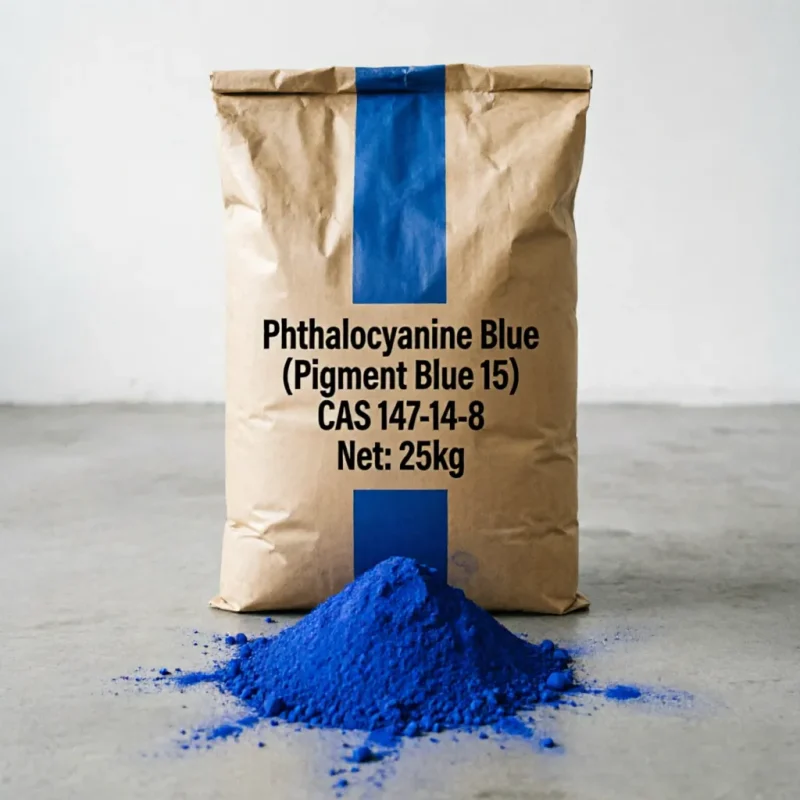
Phthalocyanine Blue (Pigment Blue 15) CAS 147-14-8
Phthalocyanine Blue (Pigment Blue 15) is a high-performance copper complex organic pigment supplied as a fine, bright blue powder. Renowned for its exceptional lightfastness, thermal stability, and chemical inertness, it is the industry benchmark for industrial coatings, plastic masterbatches, and printing inks. Each shipment includes COA, TDS, and SDS.
- CAS No: 147-14-8
- Synonyms: Pigment Blue 15, PB15, Copper Phthalocyanine, CuPc, Phthalocyanine Blue BN
- EC Number: 205-685-1
- Molecular Formula: C32H16CuN8
- Molecular Weight: 576.08 g/mol
- Appearance: Bright blue powder (Reddish or Greenish shade depending on crystal form)
- Purity / Tinting Strength: ≥ 98.0% / 100 ± 5% vs. Standard
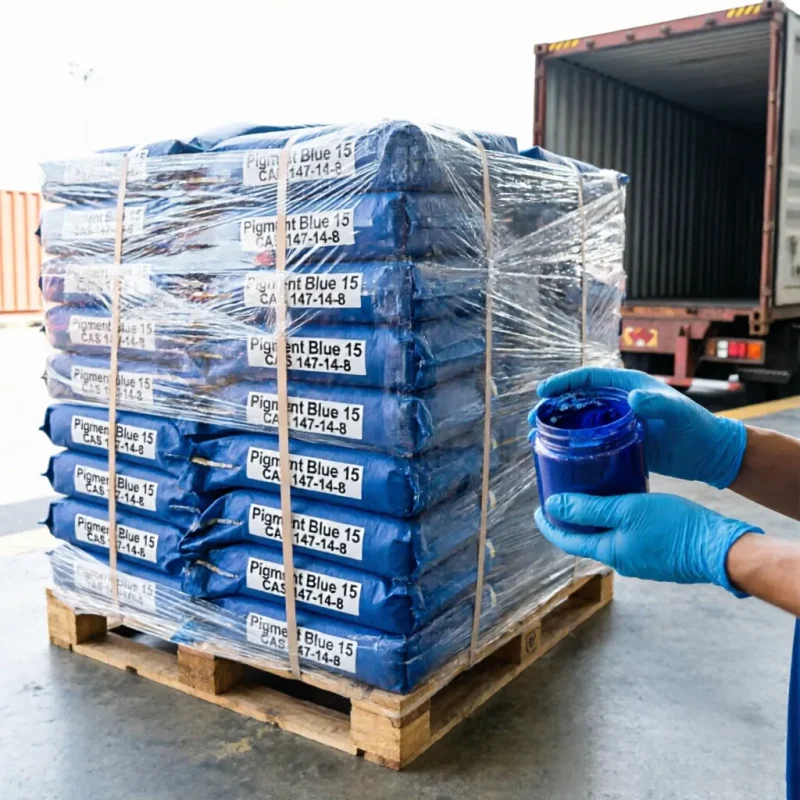
- Packaging: 25 kg (55 lb) fiber drum with PE liner; 25 kg (55 lb) woven PP bag with PE liner; 500 kg (1100 lb) pallet box. Custom packaging available upon request.
- Main Applications: Automotive & industrial coatings, plastic masterbatches, offset & gravure inks, rubber compounding
Introduction to Phthalocyanine Blue
Phthalocyanine Blue (Pigment Blue 15) is a synthetic copper complex organic pigment characterized by a highly stable macrocyclic ring structure. Formulators in the coatings and plastics industries rely on it as the ultimate blue colorant due to its unmatched lightfastness, weatherability, and heat resistance. It is commercially available in different crystalline modifications, primarily the alpha form (reddish-blue, high tinting strength) and the beta form (greenish-blue, superior solvent and crystallization stability).
The primary processing advantage is its extreme chemical inertness; it is virtually insoluble in most organic solvents and resistant to strong acids and alkalis, preventing bleeding or migration in complex polymer matrices. The critical handling risk is dust generation and potential flocculation in specific coating systems. Ensure high-shear dispersion equipment is used to achieve optimal Hegman fineness, and select the surface-treated or beta-crystal grade when formulating with aromatic solvents to prevent crystal transformation and color shifting (floating).
Key Features of Phthalocyanine Blue
- Supreme lightfastness and weatherability. Rated 8 (out of 8) on the Blue Wool Scale, ensuring zero fading or chalking in exterior architectural, automotive, and industrial coil coatings even after years of UV exposure.
- Outstanding thermal stability. Withstands processing temperatures up to 300 °C (572 °F) without sublimation or degradation, making it ideal for engineering plastics like PA, PC, and high-temperature PVC extrusion.
- Exceptional tinting strength. Provides deep, rich blue shades at very low loading ratios (often < 1%), offering high cost-in-use efficiency compared to inorganic ultramarine or cobalt blue alternatives.
- Solvent and chemical bleed resistance. The beta-crystalline form is completely immune to aromatic solvent-induced crystal transformation, eliminating the risk of flocculation, loss of gloss, and color floating in alkyd and epoxy systems.
Phthalocyanine Blue Chemical & Physical Properties
| Property | Value |
|---|---|
| Molecular Formula | C32H16CuN8 |
| Molecular Weight | 576.08 g/mol |
| Thermal Behaviour | Highly stable up to 300 °C (572 °F); sublimation occurs only above 500 °C (932 °F). |
| Density | 1.50 – 1.65 g/cm³ (93 – 103 lb/ft³) |
| Oil Absorption | 35 – 45 g / 100g |
| pH (aqueous extract) | 6.0 – 8.0 (Neutral) |
| Lightfastness (Full Shade) | 8 (Blue Wool Scale) |
| Lightfastness (Tint) | 7 – 8 (Blue Wool Scale) |
| Solubility | Insoluble in water, alcohols, and most organic solvents; slightly soluble in strong concentrated sulfuric acid. |
Applications of Phthalocyanine Blue
Automotive and industrial coatings: The beta-form (PB 15:3 or 15:4) is the standard for OEM and refinish automotive paints, coil coatings, and powder coatings. Its resistance to flocculation ensures uniform color distribution and high gloss retention in metallic and solid blue topcoats.
Plastics and masterbatches: Dosed at 0.1–2.0% in PE, PP, PVC, and engineering resins. It survives high-shear extrusion and injection molding temperatures without bleeding, warping, or losing chroma, providing brilliant blue shades for packaging, toys, and automotive interior parts.
Printing inks: Widely used in offset, gravure, and flexographic inks for packaging and publications. Its transparency and high tinting strength allow for precise color matching in process printing (Cyan) and specialty metallic inks.
Rubber and synthetic leather: Provides durable, migration-free coloring for rubber soles, seals, and PU/PVC synthetic leather, maintaining color stability during vulcanization and curing processes.
Storage & Safety Precautions for Phthalocyanine Blue
- Storage: Store in a dry, well-ventilated warehouse. Although chemically inert and non-hygroscopic, keep fiber drums and PP bags tightly sealed to prevent moisture ingress and dust contamination. Shelf life is virtually indefinite under standard dry conditions.
- Safety: Classified as a nuisance dust. Not hazardous under GHS. Avoid inhalation of airborne pigment dust during bag dumping or high-speed dispersion. Mandate the use of N95/P2 dust masks, safety goggles, and protective gloves to prevent skin and eye irritation.
- Transport: Phthalocyanine Blue is Non-DG under IATA/IMDG/ADR. Not a marine pollutant. Ships efficiently in 20ft standard dry containers.
- QC note: Verify tinting strength, shade (Delta E), and dispersion fineness (Hegman gauge) upon receipt. For liquid coatings, perform a rub-out test to check for color floating or flocculation. If using the alpha form in aromatic solvent systems, verify that it has been properly surface-treated or stabilized to prevent crystallization-induced greening.
Phthalocyanine Blue FAQ
Q: What is the difference between Pigment Blue 15:1 (Alpha) and 15:3 (Beta)?
A: Alpha (PB 15:1) offers a reddish-blue shade and slightly higher tinting strength but is prone to crystal transformation (shifting to green and losing gloss) when exposed to aromatic solvents like xylene. Beta (PB 15:3) is a greenish-blue, highly stable crystal form that will not flocculate or shift color in any solvent system, making it mandatory for industrial and automotive coatings.
Q: Why is my blue coating losing gloss and shifting color after application?
A: This is classic flocculation caused by using an unstable alpha-crystal grade in an aromatic solvent-based resin. The solvent induces crystallization, causing the pigment particles to agglomerate. Switch to a surface-treated alpha grade or a stable beta grade (PB 15:3) to resolve the issue.
Q: Can it be used in high-temperature engineering plastics like Nylon (PA)?
A: Yes. Phthalocyanine Blue is thermally stable up to 300 °C (572 °F), making it one of the few organic pigments capable of surviving the 280–300 °C processing temperatures required for PA, PC, and PBT extrusion without sublimation or color fading.
Related products
Manufacturer & Exporter Since 2006
Get Tailored Chemical Raw Material Solutions — Reply Within 1 Hour
Factory-direct pricing, stable high-purity supply and complete compliance documentation for your industrial formulations.
- 1000+Products
- 200+QC Protocols
- 7–15Days Delivery
- Factory-Direct Pricing
- COA / TDS / SDS Included
- Free Samples for Testing
- 40+ Export Countries
Request a Free Quote
Our engineers reply within 1 hour during GMT+8 business hours.
Please include in your inquiry:
- Product name or CAS number
- Required quantity
- Destination country or port
- Preferred packaging