
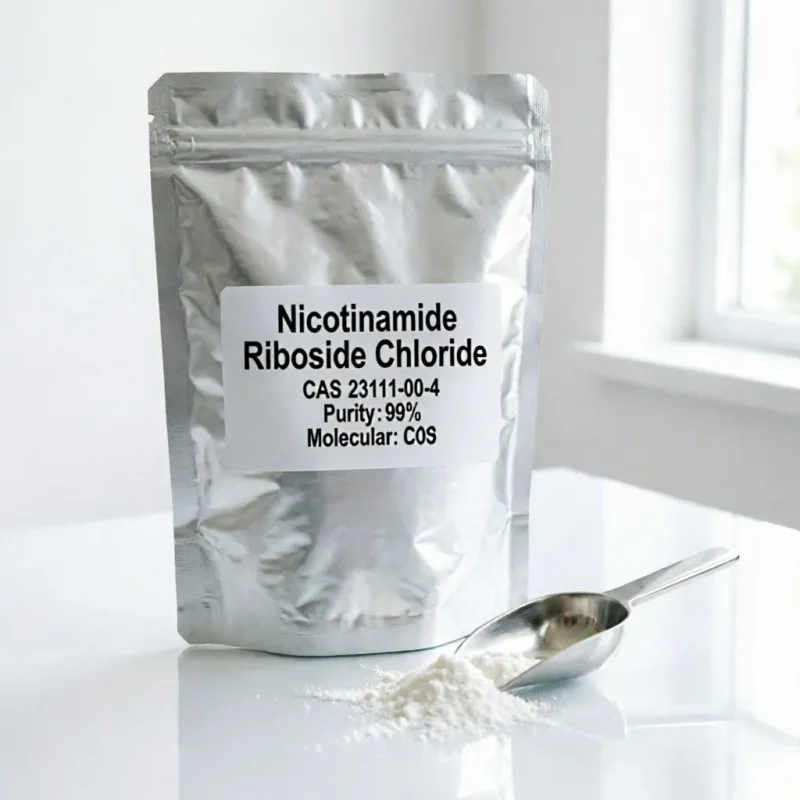
Nicotinamide Riboside Chloride CAS 23111-00-4
Nicotinamide Riboside Chloride is a bioavailable NAD⁺ precursor supplied as white to off-white crystalline powder. As the chloride salt of nicotinamide riboside, it enters the salvage pathway via NRK kinases to elevate intracellular NAD⁺ levels without requiring niacin or niacinamide conversion. Core uses include nutritional supplement formulation, anti-aging research, and cellular energy metabolism studies. Each shipment includes COA, TDS, and SDS.
- CAS No: 23111-00-4
- Synonyms: NR Chloride, β-Nicotinamide Riboside Chloride, NRCl, Nicotinamide Riboside HCl salt, 3-(Aminocarbonyl)-1-(β-D-ribofuranosyl)pyridinium chloride
- EC Number: 245-431-9
- Molecular Formula: C₁₁H₁₅ClN₂O₅
- Molecular Weight: 290.70 g/mol
- Appearance: White to off-white crystalline powder
- Purity (HPLC): ≥ 98.0%
- Packaging: 1 kg (2.2 lb) aluminum foil bag; 5 kg (11 lb) aluminum foil bag; 25 kg (55 lb) fiber drum with PE liner. Custom packaging available upon request.
- Main Applications: Dietary supplement raw material, NAD⁺ boosting formulation, anti-aging and longevity research, cellular metabolism studies, functional food ingredient
Introduction to Nicotinamide Riboside Chloride
Nicotinamide Riboside Chloride (NRCl) is the chloride salt form of nicotinamide riboside, a pyridine nucleoside composed of a nicotinamide moiety linked to a ribose sugar via a β-glycosidic bond. Once ingested or added to cell culture, NRCl is phosphorylated by nicotinamide riboside kinases (NRK1/NRK2) to nicotinamide mononucleotide (NMN), then converted to NAD⁺ by NMN adenylyltransferases. This two-step salvage pathway bypasses the rate-limiting step of the Preiss-Handler and de novo pathways, making NRCl one of the most efficient NAD⁺ precursors available for supplement and research use.
The chloride salt form improves crystallinity and flowability during capsule or tablet manufacturing compared to the free base. NRCl is highly hygroscopic; exposure to ambient humidity above 60% RH causes surface caking within hours. Store in sealed aluminum foil bags at 2–8 °C (36–46 °F) for long-term stability, or below 25 °C (77 °F) for short-term handling. Avoid repeated freeze-thaw cycles in solution; once dissolved, use within 24 hours or store at –20 °C (–4 °F) for up to 30 days.
Key Features of Nicotinamide Riboside Chloride
- Direct NAD⁺ salvage pathway entry. NRCl is phosphorylated by NRK1/NRK2 to NMN in one enzymatic step, then adenylated to NAD⁺. No niacin flush, no amide hydrolysis required—faster intracellular NAD⁺ elevation than niacin or nicotinamide.
- High water solubility for formulation flexibility. Solubility exceeds 50 g/L at 25 °C (77 °F), enabling clear liquid capsules, effervescent tablets, and aqueous supplement shots without solubilizers or emulsifiers.
- Chloride salt form for manufacturing stability. The salt form provides defined crystal habit, consistent bulk density (0.45–0.60 g/cm³), and free-flowing behavior in capsule-filling and tabletting equipment.
- ≥ 98.0% HPLC purity with low impurity profile. Nicotinamide content below 0.5%, residual solvents per ICH Q3C limits. Suitable for GRAS-level supplement manufacturing and pharmaceutical-grade research.
- Established safety profile in human trials. Multiple clinical studies at doses up to 2,000 mg/day show no serious adverse effects. GRAS Notice (FDA GRN 000793) supports use in dietary supplements and functional foods.
Nicotinamide Riboside Chloride Chemical & Physical Properties
| Property | Value |
|---|---|
| Molecular Formula | C₁₁H₁₅ClN₂O₅ |
| Molecular Weight | 290.70 g/mol |
| Melting Point | 160–165 °C (320–329 °F) with decomposition |
| Density | Crystal density approx. 1.60 g/cm³ (99.9 lb/ft³); bulk powder density 0.45–0.60 g/cm³ (28.1–37.5 lb/ft³) |
| Solubility in Water | ≥ 50 g/L at 25 °C (77 °F); soluble in methanol; practically insoluble in dichloromethane and ethyl acetate |
| pH (1% aqueous solution) | 4.0 – 6.0 |
| Specific Rotation | [α]²⁰_D = +38.0° to +42.0° (c = 1.0, H₂O) |
| UV Absorption | λmax = 265 nm (ε ≈ 4,500 L·mol⁻¹·cm⁻¹) in water |
| Loss on Drying | ≤ 2.0% (Karl Fischer or 105 °C / 3 h) |
| Residual Solvents | Per ICH Q3C: methanol ≤ 3,000 ppm; ethanol ≤ 5,000 ppm |
Applications of Nicotinamide Riboside Chloride
Dietary supplement and functional food formulation: NRCl is encapsulated at 250–500 mg per serving for NAD⁺ support products. Blend with microcrystalline cellulose or silicon dioxide to counteract hygroscopicity during capsule filling. For effervescent or liquid formats, dissolve directly in purified water at 10–30 mg/mL; adjust pH to 5.0–6.5 with sodium citrate for taste and stability. Shelf-life testing per ICH Q1A at 25 °C (77 °F) / 60% RH shows less than 5% degradation over 24 months in sealed foil pouches.
Cell culture and in-vitro NAD⁺ research: Dissolve NRCl in sterile PBS or culture medium to 10–50 µM working concentration. Add to hepatocytes, skeletal muscle cells, or neuronal cultures to study NAD⁺-dependent sirtuin activation, mitochondrial biogenesis, or PARP-mediated DNA repair. Prepare fresh stock solutions weekly; store concentrated stocks (10 mM in water) at –20 °C (–4 °F) in single-use aliquots.
Preclinical animal studies: Administer NRCl in drinking water at 100–300 mg/kg body weight for metabolic, neurological, or aging models. Dissolve in tap water at 1–3 mg/mL; replace solution every 2 days to prevent microbial growth. Stable at 4 °C (39 °F) for 48 hours in amber bottles.
Cosmetic and topical NAD⁺ applications: Incorporated into serum and cream formulations at 0.1–2% w/w for skin barrier support and anti-aging claims. Compatible with hyaluronic acid, niacinamide, and peptide actives at pH 4.5–6.5. Avoid combining with strong acids (pH < 3) which hydrolyze the glycosidic bond.
Storage & Safety Precautions for Nicotinamide Riboside Chloride
- Storage: Keep sealed in original aluminum foil bags at 2–8 °C (36–46 °F) for shelf life exceeding 24 months. Short-term storage (under 30 days) acceptable at 15–25 °C (59–77 °F) if bags remain sealed and humidity stays below 50% RH. NRCl is highly hygroscopic; opened bags must be re-sealed with desiccant packs and used within 7 days. Avoid storage above 30 °C (86 °F) to prevent glycosidic bond hydrolysis.
- Safety: Not classified as hazardous under GHS. Non-irritant to skin and eyes at commercial concentrations. Avoid inhalation of fine powder during large-scale weighing; use local exhaust ventilation or N95 dust mask. In case of eye contact, rinse with water for 10 minutes. Ingestion of bulk powder at supplement-level doses (≤ 2 g) is non-toxic.
- Transport: Nicotinamide Riboside Chloride is Non-DG under IATA/IMDG/ADR. No UN number, no packing group. Ship in insulated cartons with desiccant if transit exceeds 7 days or ambient temperature may exceed 30 °C (86 °F). Cold-chain shipping (2–8 °C / 36–46 °F) recommended for orders above 25 kg (55 lb) to preserve long-term potency.
- QC note: On receipt, verify identity by HPLC retention time match and UV spectrum (λmax 265 nm). Confirm purity ≥ 98.0% by area normalization. Check water content by Karl Fischer (≤ 2.0%). A yellowish tint or water content above 3.0% indicates moisture uptake during transit—request replacement if outside specification.
Nicotinamide Riboside Chloride FAQ
Q: How does Nicotinamide Riboside Chloride (CAS 23111-00-4) differ from NMN as an NAD⁺ precursor?
A: NRCl enters cells via equilibrative nucleoside transporters (ENT1/2) and is phosphorylated intracellularly by NRK1/NRK2. NMN requires specific Slc12a8 transport or extracellular conversion to NR before uptake. NRCl has a longer regulatory history in supplements (FDA GRAS since 2016) and higher water solubility for formulation. Both elevate NAD⁺, but NRCl offers simpler manufacturing and broader regulatory acceptance.
Q: My NRCl powder has turned slightly yellow. Is it still usable?
A: Mild yellowing indicates partial hydrolysis of the glycosidic bond or Maillard-type degradation from moisture exposure. Run HPLC purity check; if nicotinamide content exceeds 1.0% or total purity drops below 95.0%, reject the lot. Prevent recurrence by storing at 2–8 °C (36–46 °F) with desiccant in sealed foil bags.
Q: Can NRCl be autoclaved for sterile solution preparation?
A: No. Autoclaving at 121 °C (250 °F) for 15–20 min will hydrolyze the riboside bond, generating free nicotinamide and ribose. Use 0.22 µm membrane filtration for sterilization. Prepare solutions in a laminar flow hood and store at 2–8 °C (36–46 °F) for up to 7 days.
Related products
Manufacturer & Exporter Since 2006
Get Tailored Chemical Raw Material Solutions — Reply Within 1 Hour
Factory-direct pricing, stable high-purity supply and complete compliance documentation for your industrial formulations.
- 1000+Products
- 200+QC Protocols
- 7–15Days Delivery
- Factory-Direct Pricing
- COA / TDS / SDS Included
- Free Samples for Testing
- 40+ Export Countries
Request a Free Quote
Our engineers reply within 1 hour during GMT+8 business hours.
Please include in your inquiry:
- Product name or CAS number
- Required quantity
- Destination country or port
- Preferred packaging