
Sulfated Castor Oil (CAS 8002-33-3) | Turkey Red Oil
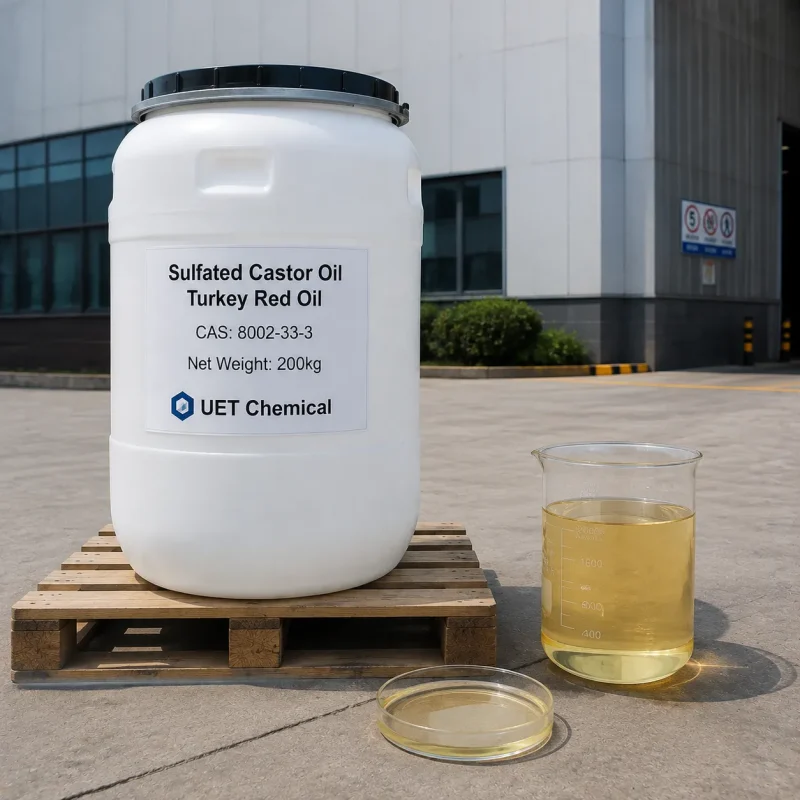
Sulfated Castor Oil (Turkey Red Oil) is an anionic sulfate ester surfactant derived from castor oil, supplied as a yellow to amber viscous liquid. It delivers reliable wetting, emulsifying and lubricating performance for textile dyeing, leather fatliquoring and specialty emulsion formulations. UETChem supplies consistent-grade Turkey Red Oil with controlled active content and pH stability for predictable processing results. Each shipment includes COA, TDS, SDS.
- CAS No: 8002-33-3
- Synonyms: Turkey Red Oil; Sulphated Castor Oil; Castor Oil Sulfate
- EINECS: 232-296-4
- Chemical Type: Mixed sulfated glycerides
- Avg. Molecular Weight: 950–1,200 g/mol
- Appearance: Yellow to amber viscous liquid
- Active Oil Content: 70–75% typical
- pH (10% Aqueous Dispersion): 6.0–8.0
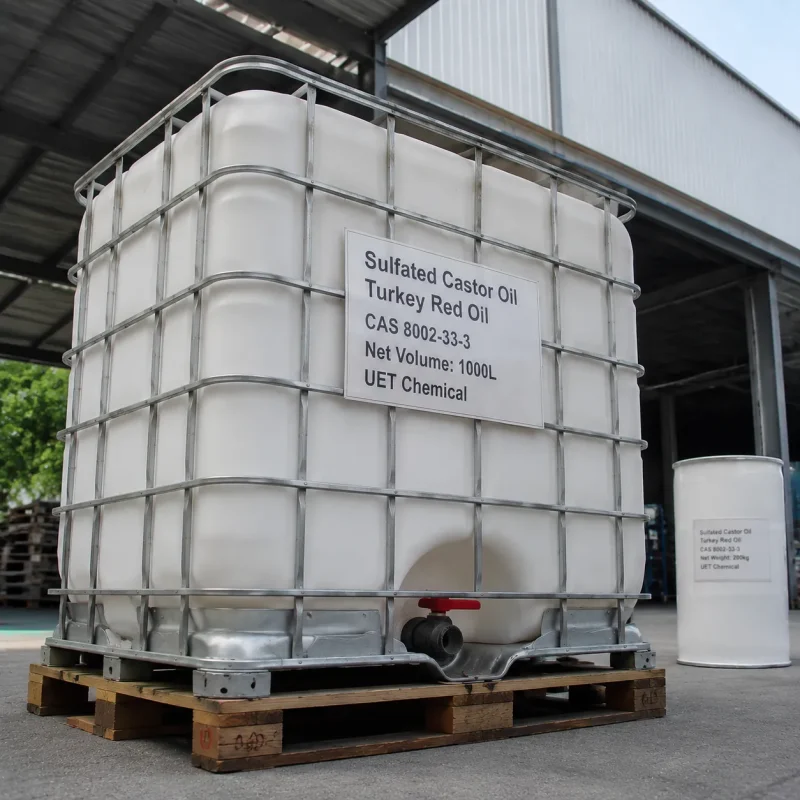
- Packaging: 50 kg, 200 kg, 1000 kg drums. Custom packaging available upon request.
- Main Applications: Textile dye auxiliaries, leather fatliquors, oil emulsifiers, bath & cleansing solubilizers
Introduction to Sulfated Castor Oil
Sulfated Castor Oil, commonly known as Turkey Red Oil, is an anionic surfactant produced by sulfating natural castor oil. Its glyceride backbone retains ricinoleate fatty chains, while introduced sulfate ester groups turn the naturally water-insoluble oil into a water-dispersible liquid. It is widely used in textile and leather processing to wet fiber surfaces, stabilize oil droplets and emulsify dye systems.
Unlike unmodified castor oil, it forms stable milky dispersions in water at common use concentrations. The material is sensitive to acid hydrolysis: exposure to pH below 4 at elevated temperatures breaks sulfate ester bonds, reduces water dispersibility and can cause batch separation. It should be stored sealed and neutralized carefully during use. Stir thoroughly before sampling, as natural oil-based lots may stratify or darken with age.
Sulfated Castor Oil Chemical & Physical Properties
| Property | Value |
|---|---|
| Chemical Nature | Complex sulfated triglyceride mixture |
| Appearance | Yellow to amber viscous liquid |
| Active Oil Content | 70–75% typical |
| pH (10% Aqueous Dispersion) | 6.0–8.0 |
| Density (20 °C) | 1.02–1.08 g/cm³ |
| Solubility | Dispersible in water; partially soluble in lower alcohols |
| Flash Point | > 200 °C (typical for active oil) |
Applications of Sulfated Castor Oil
Textile dyeing & printing
Lowers bath surface tension and disperses dye aggregates for more uniform fiber penetration. The ricinoleate chains lubricate yarn surfaces to reduce friction and breakage during processing.
Leather fatliquoring
Stabilizes oil droplets in tanning baths, allowing glyceride oils to penetrate collagen fiber networks. This reduces fiber friction and imparts a soft, supple feel to finished leather.
Oil-in-water emulsification
Functions as a primary emulsifier to form stable milky O/W emulsions. Sulfate head groups anchor in the aqueous phase while fatty glyceride tails dissolve in the oil phase, supporting stable emulsion systems.
Bath & cleansing formulations
Solubilizes vegetable oils and fragrance oils into aqueous bath products, and leaves a mild emollient film on skin after rinsing.
Storage & Safety Precautions for Sulfated Castor Oil
- Store in sealed HDPE or lined drums at 5–35 °C, away from direct sunlight, strong acids, oxidizers and cationic materials. Acid contact hydrolyzes sulfate esters and causes separation; cationic materials trigger precipitation.
- Stir drums thoroughly before sampling. Natural sulfated oil may stratify during storage, leading to variations in color and viscosity between layers.
- Wear chemical splash goggles, nitrile gloves and long-sleeve clothing during handling. Absorb spills with inert material then rinse with water, as spilled liquid creates slippery surfaces.
- Classified as Non-DG for standard transport. Refer to the current SDS for full hazard details before booking cargo.
Sulfated Castor Oil FAQ
Q: What does “sulfated” mean for Turkey Red Oil?
A: It means sulfate ester groups bond to hydroxyl sites on the castor oil structure, making the oil water-dispersible while retaining lubricating properties. Acid conditions can break these bonds and reduce performance.
Q: Why does Turkey Red Oil separate in acidic dye baths?
A: Low pH, heat or high electrolyte levels destabilize the sulfate emulsion. Below pH 4, sulfate esters hydrolyze and calcium/magnesium ions can cause flocculation. Keep pH between 5–8 and test dispersions before full batch use.
Q: Can Turkey Red Oil replace synthetic anionic surfactants in emulsions?
A: It can partially replace them in formulations where lubrication is also needed. It works best in neutral to mildly alkaline systems, and requires compatibility testing with preservatives and high-electrolyte ingredients.
Related products
Manufacturer & Exporter Since 2006
Get Tailored Chemical Raw Material Solutions — Reply Within 1 Hour
Factory-direct pricing, stable high-purity supply and complete compliance documentation for your industrial formulations.
- 1000+Products
- 200+QC Protocols
- 7–15Days Delivery
- Factory-Direct Pricing
- COA / TDS / SDS Included
- Free Samples for Testing
- 40+ Export Countries
Request a Free Quote
Our engineers reply within 1 hour during GMT+8 business hours.
Please include in your inquiry:
- Product name or CAS number
- Required quantity
- Destination country or port
- Preferred packaging