
N-Butyl Acrylate (BA) CAS 141-32-2
N-Butyl Acrylate (BA) is a monofunctional acrylic ester monomer—one vinyl group on a butyl ester backbone. Colorless transparent liquid, ≥99.0% GC purity, stabilized with 15–20 ppm MEHQ. A homopolymer Tg of −54 °C makes BA the standard soft monomer for acrylic emulsion paints, pressure-sensitive adhesives, and flexible coatings. Fast free-radical copolymerization with MMA, styrene, and VAc. Each shipment includes COA, TDS, and SDS.
- CAS No.: 141-32-2
- Synonyms: Butyl acrylate; BA; Acrylic acid n-butyl ester; Butyl 2-propenoate
- EINECS: 205-480-7
- Molecular Formula: C₇H₁₂O₂
- Molecular Weight: 128.17 g/mol
- Appearance: Colorless transparent liquid
- Purity (GC): ≥99.0%
- Inhibitor (MEHQ): 15–20 ppm
- Boiling Point: 145 °C
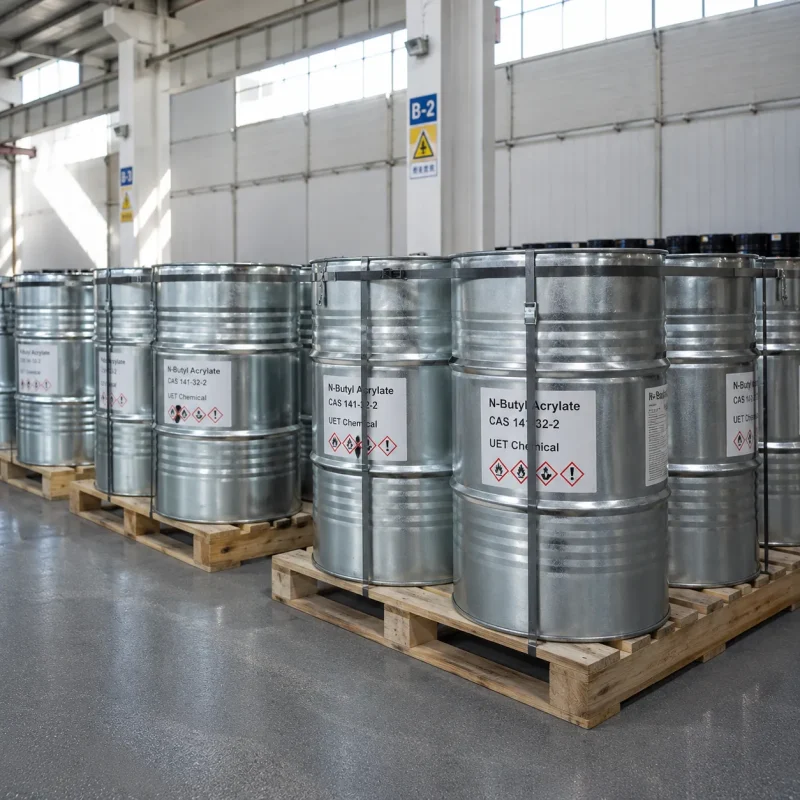
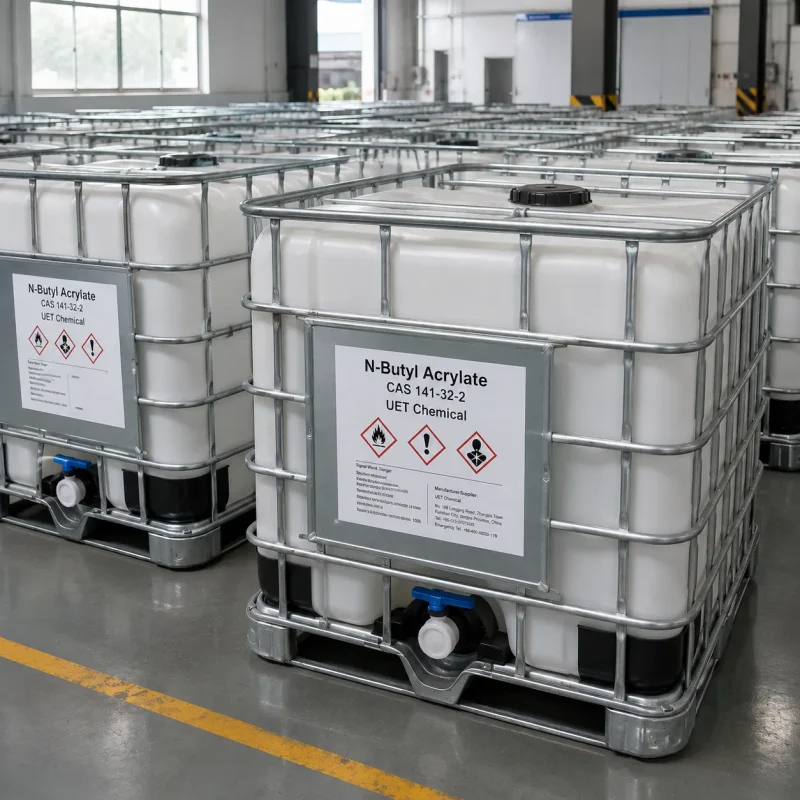
- Packaging: 200 kg steel drum / 1000 kg IBC tote / ISO tank. Custom packaging available upon request.
- Main Applications: Acrylic emulsions; pressure-sensitive adhesives; flexible coatings; textile & paper binders
Introduction to N-Butyl Acrylate
N-Butyl Acrylate is a colorless transparent liquid, a monofunctional acrylic ester carrying one polymerizable vinyl group per molecule. The butyl ester side chain pulls the homopolymer glass transition down to −54 °C, which is why BA serves as the workhorse soft monomer in architectural latex paints, pressure-sensitive adhesives, and flexible coating binders. It copolymerizes readily with methyl methacrylate, styrene, vinyl acetate, and acrylonitrile under standard free-radical initiation.
The butyl ester delivers low minimum film-formation temperature, strong pigment wetting, and adhesion to plastics without external plasticizers. One practical caution: the 15–20 ppm MEHQ inhibitor scavenges radicals only while dissolved oxygen is present—never nitrogen-blanket a BA drum, and keep storage below 30 °C. Inhibited monomer held above 35 °C for weeks loses inhibitor and can start slow dimerization, raising viscosity and acid value.
Key Features of N-Butyl Acrylate
- −54 °C homopolymer Tg. The flexible butyl ester side chain gives poly(BA) a Tg of −54 °C; 40–70% BA in a copolymer drops emulsion MFFT below 0 °C without film-forming solvents.
- Fast radical copolymerization. High propagation rates with MMA, styrene, and VAc allow near-azeotropic semi-continuous feeds and >98% conversion in emulsion processes at 60–80 °C.
- Built-in MEHQ stabilization. 15–20 ppm MEHQ plus dissolved oxygen suppress self-polymerization during ocean freight; inhibitor level is verifiable by UV at 295 nm or HPLC on arrival.
- Low water solubility, full solvent miscibility. ~1.4 g/L in water at 20 °C yet miscible with alcohols, esters, and aromatics—suitable for both emulsion and solution polymerization.
- Soft, water-white, tacky films. Homopolymer films stay clear and tacky, providing wet tack and 180° peel adhesion in label PSAs without tackifier resins.
N-Butyl Acrylate Chemical & Physical Properties
| Property | Value |
|---|---|
| Molecular Formula | C₇H₁₂O₂ |
| Molecular Weight | 128.17 g/mol |
| Boiling Point | 145 °C (101.3 kPa) |
| Melting Point | −75 °C |
| Density (20 °C) | 0.894 g/cm³ |
| Flash Point | 37 °C (closed cup) |
| Viscosity (25 °C) | 0.9 mPa·s |
| Refractive Index (20 °C) | 1.4180–1.4210 |
| Solubility in Water | 1.4 g/L (20 °C); miscible with most organic solvents |
| Water Content | ≤0.10% (Karl Fischer) |
| Acidity (as acrylic acid) | ≤0.02% |
Applications of N-Butyl Acrylate
Architectural and industrial acrylic emulsions: Charged at 30–60% of the monomer feed. The soft BA segments lower MFFT and impart crack-free film formation; BA:MMA ratios of 55:45 to 65:35 give exterior paint binders with Tg 5–15 °C and good UV/hydrolysis resistance.
Pressure-sensitive adhesives (labels and tapes): Used at 60–90% of monomers with 3–8% acrylic acid. BA supplies the tack and peel window; solution or emulsion polymerization runs at 60–80 °C with peroxide or persulfate initiation.
Flexible coatings, sealants, and roof membranes: 40–70% of the binder composition. Butyl side chains provide elongation and movement capability in caulks and elastomeric roof coatings without migratory plasticizers.
Textile, leather, and paper binders: 30–50% soft monomer in the copolymer. BA segments give the hand feel, wash fastness, and dry-rub resistance required for finishing agents and paper coating binders.
Storage & Safety Precautions for N-Butyl Acrylate
Storage conditions. Store in sealed steel drums or IBC totes below 30 °C, away from sunlight and heat sources. Keep an air headspace—MEHQ needs dissolved oxygen to function; nitrogen blanketing deactivates the inhibitor. Shelf life ~6 months; re-test MEHQ and acid value every 3 months. Keep away from oxidisers, amines, strong alkalis, and peroxide initiators.
Safety and PPE. GHS: Flam. Liq. 3 (H226); Skin Irrit. 2 (H315); Eye Irrit. 2 (H319); Skin Sens. 1 (H317). Wear nitrile gloves, chemical-splash goggles, and work in ventilated areas. Spills: eliminate ignition sources, contain with inert absorbent, and add a polymerization inhibitor to any recovered material before disposal.
Transport classification. UN 2348, Class 3, Packing Group III (Butyl acrylates, stabilized). DG declaration required for ocean and air freight; drums must carry the stabilized marking.
Practitioner note: On arrival, verify MEHQ (15–20 ppm by UV at 295 nm) and acid value (≤0.02%) before accepting the lot. If a drum shows viscosity above 1.2 mPa·s, an exotherm, or gel particles on a 100-mesh screen test, isolate it and contact the supplier—do not pump or distil uninhibited monomer.
N-Butyl Acrylate FAQ
Q: Why must N-Butyl Acrylate (CAS 141-32-2) drums keep an air headspace instead of a nitrogen blanket?
A: MEHQ terminates radicals only after oxidation to its quinone form, which requires dissolved oxygen. Under a nitrogen blanket the inhibitor stays inactive and slow polymerization can begin. Keep 8–10% air headspace, store below 30 °C, and check MEHQ at 15–20 ppm on arrival. Inhibitor-free grades exist but must be used within days.
Q: What BA:MMA ratio gives an exterior wall-paint emulsion with MFFT around 5 °C?
A: Start at 55:45 to 60:40 BA:MMA. Fox-equation Tg lands near 5–15 °C, giving MFFT ≈ 5 °C with good block resistance. Add 1–2% acrylic acid for colloidal stability and 2–3% methacrylic acid if scrub resistance matters. Confirm with a 30-day freeze-thaw and 96-h water-blister test before scaling.
Q: How do I detect early polymerization in a stored drum?
A: Three checks: viscosity above 1.2 mPa·s, acid value rising past 0.02%, and gel on a 100-mesh screen test. A warm drum wall signals an active exotherm—do not open it. If MEHQ reads below 10 ppm, restore inhibitor to 20 ppm and consume the lot within two weeks, or reject for polymer-grade use.
Related products
Manufacturer & Exporter Since 2006
Get Tailored Chemical Raw Material Solutions — Reply Within 1 Hour
Factory-direct pricing, stable high-purity supply and complete compliance documentation for your industrial formulations.
- 1000+Products
- 200+QC Protocols
- 7–15Days Delivery
- Factory-Direct Pricing
- COA / TDS / SDS Included
- Free Samples for Testing
- 40+ Export Countries
Request a Free Quote
Our engineers reply within 1 hour during GMT+8 business hours.
Please include in your inquiry:
- Product name or CAS number
- Required quantity
- Destination country or port
- Preferred packaging