
Glucose Oxidase (GOD) Enzyme CAS 9001-37-0
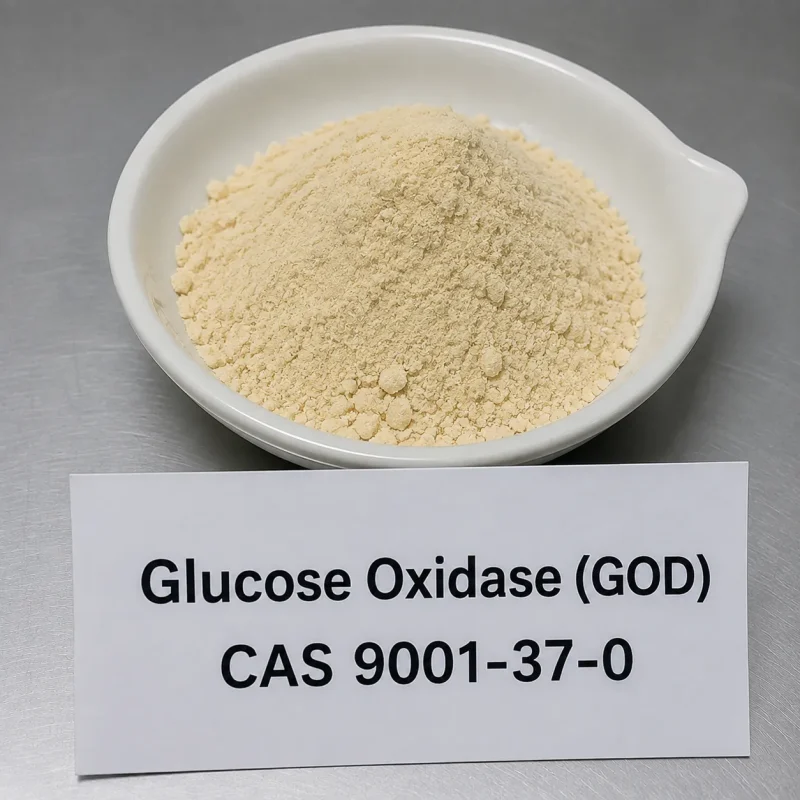
Glucose Oxidase (GOD) is a flavin-dependent oxidoreductase (EC 1.1.3.4) that oxidises β-D-glucose to D-glucono-δ-lactone, consuming one mole of dissolved O₂ per mole of glucose. Supplied as a pale-yellow to tan powder (≥100,000 U/g), it acts as a natural de-glucosylation and oxygen-scavenging enzyme in bakery, egg processing, and gluconic acid production. One dosing step removes both browning substrate and headspace oxygen. Each shipment includes COA, TDS, and SDS.
- CAS No.: 9001-37-0
- Synonyms: Glucose oxidase; GOD; EC 1.1.3.4
- EINECS: 232-642-4
- Source: Aspergillus niger fermentation
- Molecular Weight: ~160 kDa (homodimer, 2 FAD cofactors)
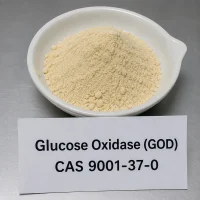
- Appearance: Pale yellow to tan free-flowing powder
- Activity: ≥100,000 U/g
- Optimum pH: 5.0–6.0 (active 3.5–7.5)
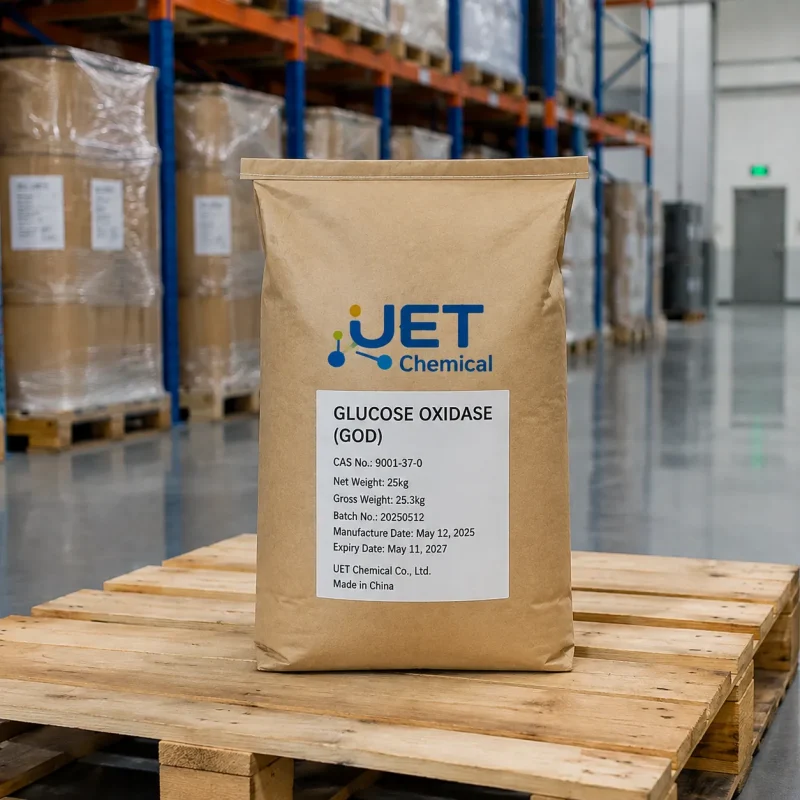
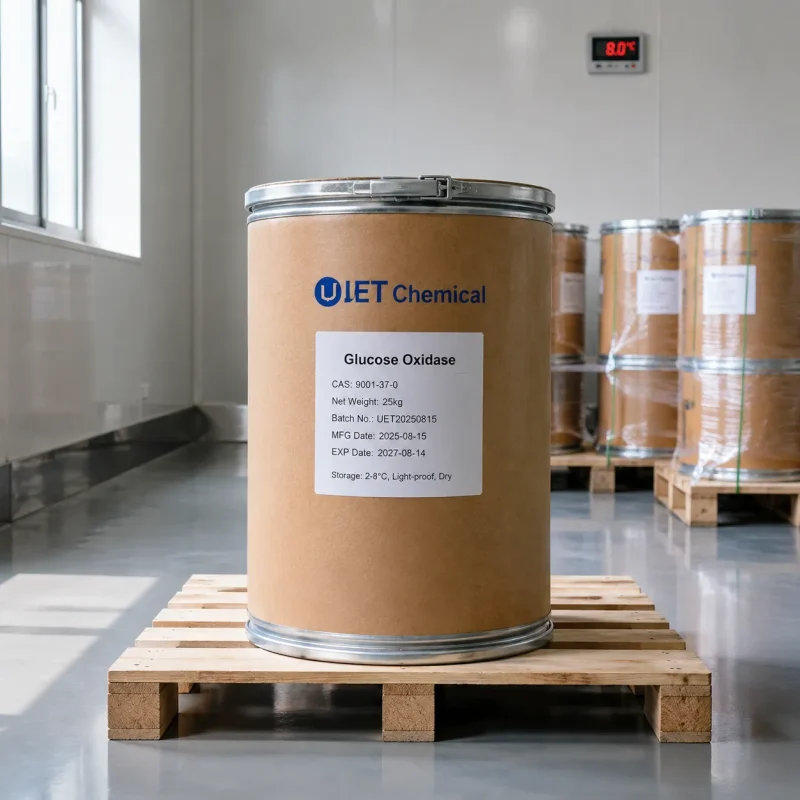
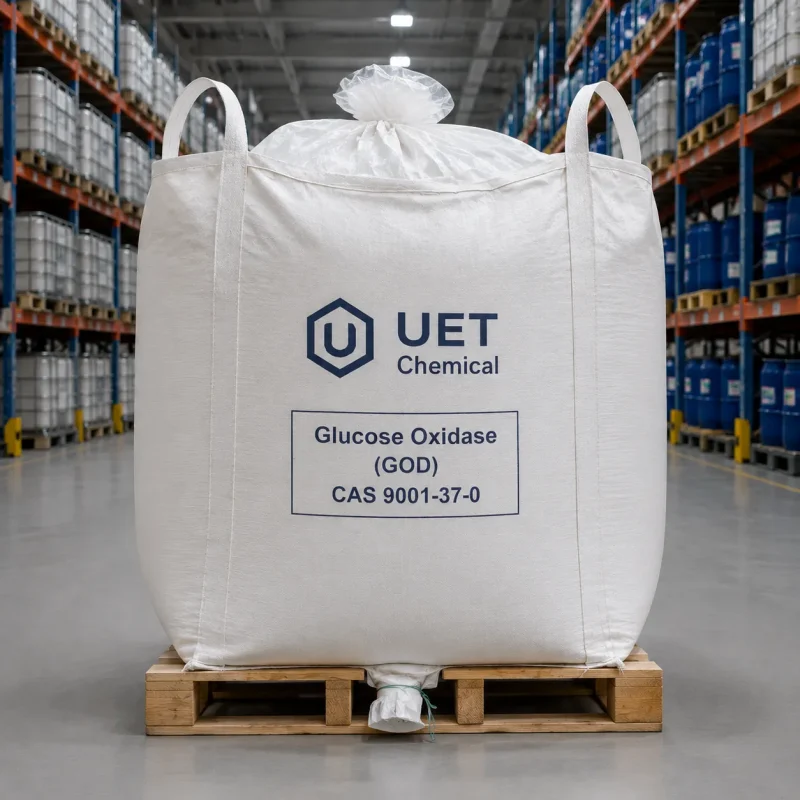
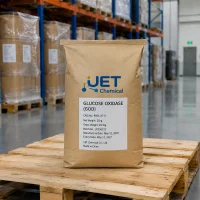
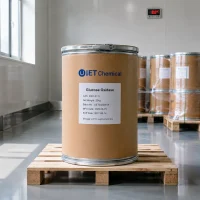
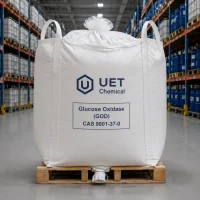
- Packaging: 25 kg fibre drum with PE liner / 25 kg kraft bag. Custom packaging available upon request.
- Main Applications: Bakery conditioning; egg de-glucosylation; gluconic acid; diagnostic reagents
Introduction to Glucose Oxidase
Glucose Oxidase is a pale-yellow to tan powder, a flavoprotein oxidoreductase (EC 1.1.3.4) produced by Aspergillus niger fermentation. Each ~160 kDa homodimer carries two FAD cofactors and catalyses the oxidation of β-D-glucose to D-glucono-δ-lactone, releasing hydrogen peroxide while consuming dissolved oxygen. Food processors use it to strip glucose from egg white and dough; diagnostic manufacturers use it as the recognition element in blood-glucose test strips.
The dual action—glucose removal plus oxygen scavenging—delays Maillard browning and oxidative rancidity in a single dosing step. One practical caution: GOD is a protein. Above 70 °C, or outside pH 3.5–8.0, the tertiary structure denatures and activity is lost permanently; dose after cool-down in hot processes, and keep heavy-metal ions (Cu²⁺, Hg²⁺, Ag⁺) out of the reaction mass—they poison the FAD centre.
Key Features of Glucose Oxidase
- Substrate-specific catalysis. Only β-D-glucose is oxidised; sucrose, lactose, and starch pass untouched, so GOD removes the browning substrate in egg and dairy systems without touching other sugars.
- Built-in oxygen scavenging. Every catalytic cycle consumes one O₂ molecule, pulling dissolved and headspace oxygen out of bottled beverages and packaged foods, slowing fat and pigment oxidation.
- Self-limiting in baking. Strengthens gluten through oxidative crosslinking during mixing and proofing, then denatures above 70 °C in the oven—no residual enzyme activity in the finished loaf.
- Mild-condition operation. Runs at 20–60 °C and pH 3.5–7.5 with no added cofactors; the bound FAD regenerates in situ each cycle.
- Clean-label status. Declared simply as “glucose oxidase” on ingredient lists and leaves no residue beyond gluconic acid, a naturally occurring food acid.
Glucose Oxidase Chemical & Physical Properties
| Property | Value |
|---|---|
| EC Number | 1.1.3.4 |
| Source | Aspergillus niger (fermentation) |
| Molecular Weight | ~160 kDa (homodimer, 2 FAD) |
| Appearance | Pale yellow to tan powder |
| Activity | ≥100,000 U/g |
| Optimum pH | 5.0–6.0 |
| Optimum Temperature | 50–60 °C |
| Thermal Inactivation | >70 °C (10 min, >90% activity loss) |
| pH Stability Range | 3.5–8.0 |
| Loss on Drying | ≤8.0% |
Applications of Glucose Oxidase
Bakery and dough conditioning: Dosed at 10–60 mg/kg flour. GOD oxidises free sulfhydryl groups on gluten proteins into disulfide bridges, tightening the network and raising dough tolerance. Activity builds during proofing and stops completely once crumb temperature passes 70 °C.
Egg products de-glucosylation: Added at 100–500 ppm to liquid egg at 30–40 °C, pH adjusted to 6.5–7.5. Residual glucose is the browning and off-flavour precursor in spray-dried egg; GOD converts it to gluconic acid before drying, keeping powder colour and flavour stable for 12+ months.
Beverage and beer antioxidant: Used at 2–10 ppm. Catalytic oxygen consumption drops dissolved O₂ below 0.1 mg/L, stabilising colour and flavour in bottled tea, beer, and fruit juice and extending shelf life without chemical antioxidants.
Gluconic acid and gluconate production: Run at pH 5.5–6.5, 30–35 °C with continuous aeration. GOD converts glucose to glucono-δ-lactone, which hydrolyses to gluconic acid; conversion exceeds 95% with proper O₂ supply.
Diagnostic and biosensor reagents: Serves as the glucose recognition layer in enzymatic test strips, coupled with peroxidase or an electrochemical electrode. High-purity grades are spray-dried with stabilisers for 12–24 month reagent shelf life.
Storage & Safety Precautions for Glucose Oxidase
Storage conditions. Store sealed, light-protected, and dry at 2–8 °C for full 24-month shelf life. Short-term holding below 20 °C is acceptable for under 3 months. Moisture is the main enemy: once the powder absorbs water, activity decays rapidly. At 25 °C storage expect roughly 5–10% activity loss per year versus 2–8 °C—plan inventory accordingly.
Safety and PPE. GHS: Resp. Sens. 1 (H334); Eye Irrit. 2 (H319). Enzyme dust can sensitise airways. Wear an N95/P2 dust mask, goggles, and nitrile gloves during drum emptying; use local exhaust and avoid creating dust clouds. Spills: vacuum with HEPA filter or damp-wipe; never dry-sweep large quantities.
Transport classification. Non-DG. Not regulated under IMDG, IATA, or ADR. For ocean freight above 30 days, request insulated packaging with gel packs to hold the container below 20 °C.
Practitioner note: For incoming QC, assay by the coupled spectrophotometric method: GOD + peroxidase with o-dianisidine or ABTS at 405–500 nm, pH 5.5, 35 °C. One unit oxidises 1 µmol β-D-glucose per minute. Always run a reference standard in parallel, and check loss on drying (≤8%)—a wet powder reads low on activity per gram even when the protein is intact.
Glucose Oxidase FAQ
Q: How do I verify the activity of Glucose Oxidase (CAS 9001-37-0) on arrival?
A: Run the coupled POD assay (o-dianisidine or ABTS, 405–500 nm, pH 5.5, 35 °C); 1 U oxidises 1 µmol β-D-glucose/min. Run a reference standard in parallel and check loss on drying ≤8%. If activity reads 10% low but moisture is high, re-test on a dry-weight basis before rejecting the lot.
Q: Why did GOD fail to strengthen my dough when I pre-dissolved it in hot water?
A: Thermal denaturation. Above 70 °C the protein unfolds and activity is lost permanently within minutes; even 50–60 °C water accelerates decay. Dissolve the powder in water below 40 °C, or blend it directly with the flour. In baking this is also the safety feature: the enzyme dies in the oven, leaving no residual activity.
A: Q: Does GOD work in liquid egg white at its natural pH of ~9?
A: Poorly. Activity collapses above pH 8.0. Adjust the liquid egg to pH 6.5–7.5 with food-grade citric acid before dosing 100–500 ppm GOD, hold at 30–40 °C, and aerate lightly—the reaction needs dissolved O₂. Without aeration the conversion stalls at 50–60% glucose removal.
Related products
Manufacturer & Exporter Since 2006
Get Tailored Chemical Raw Material Solutions — Reply Within 1 Hour
Factory-direct pricing, stable high-purity supply and complete compliance documentation for your industrial formulations.
- 1000+Products
- 200+QC Protocols
- 7–15Days Delivery
- Factory-Direct Pricing
- COA / TDS / SDS Included
- Free Samples for Testing
- 40+ Export Countries
Request a Free Quote
Our engineers reply within 1 hour during GMT+8 business hours.
Please include in your inquiry:
- Product name or CAS number
- Required quantity
- Destination country or port
- Preferred packaging