
L-Lysine Hydrochloride CAS 657-27-2
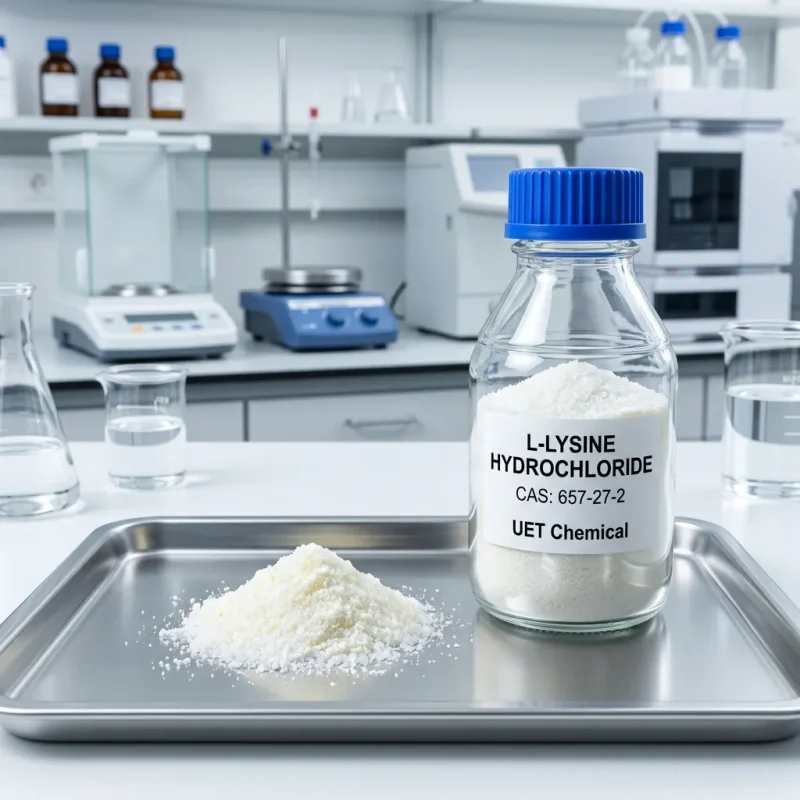
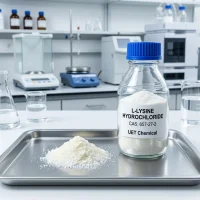
L-Lysine Hydrochloride is the monohydrochloride salt of the essential amino acid L-lysine—a diamino acid carrying one HCl on the side-chain amine. White crystalline powder, ≥99.0% purity (feed grade ≥98.5%). As the first limiting amino acid in swine diets and second limiting in poultry, it balances low-protein formulations, while its high water solubility also supports drinking-water dosing, food fortification, and infusion nutrition. We supply fermentation-grade batches with full batch traceability; each shipment includes COA, TDS, and SDS.
- CAS No.: 657-27-2
- Synonyms: L-Lysine HCl; L-Lysine monohydrochloride; (S)-2,6-Diaminohexanoic acid hydrochloride
- EINECS: 211-519-9
- Molecular Formula: C₆H₁₅ClN₂O₂ (C₆H₁₄N₂O₂·HCl)
- Molecular Weight: 182.65 g/mol
- Appearance: White crystalline powder
- Purity: ≥99.0% (feed grade ≥98.5%)
- Lysine Equivalent: ≥78–80%
- Specific Rotation [α]D20: +18.0° to +21.5° (c = 8, 6 M HCl)
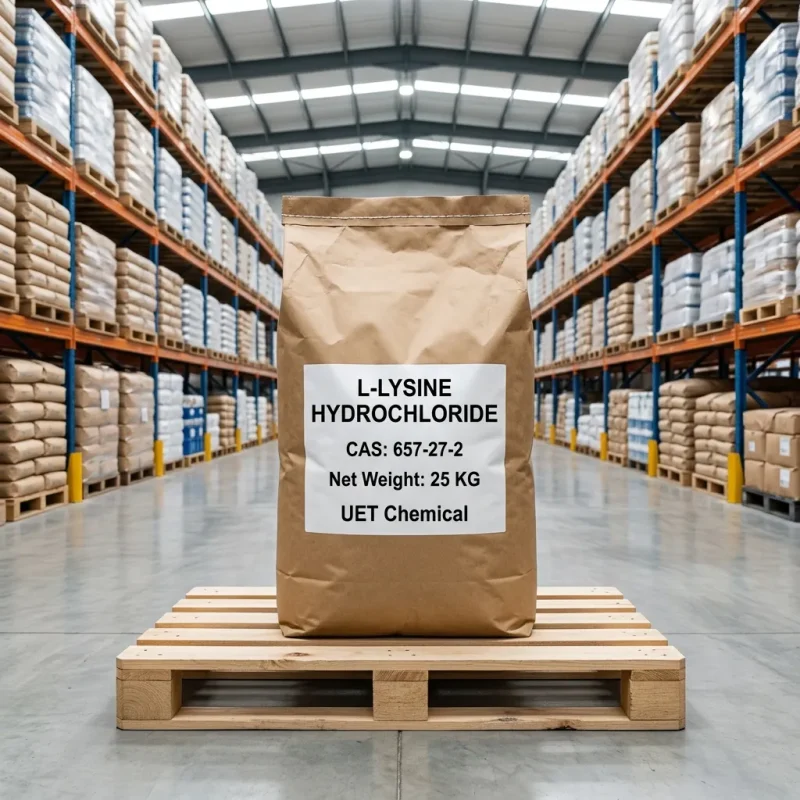
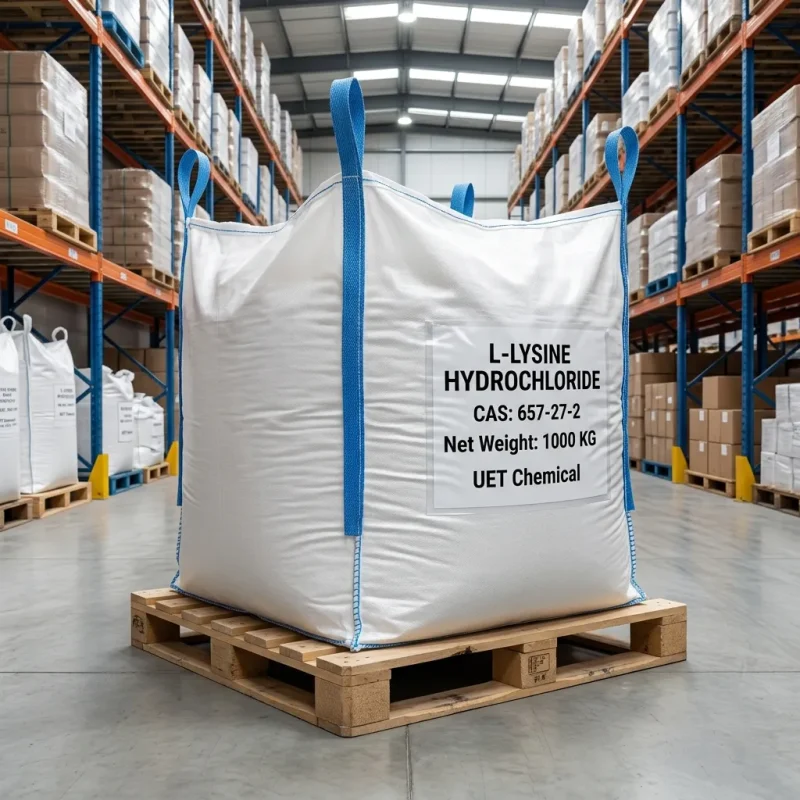
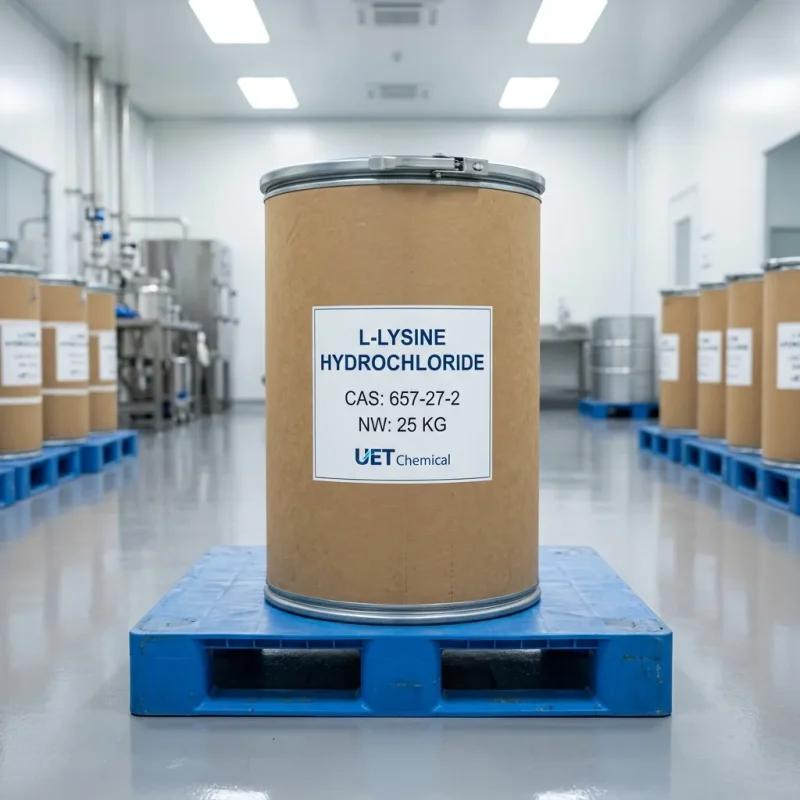
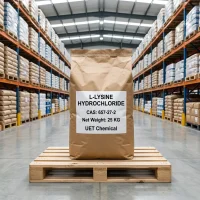
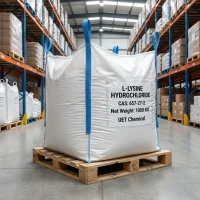
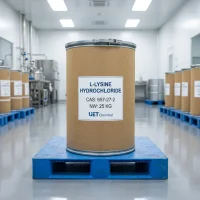
- Packaging: 25 kg kraft bag with PE liner / 25 kg fibre drum / 1000 kg FIBC. Custom packaging available upon request.
- Main Applications: Swine & poultry feed; aquafeed & pet food; food fortification; infusion & sports nutrition
Introduction to L-Lysine Hydrochloride
L-Lysine Hydrochloride is a white crystalline powder, the HCl salt of L-lysine produced by Corynebacterium glutamicum fermentation. The salt form dissolves freely in water (~400–500 g/L at 20 °C)—far beyond the free base—enabling drinking-water dosing and liquid premixes. Feed mills use it to balance the first limiting amino acid in corn–soy diets; nutraceutical brands use it in capsules and sports formulas; pharma uses it in infusion and parenteral nutrition.
The theoretical lysine content of the salt is 80% (≥78% as feed-grade specification), giving a fixed 0.80 conversion factor for formulation. One practical caution: the salt is mildly hygroscopic, and the ε-amino group drives Maillard browning with reducing sugars under moist heat; keep bags sealed below 60% RH and never wet-granulate it together with dextrose or glucose syrups.
Key Features of L-Lysine Hydrochloride
- First limiting amino acid correction. Lysine is first limiting in swine and second limiting in poultry on cereal-based diets; supplementation at 1–3 kg/t lets formulators cut 2–3 points of crude protein without sacrificing growth performance.
- Fixed lysine equivalent. 182.65 g/mol salt carries 146.19 g/mol lysine—80% theoretical, ≥78% as shipped feed grade—so dose conversion stays predictable lot to lot.
- High water solubility. ~400–500 g/L at 20 °C versus a poorly soluble free base, allowing medicated drinking water, liquid premixes, and clear infusion solutions.
- Fermentation-derived, animal-free. Bacterial fermentation platform gives a non-animal, BSE/TSE-free amino acid with D-lysine <0.1% enantiomeric purity.
- Stable, free-flowing salt. Less hygroscopic than free L-lysine base; the crystalline HCl salt stays free-flowing when stored dry and survives pelleting temperatures up to 80–85 °C.
L-Lysine Hydrochloride Chemical & Physical Properties
| Property | Value |
|---|---|
| Molecular Formula | C₆H₁₅ClN₂O₂ (C₆H₁₄N₂O₂·HCl) |
| Molecular Weight | 182.65 g/mol |
| Appearance | White crystalline powder, slight characteristic odour |
| Purity | ≥99.0% (pharma/food); ≥98.5% (feed grade) |
| Specific Rotation [α]D20 | +18.0° to +21.5° (c = 8, 6 M HCl) |
| pH (5% aq. solution) | 5.0–6.0 |
| Solubility in Water | Freely soluble (~400–500 g/L at 20 °C); practically insoluble in ethanol and ether |
| Loss on Drying | ≤0.4% |
| Residue on Ignition | ≤0.1% |
| Heavy Metals / As | ≤10 ppm / ≤2 ppm |
Applications of L-Lysine Hydrochloride
Swine and poultry feed: Dosed at 1–3 kg per tonne of compound feed (up to 3–4 kg/t in weaner piglet diets). Corrects the first limiting amino acid in corn–soybean meal rations, improving feed conversion ratio and lean gain while allowing lower crude protein and reduced nitrogen excretion.
Aquafeed and pet food: Added at 0.5–2% of the formulation. Plant-protein-based fish and pet diets are lysine-short; the HCl salt disperses readily in feed-mix water and survives extrusion at 90–110 °C.
Food fortification and sports nutrition: Used at 250–1,000 mg per serving in capsules, stick packs, and fortified flour or bread. Raises the lysine score of cereal proteins; mild sweet-saline taste at fortification levels stays below flavour thresholds.
Infusion and parenteral nutrition: Pharma-grade material supplies the lysine fraction in amino-acid infusion blends; the HCl salt contributes to solution stability and isotonicity without antioxidant systems.
Cell culture and fermentation media: Supplied at 0.1–0.5 g/L in defined media for mammalian and microbial cultures, where lysine auxotrophs require the free amino acid for growth.
Storage & Safety Precautions for L-Lysine Hydrochloride
Storage conditions. Store in sealed, PE-lined kraft bags, fibre drums, or FIBC at 15–25 °C, in a dry warehouse. Above 70% RH the powder absorbs moisture and cakes; caked material retains full assay after milling. Keep away from strong oxidisers and from reducing sugars in wet processes—Maillard browning accelerates above 60 °C at high water activity. Reseal opened bags immediately.
Safety and PPE. GHS: Not classified as hazardous. Non-toxic and non-irritating at handling levels. Wear an N95 dust mask and safety glasses during bag emptying to avoid nuisance dust. Spills are non-toxic but slippery when wet; sweep dry first, then wash the floor.
Transport classification. Non-DG. Not regulated under IMDG, IATA, or ADR. Ship as standard general cargo. Ensure container liners are intact to prevent moisture ingress during ocean freight.
Practitioner note: For incoming QC, confirm identity by specific rotation (+18.0° to +21.5°, c = 8 in 6 M HCl) and assay by non-aqueous potentiometric titration or HPLC; cross-check chloride at ~19.5% theoretical. A positive ninhydrin spot and a clear 5% solution are fast identity screens. Crystal habit (fine needles vs granules) varies between crystallisation lots without affecting assay.
L-Lysine Hydrochloride FAQ
Q: How does L-Lysine Hydrochloride (CAS 657-27-2) differ from L-lysine base (CAS 56-87-1)?
A: The HCl salt carries 80% lysine equivalent (≥78% as feed grade) versus 100% for the base, but it is far more water-soluble (~400–500 g/L vs poorly soluble base), less hygroscopic, and cheaper per kg of lysine delivered. Choose the base only where chloride load must be minimised, such as certain infusion formulas; remember to divide your lysine target by 0.80 when dosing the salt.
Q: My lysine HCl caked after a humid season. Is it still usable?
A: Yes. Caking is physical moisture uptake, not degradation. Mill the cake, verify loss on drying (≤0.4–1.0%) and assay, then dose normally—solubility and bioavailability are unchanged. Store future lots on pallets away from walls with warehouse RH below 60% and reseal opened bags.
Q: Why did my fortified cereal bar turn brown after adding lysine HCl?
A: Maillard browning. The ε-amino group reacts with reducing sugars (glucose, syrups) above ~60 °C at elevated water activity. Keep bar water activity below 0.4, store below 25 °C, or switch to encapsulated lysine in high-sugar, high-moisture matrices. Browning is irreversible; isolate affected lots.
Related products
Manufacturer & Exporter Since 2006
Get Tailored Chemical Raw Material Solutions — Reply Within 1 Hour
Factory-direct pricing, stable high-purity supply and complete compliance documentation for your industrial formulations.
- 1000+Products
- 200+QC Protocols
- 7–15Days Delivery
- Factory-Direct Pricing
- COA / TDS / SDS Included
- Free Samples for Testing
- 40+ Export Countries
Request a Free Quote
Our engineers reply within 1 hour during GMT+8 business hours.
Please include in your inquiry:
- Product name or CAS number
- Required quantity
- Destination country or port
- Preferred packaging