
Zinc Carbonate CAS 3486-35-9
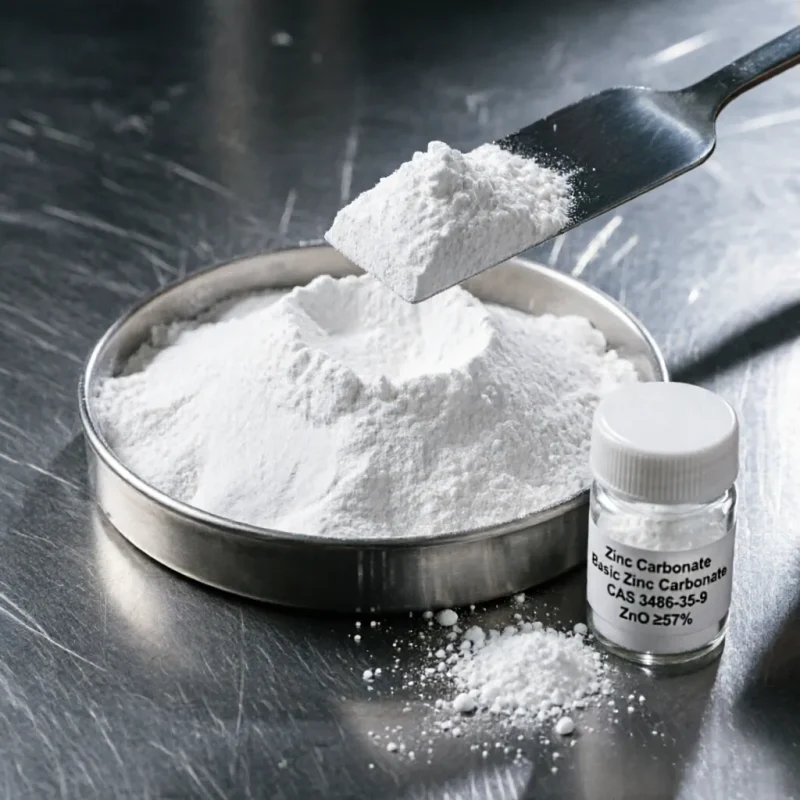
Zinc Carbonate is a white inorganic powder, used mainly as a zinc source in animal feed and a vulcanization activator in rubber compounding. The carbonate structure breaks down into active zinc oxide at curing temperatures, giving good dispersion and lowering total zinc use. COA, TDS, and SDS ship with every order.
- CAS No: 3486-35-9
- Synonyms: Zinc(II) carbonate; Carbonic acid, zinc salt (1:1)
- EINECS: 222-477-6
- Molecular Formula: ZnCO3
- Molecular Weight: 125.38 g/mol
- Appearance: Fine white powder
- Zinc (Zn) Content: ≥50.0%
- Heavy Metals (Pb, As, Cd): ≤10 ppm (Feed Grade)
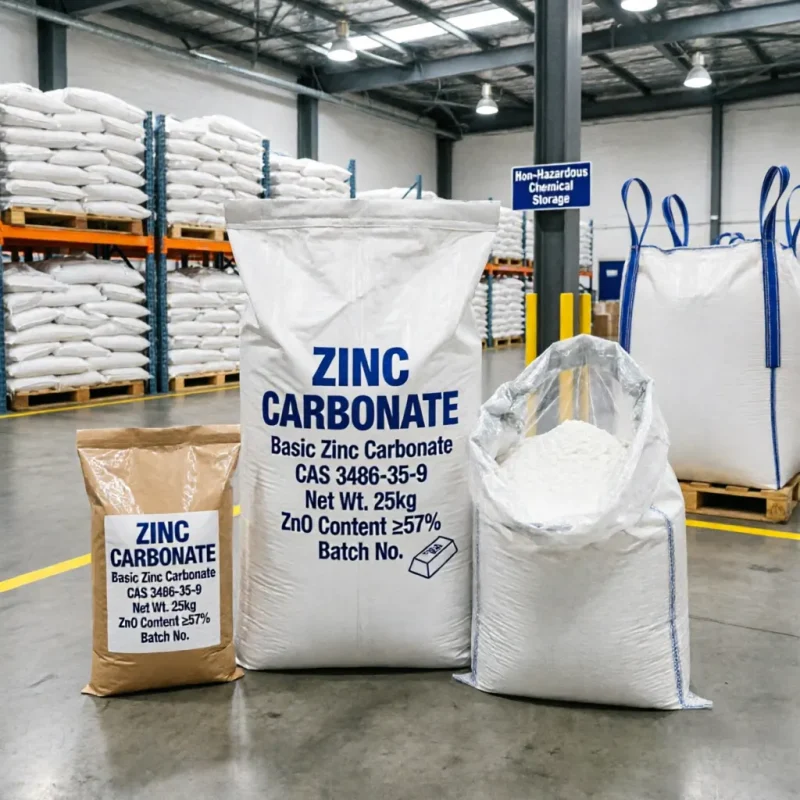
- Packaging: 25 kg multi-wall paper bag; Custom packaging available upon request.
- Main Applications: Animal feed, rubber vulcanization, ceramics, catalysts
Introduction to Zinc Carbonate
Zinc Carbonate is an odorless white powder with a trigonal crystal structure. Feed mills use it to supply bioavailable zinc to livestock. Rubber factories add it to sulfur-cured systems. Heat converts the powder into active zinc oxide right inside the mixer. The porous particles spread easily through the polymer, helping formulators cut total zinc weight.
Mixing this powder with strong acids releases carbon dioxide gas fast. Never put it into a closed feed mixer with acidic ingredients. Pressure builds up and can burst the vessel. Bulk density shifts slightly between batches because precipitation speeds vary. Premix plants need to recalibrate volumetric feeders when opening a new lot.
Key Features of Zinc Carbonate
- Thermal Activation: Breaks down into active zinc oxide and carbon dioxide around 300 °C (572 °F). This creates local hot spots for sulfur crosslinking in rubber.
- High Bioavailability: Dissolves fast in stomach acid. Livestock absorb the zinc easily for bone growth and immune health.
- Low Dust Options: Granulated or surface-treated grades cut down airborne dust during high-speed milling. This keeps operators safe and stops cross-contamination.
- Heavy Metal Control: Purified grades keep lead, arsenic, and cadmium below 10 ppm. This meets strict FDA and EU feed rules.
Zinc Carbonate Chemical & Physical Properties
| Property | Value |
|---|---|
| Molecular Formula | ZnCO3 |
| Molecular Weight | 125.38 g/mol |
| Appearance | Fine white powder |
| Zinc (Zn) Content | ≥50.0% (dry basis) |
| Loss on Ignition | 30–35% (yields ZnO) |
| Density | 4.39 g/cm³ at 25 °C (77 °F) |
| Solubility | Insoluble in water; soluble in dilute acids with effervescence |
| Particle Size (325 mesh) | ≥99.0% passing |
Applications of Zinc Carbonate
Animal Feed Premixes: Dose at 50–150 ppm elemental zinc for poultry and swine. Stomach acid dissolves the carbonate matrix and releases Zn2+ ions. These ions activate enzymes for bone and feather growth. Vitamin-mineral blends prefer this salt because it stops oxidative rancidity during storage.
Rubber Vulcanization: Add 2–5 phr to EPDM, SBR, and natural rubber. At 150–170 °C (302–338 °F) cure temperatures, the powder turns into nascent zinc oxide. This fresh oxide reacts with stearic acid instantly to speed up sulfur crosslinking. Tires and hoses get better cure kinetics with less total zinc.
Ceramic Glazes: Use 3–8 wt% as a flux and opacifier. Kiln firing above 900 °C (1652 °F) drives off CO2 to make a micro-porous structure before melting. The leftover ZnO drops the thermal expansion rate and helps the glaze stick to the clay body.
Catalyst Supports: Load 5–15 wt% onto alumina or silica for methanol synthesis. Heat decomposition leaves a high-surface-area zinc oxide network. This maximizes active sites without plugging the support pores.
Storage & Safety Precautions for Zinc Carbonate
- Storage & Moisture: keep at 15–30 °C (59–86 °F) in a dry warehouse; seal bags on pallets to stop caking.
- Acid Incompatibility: never mix with strong acids in closed vessels; rapid CO2 gas release causes pressure build-up and bursting.
- Handling & PPE: use local exhaust for dust; wear an N95/P2 mask, goggles, and gloves when emptying bags.
- Transport: Non-DG for air and sea freight; keep away from liquid acids.
- QC & Testing: check Zn content by EDTA titration and heavy metals by ICP-OES; test 325-mesh residue to avoid grit in rubber.
Zinc Carbonate FAQ
Q: How does CAS 3486-35-9 behave in acidic feed premixes?
A: It reacts with acids to release CO2. Blending it with choline chloride or acidic salts in a sealed mixer causes gas pressure to build up. Add it to neutral carriers, or make sure the mixer vents properly to stop bags from swelling or equipment breaking.
Q: Why use Zinc Carbonate in vitamin premixes?
A: Vitamin premixes need dry ingredients. Zinc carbonate stays dry and neutral. It stops oxidative rancidity and keeps vitamins A, D, and E stable. This extends the shelf life of the final premix blend.
Q: What happens during rubber vulcanization?
A: At 150–170 °C (302–338 °F), the carbonate breaks into fresh ZnO and CO2. The new ZnO has massive surface area. It grabs stearic acid right away to speed up sulfur crosslinking, giving faster cures without extra inert filler.
Related products
Manufacturer & Exporter Since 2006
Get Tailored Chemical Raw Material Solutions — Reply Within 1 Hour
Factory-direct pricing, stable high-purity supply and complete compliance documentation for your industrial formulations.
- 1000+Products
- 200+QC Protocols
- 7–15Days Delivery
- Factory-Direct Pricing
- COA / TDS / SDS Included
- Free Samples for Testing
- 40+ Export Countries
Request a Free Quote
Our engineers reply within 1 hour during GMT+8 business hours.
Please include in your inquiry:
- Product name or CAS number
- Required quantity
- Destination country or port
- Preferred packaging