
Ethyl Vanillin CAS 121-32-4
Ethyl Vanillin is a synthetic aromatic aldehyde—3-ethoxy-4-hydroxybenzaldehyde, the ethyl-ether analogue of vanillin—supplied as white to pale-yellow needle crystals (≥99.0% GC purity). Its sweet, creamy vanilla impact is 2.5–4 times stronger than vanillin, making it the intensity driver in chocolate, confectionery, beverages, and ice cream, as well as tobacco casings and gourmand perfumery. We supply food-grade fine-crystal material with full batch traceability; each shipment includes COA, TDS, and SDS.
- CAS No.: 121-32-4
- Synonyms: 3-Ethoxy-4-hydroxybenzaldehyde; Bourbonal; Ethylvanillin; 4-Hydroxy-3-ethoxybenzaldehyde
- EINECS: 204-464-7
- Molecular Formula: C₉H₁₀O₃
- Molecular Weight: 166.17 g/mol
- Appearance: White to pale-yellow fine needle crystals
- Purity (GC): ≥99.0%
- Melting Point: 76–78 °C
- Odour: Sweet creamy vanilla, ~3× vanillin strength
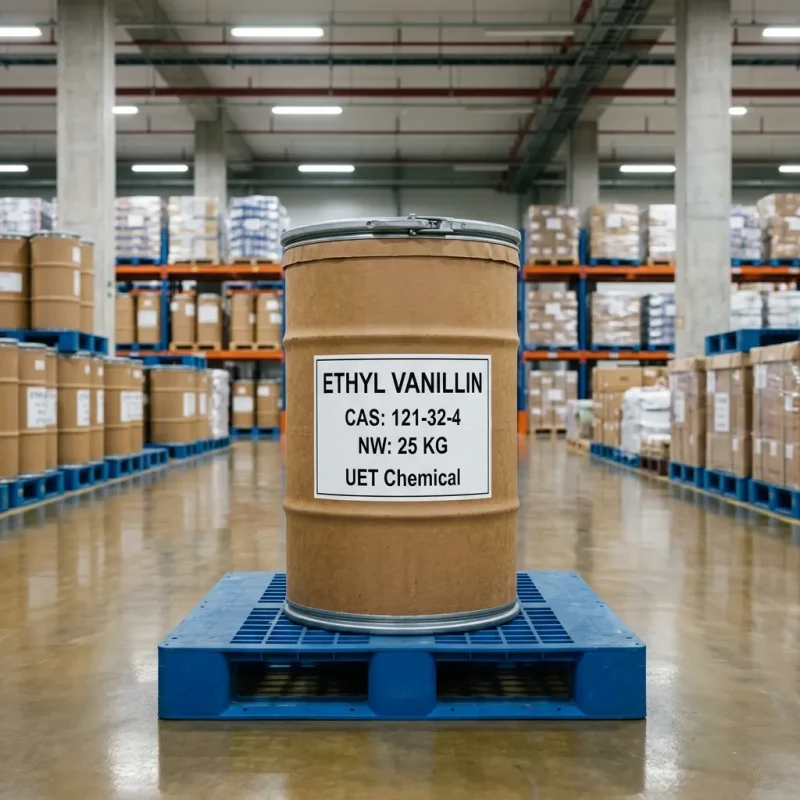
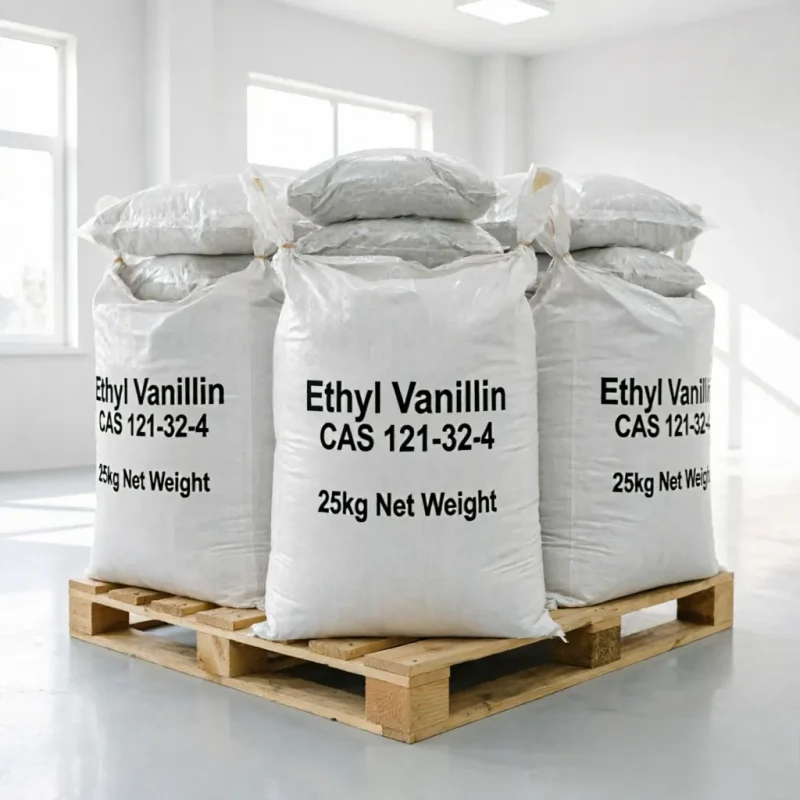
- Packaging: 25 kg fibre drum with PE liner / 25 kg kraft bag. Custom packaging available upon request.
- Main Applications: Food & beverage flavouring; chocolate & confectionery; tobacco casings; perfumery
Introduction to Ethyl Vanillin
Ethyl Vanillin is a white to pale-yellow needle crystal, a synthetic aromatic aldehyde in which the methoxy group of vanillin is replaced by an ethoxy group. The ethoxy shift raises flavour intensity to 2.5–4 times that of vanillin, so formulators reach the same vanilla impact at roughly one-third the dose. Flavour houses use it as the high-intensity core of vanilla, chocolate, caramel, and cream profiles; perfumers use it as a gourmand base note.
The molecule is freely soluble in ethanol, propylene glycol, and glycerol but only ~2.8 g/L in water at 25 °C, so production lines dose it as a glycol or ethanol stock. One practical caution: the phenolic –OH darkens on contact with iron or alkaline surfaces, and prolonged light exposure tints the crystals beige-pink—run product contact parts in stainless steel, glass-lined, or polymer materials, and keep drums sealed and dark, as the aldehyde also sublimes slowly like vanillin.
Key Features of Ethyl Vanillin
Ethyl Vanillin Chemical & Physical Properties
| Property | Value |
|---|---|
| Molecular Formula | C₉H₁₀O₃ |
| Molecular Weight | 166.17 g/mol |
| Appearance | White to pale-yellow fine needle crystals |
| Melting Point | 76–78 °C |
| Boiling Point | ~285 °C (760 mmHg) |
| Flash Point | ~127 °C (closed cup) |
| Solubility in Water | ~2.8 g/L (25 °C); 1 g in ~2 mL 95% ethanol; soluble in propylene glycol, glycerol |
| Vapour Pressure (25 °C) | ~0.001 mmHg (est.) |
| Purity (GC) | ≥99.0% |
| Loss on Drying | ≤0.5% |
Applications of Ethyl Vanillin
Food and beverage flavouring (FEMA 2464, GRAS; JECFA flavouring agent): Dosed at 10–100 ppm in soft drinks, ice cream, and baked goods. Delivers a smooth vanilla note at a fraction of vanillin usage; pair with ethyl maltol for cream-caramel directions.
Chocolate and confectionery: Used at 50–250 mg/kg. The higher intensity survives conching and baking, anchoring the vanilla-chocolate base in compound chocolate, fillings, and hard candy.
Tobacco casings: Added at 0.01–0.1% of casing weight. The sweet vanilla top note rounds harsh smoke characters and survives casing application temperatures.
Perfumery and daily-use fragrances: Formulated at 0.1–2% as a gourmand vanilla fixative in fine fragrances, soaps, and detergent perfumes, blending with coumarin, ethyl maltol, and balsamic notes.
Fine-chemical intermediate: Serves as the aldehyde building block for pharmaceutical intermediates and derivative aroma chemicals via ether, Schiff-base, and oxidation chemistry.
Storage & Safety Precautions for Ethyl Vanillin
Storage conditions. Store in sealed, PE-lined drums or kraft bags at 5–25 °C, dry and protected from light. The crystals sublime slowly and absorb odours; light and heat tint them pink-beige without assay loss. Keep away from strong oxidisers, iron contact, and alkaline dust—phenol–iron contact produces pink stains.
Safety and PPE. GHS: Eye Irrit. 2 (H319); Aquatic Acute 3 (H402). Wear an N95 dust mask, safety glasses, and nitrile gloves during drum emptying to avoid dust inhalation and eye irritation. Spills: sweep up dry, then wash the floor with water.
Transport classification. Non-DG. Not regulated under IMDG, IATA, or ADR. Ship as standard general cargo. Ensure container liners are intact to prevent moisture and odour ingress during ocean freight.
Practitioner note: For incoming QC, verify purity by GC (≥99.0%, with vanillin reported as a related substance), melting point 76–78 °C, and a clear solution of 1 g in 2 mL of 95% ethanol. A pink or grey tint flags iron or alkaline contact during prior handling; sample from the drum core—surface crystals discolour first under light.
Ethyl Vanillin FAQ
Q: How do I replace vanillin with Ethyl Vanillin (CAS 121-32-4) in an existing formula?
A: Start at one-third of the vanillin weight—ethyl vanillin runs 2.5–4× stronger—then adjust by sensory panel. Expect a sweeter, creamier, slightly floral shift versus vanillin; rebalance dairy and caramel notes accordingly, and confirm the final profile after one week of storage.
Q: Why did my batch turn pink-beige in storage?
A: The phenolic group reacts with trace iron or alkaline surfaces, and light accelerates the tint. Use stainless steel, glass-lined, or polymer contact parts; keep drums sealed, dark, and below 25 °C. A slight surface tint is cosmetic if GC purity holds ≥99.0%; deep discoloration with an off-odour justifies rejection.
Q: What is the best way to dose it into beverages and dairy?
A: Pre-dissolve as a 10–20% stock in propylene glycol or food-grade ethanol (1 g dissolves in ~2 mL of 95% ethanol), then meter the stock into the batch. Direct water addition fails—solubility is only ~2.8 g/L at 25 °C—and undissolved crystals settle as flavour hot spots.
Related products
Manufacturer & Exporter Since 2006
Get Tailored Chemical Raw Material Solutions — Reply Within 1 Hour
Factory-direct pricing, stable high-purity supply and complete compliance documentation for your industrial formulations.
- 1000+Products
- 200+QC Protocols
- 7–15Days Delivery
- Factory-Direct Pricing
- COA / TDS / SDS Included
- Free Samples for Testing
- 40+ Export Countries
Request a Free Quote
Our engineers reply within 1 hour during GMT+8 business hours.
Please include in your inquiry:
- Product name or CAS number
- Required quantity
- Destination country or port
- Preferred packaging