
DL-Tartaric Acid CAS 133-37-9
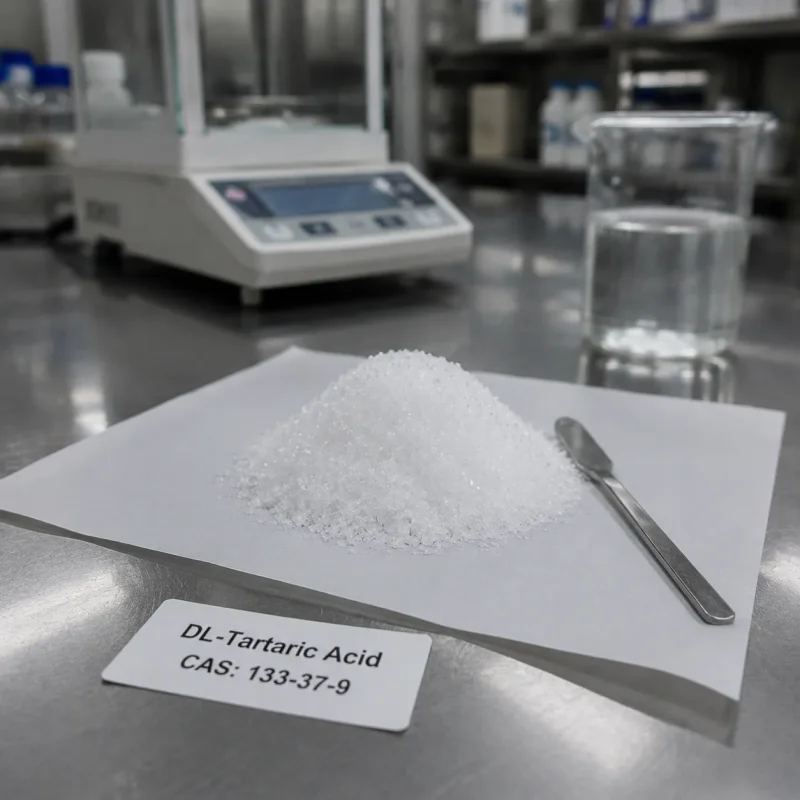
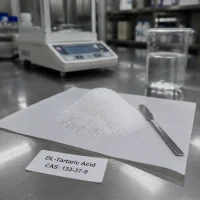
DL-Tartaric Acid is the racemic form of 2,3-dihydroxybutanedioic acid, carrying two carboxyl and two hydroxyl groups on a four-carbon chain. Supplied as a white crystalline powder (≥99% purity), it serves as a chelating agent in electroplating baths, a complexing agent in mirror silvering, and a set retarder in gypsum and cement systems. The racemate is optically inactive ([α]D ≈ 0°) and melts ~35 °C higher than the L-isomer. Each shipment includes COA, TDS, and SDS.
- CAS No.: 133-37-9
- Synonyms: DL-Tartaric acid; 2,3-Dihydroxybutanedioic acid; Racemic tartaric acid
- EINECS: 205-105-7
- Molecular Formula: C₄H₆O₆
- Molecular Weight: 150.09 g/mol
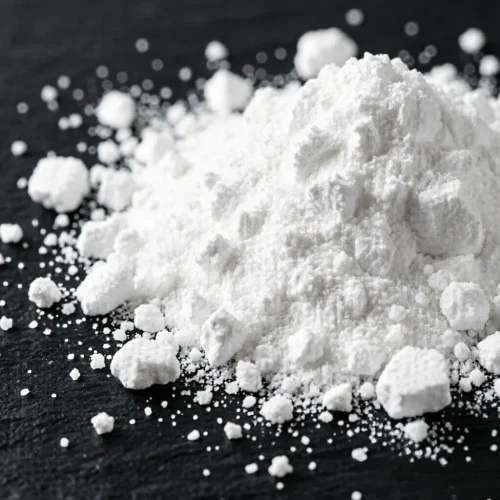
- Appearance: White crystalline powder or colorless crystals
- Assay: ≥99.0%
- Specific Rotation [α]D20: -0.2° to +0.2° (c = 20, water)
- Melting Point: 206–212 °C (decomposes)
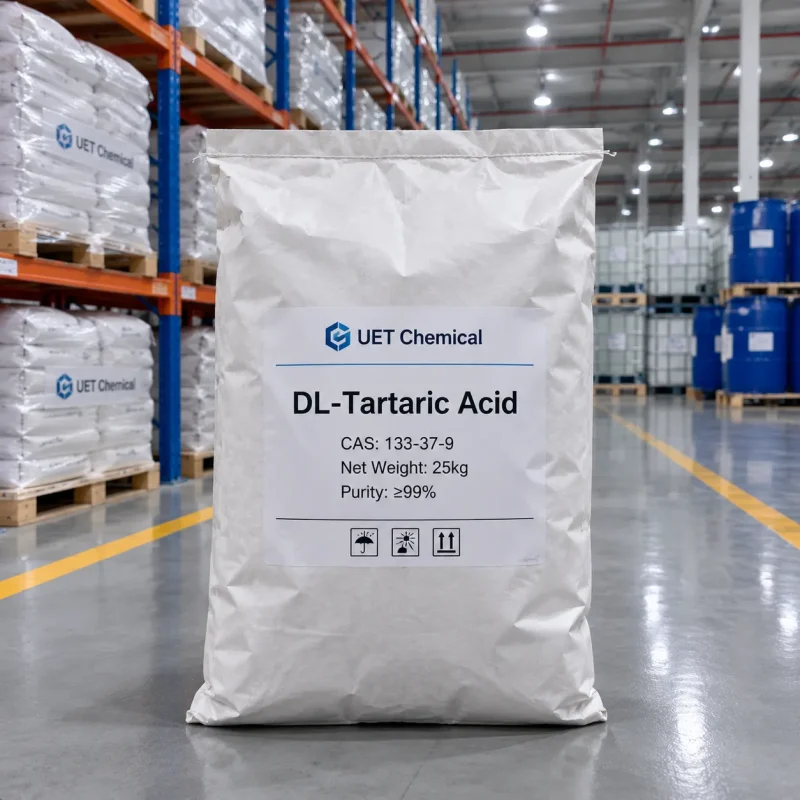
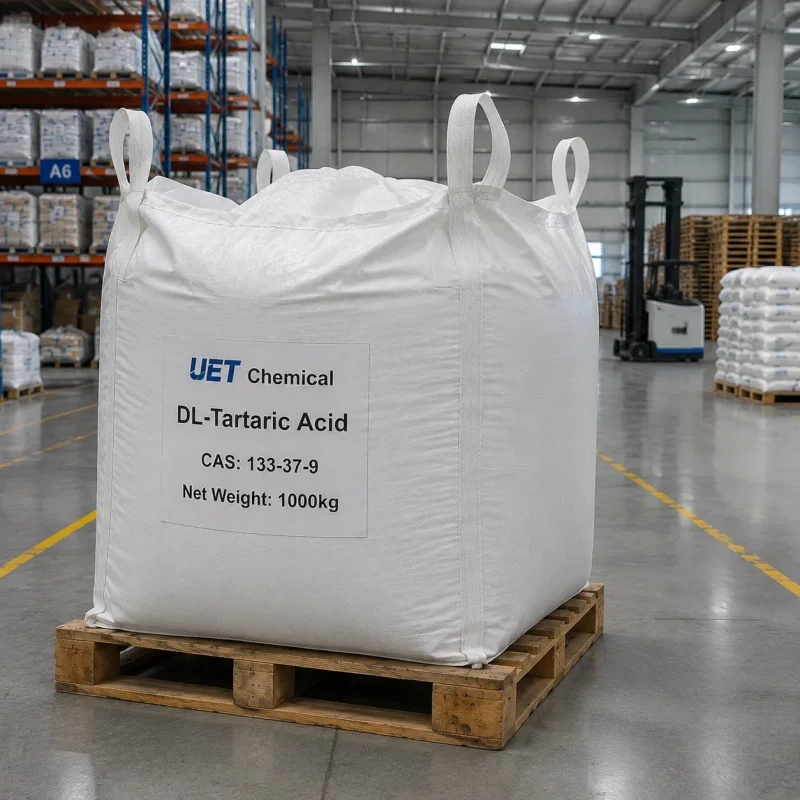
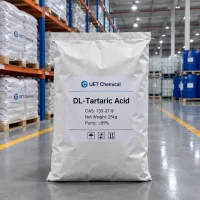
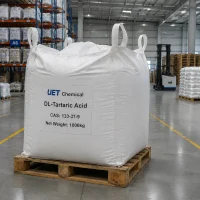
- Packaging: 25 kg woven bag with PE liner / 1000 kg FIBC bulk bag. Custom packaging available upon request.
- Main Applications: Electroplating chelation; mirror silvering; gypsum & cement retarder; tanning & textile
Introduction to DL-Tartaric Acid
DL-Tartaric Acid is a white crystalline powder, the racemic 1:1 mixture of D- and L-tartaric acid. Each molecule carries two carboxyl groups and two adjacent hydroxyl groups on a four-carbon chain, an arrangement that locks Cu²⁺, Fe³⁺, and Sb³⁺ into stable five-membered chelate rings. Industrial users run it as a chelating agent in electroplating baths, a complexing agent in Tollens mirror silvering, and a set retarder in gypsum and cement systems.
The racemic composition leaves the powder optically inactive and pushes the melting point to 206–212 °C, roughly 35 °C above the L-isomer, while water solubility falls to ~20.6 g/100 mL at 20 °C—about one-seventh of the L-form. One practical caution: that low solubility slows dissolution in cold process water; charge the powder slowly into water at 40–50 °C, or undissolved crystals will settle in dosing tanks.
Key Features of DL-Tartaric Acid
- Optically inactive racemate. [α]D reads 0° (±0.2°), so the powder introduces no chiral bias—valuable when resolving racemic amines via diastereomeric tartrate salts, or when stereochemistry must not interfere with metal complexation.
- α-hydroxy-carboxyl chelation. The adjacent -OH and -COOH pairs bind Cu²⁺, Fe³⁺, and Sb³⁺ into five-membered rings, keeping these metals in solution at alkaline pH where simple salts would precipitate as hydroxides.
- Gypsum and cement retardation. At 0.1–0.5% of binder weight, carboxyl groups adsorb onto calcium sites and delay sulfate crystallisation, extending the working time of plasters, grouts, and concrete.
- Higher melting, slower dissolution than the L-form. Melting point 206–212 °C versus 169–172 °C for L-tartaric acid; solubility ~20.6 g/100 mL versus ~139 g/100 mL at 20 °C—a built-in slow-release profile for retardation duties.
- Strong diacid buffering. pKa values of 3.03 and 4.37 give effective buffering between pH 2.5 and 4.5 in technical baths and cleaning formulations.
DL-Tartaric Acid Chemical & Physical Properties
| Property | Value |
|---|---|
| Molecular Formula | C₄H₆O₆ |
| Molecular Weight | 150.09 g/mol |
| Appearance | White crystalline powder or colorless crystals |
| Melting Point | 206–212 °C (decomposes) |
| Density (solid, 20 °C) | 1.79 g/cm³ |
| Solubility in Water | ~20.6 g/100 mL (20 °C); rises sharply with temperature |
| Solubility (Other) | Soluble in ethanol; practically insoluble in ether |
| Specific Rotation [α]D20 | -0.2° to +0.2° (c = 20, water) |
| pH (10% aq. solution) | ~2.0 |
| pKa (25 °C) | 3.03 / 4.37 |
| Loss on Drying | ≤0.5% (105 °C) |
Applications of DL-Tartaric Acid
Electroplating and metal finishing: Dosed at 5–20 g/L. The α-hydroxy-carboxyl pairs chelate Cu²⁺ and Sb³⁺ in alkaline baths, preventing hydroxide sludge and refining deposit grain. Also used in copper polishing and pickling formulations at 2–5%.
Mirror silvering (Tollens process): Used at 2–5 g per m² of silver deposit. The acid complexes the silver-ammonia system and moderates the reduction rate by glucose, producing a uniform, spot-free silver film on glass.
Construction retarder for gypsum and cement: Added at 0.1–0.5% of binder weight. Carboxyl groups chelate Ca²⁺ and delay sulfate crystallisation, extending plaster working time by 20–60 minutes. Above 1% dosage, set retardation becomes excessive—titrate the dose in the lab first.
Tanning and textile processing: Used at 1–3% on material weight. Adjusts bath pH and complexes chromium, aluminium, and iron mordants; in tanning liquors it masks iron stains that would otherwise discolour hides.
Resolution chemistry and tartrate salts: The racemate resolves racemic organic amines by crystallising diastereomeric tartrate salts, and serves as feedstock for technical tartrate esters used as plasticisers and coalescing agents.
Storage & Safety Precautions for DL-Tartaric Acid
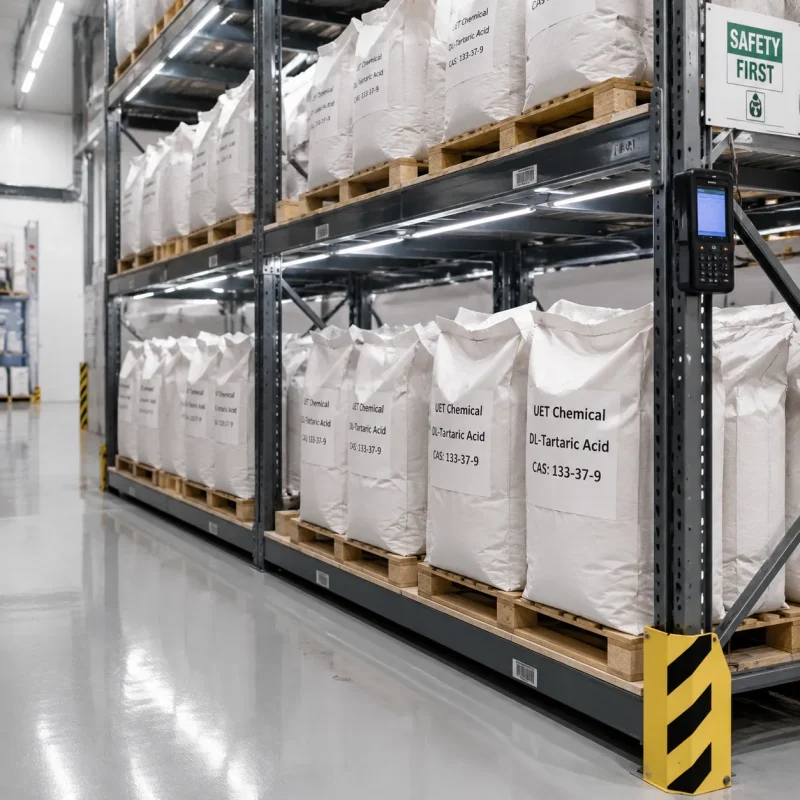
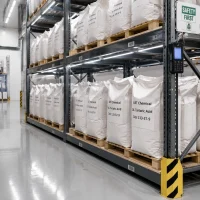
Storage conditions. Store in sealed, PE-lined bags on pallets at 5–30 °C, in a dry warehouse. The powder cakes slowly above 70% RH. Keep away from strong oxidisers (peroxides, nitrates, chlorates): tartaric acid is a reducing organic acid, and dry blends with oxidisers can react exothermically. Separate from alkalis and ammonia.
Safety and PPE. GHS: Eye Irrit. 2 (H319). Wear an N95 dust mask, chemical-splash goggles, and nitrile gloves during bag emptying. Spills are non-toxic but acidic; sweep up dry, then wash the floor with water and neutralise traces with sodium bicarbonate.
Transport classification. Non-DG. Not regulated under IMDG, IATA, or ADR. Ship as standard general cargo. Ensure container liners are intact to prevent moisture ingress during ocean freight.
Practitioner note: For incoming QC, confirm racemic identity by polarimetry (10% solution, 100 mm tube: reading within ±0.2°) plus melting point 206–212 °C. A rotation of +12° to +13° means the lot is L-tartaric acid mislabelled as DL. Cross-check assay by NaOH titration against the theoretical acid value of 748 mg KOH/g.
DL-Tartaric Acid FAQ
Q: How do I confirm a delivered lot is DL-Tartaric Acid (CAS 133-37-9) and not the L-form?
A: Run polarimetry first: a 10% solution in a 100 mm tube reads 0° ±0.2° for DL, but +12° to +13° for the L-form. Cross-check the melting point—DL melts at 206–212 °C versus 169–172 °C for L. Two minutes on the polarimeter catches any mislabelled lot before it enters process water.
Q: Why does DL-Tartaric Acid dissolve much slower than the L-grade we used before?
A: The solubility gap is real: DL dissolves at ~20.6 g/100 mL versus ~139 g/100 mL for the L-form at 20 °C. Warm process water to 40–50 °C, charge the powder slowly under agitation, and size dosing tanks for the slower rate. Solubility rises sharply with temperature, so heat closes the gap.
Q: Can DL-Tartaric Acid be used as a food acidulant?
A: Not in the EU and several other markets—food regulations authorise only the L(+)-form (E334). Position DL-Tartaric Acid for industrial duties: electroplating, mirror silvering, construction retardation, tanning, and resolution chemistry. Check local food-contact rules before any food or pharma application.
Related products
Manufacturer & Exporter Since 2006
Get Tailored Chemical Raw Material Solutions — Reply Within 1 Hour
Factory-direct pricing, stable high-purity supply and complete compliance documentation for your industrial formulations.
- 1000+Products
- 200+QC Protocols
- 7–15Days Delivery
- Factory-Direct Pricing
- COA / TDS / SDS Included
- Free Samples for Testing
- 40+ Export Countries
Request a Free Quote
Our engineers reply within 1 hour during GMT+8 business hours.
Please include in your inquiry:
- Product name or CAS number
- Required quantity
- Destination country or port
- Preferred packaging