
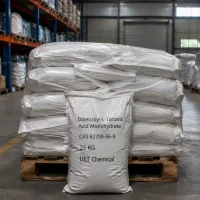
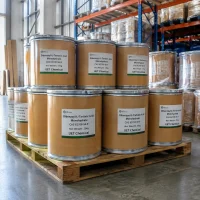
Dibenzoyl-L-Tartaric Acid Monohydrate CAS 62708-56-9
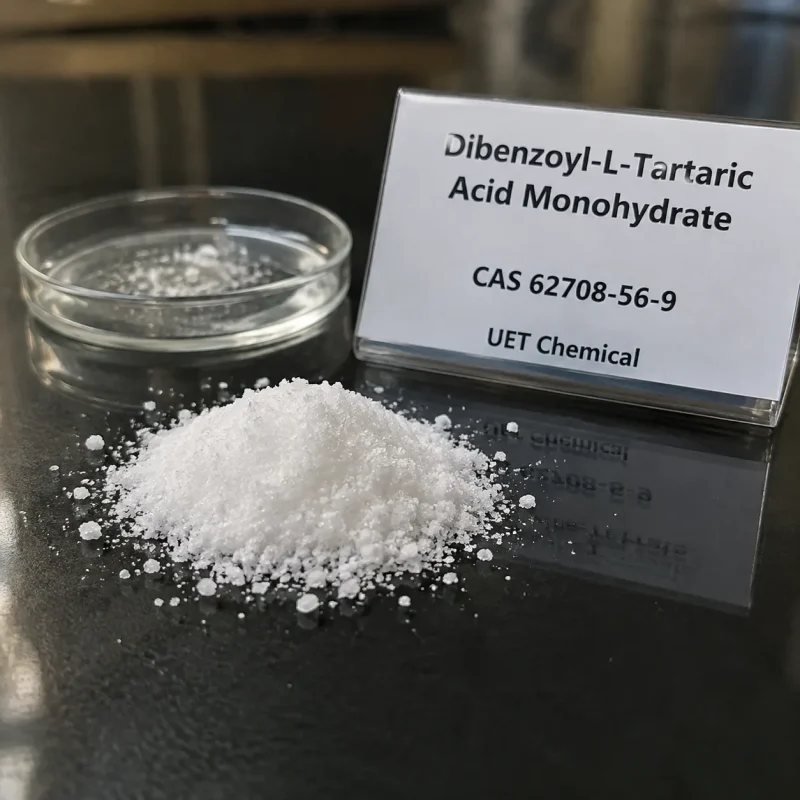
Dibenzoyl-L-Tartaric Acid Monohydrate is a high-efficiency chiral resolving agent for racemic amine resolution, API synthesis and chiral intermediate purification in pharmaceutical manufacturing. Its monohydrate crystal lattice delivers stable stoichiometry and consistent chiral separation efficiency, avoiding enantiomeric excess collapse and yield variation in large-scale production. UETChem supplies DBTA monohydrate with strict controls over optical rotation, moisture and heavy metals, ensuring predictable reaction performance and maximum target enantiomer purity. Each shipment includes COA, TDS, SDS.
- CAS No: 62708-56-9
- Synonyms: DBTA monohydrate; L-(-)-Dibenzoyl tartaric acid monohydrate
- EINECS: N/A
- Molecular Formula: C₁₈H₁₄O₈·H₂O
- Molecular Weight: 376.32 g/mol
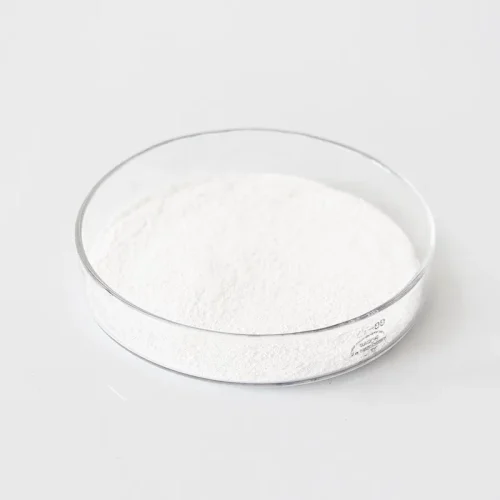
- Appearance: White to off-white crystalline powder
- Assay: 99.0% min
- Specific Rotation: -115° to -125° (c=1, Ethanol)
- Moisture: 4.5% – 5.5% (monohydrate specific)
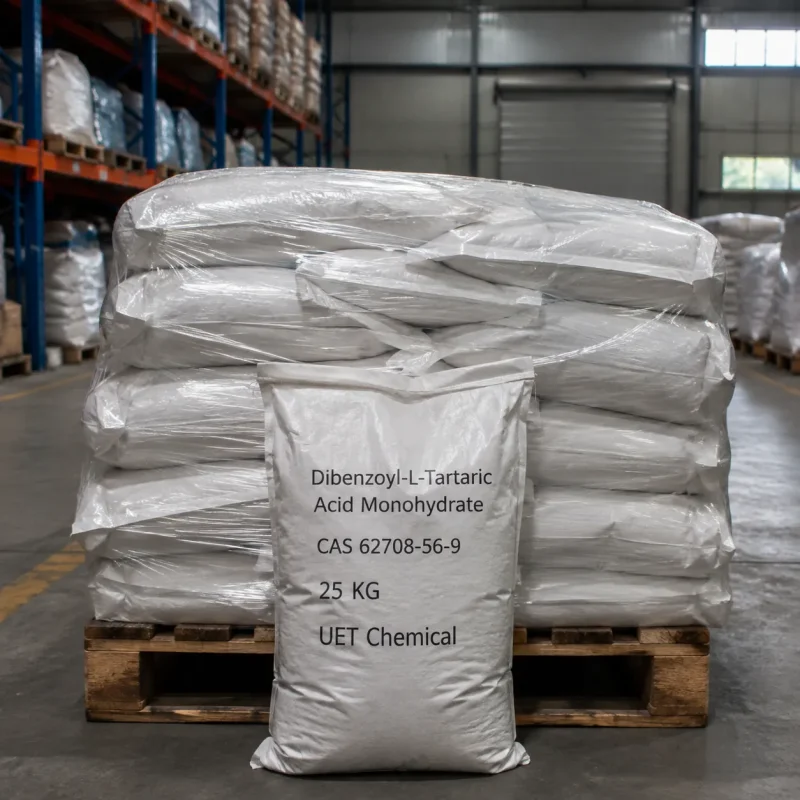
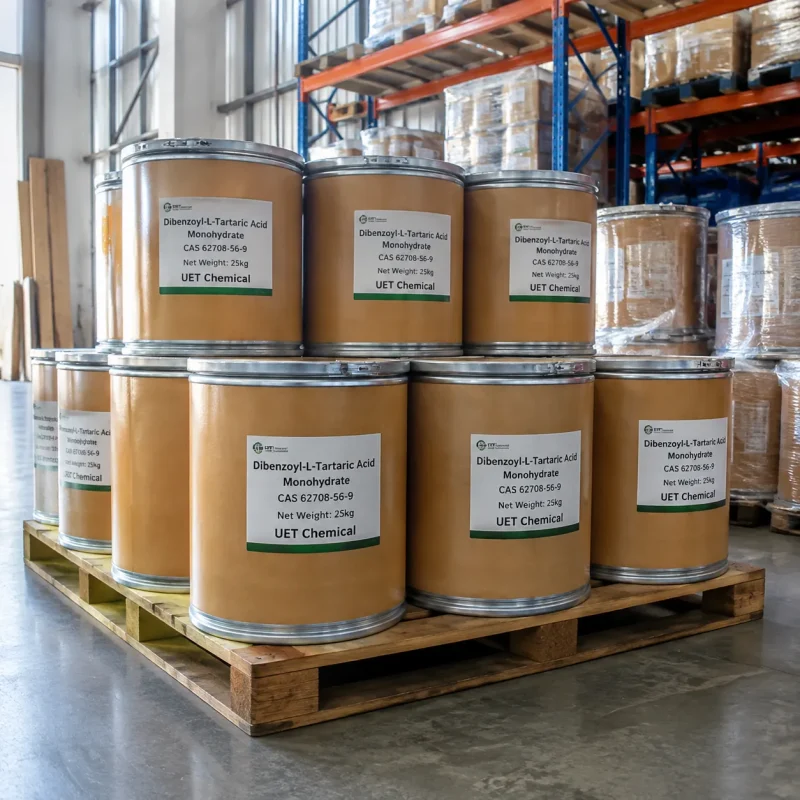
- Packaging: 25 kg fiber drum, 200 kg drum. Custom packaging available upon request.
- Main Applications: Chiral amine resolution, pharmaceutical API synthesis, asymmetric catalysis, optical purity analysis
Introduction to Dibenzoyl-L-Tartaric Acid Monohydrate
Dibenzoyl-L-Tartaric Acid Monohydrate is a specialized chiral organic acid built on a tartaric acid backbone esterified with two benzoyl groups, coordinated with one molecule of water of crystallization. The molecular architecture provides a rigid asymmetric chiral environment and two strongly acidic carboxyl groups. It appears as a white to off-white crystalline powder at room temperature, readily soluble in alcohols, ethyl acetate and polar organic solvents, and sparingly soluble in cold water.
The monohydrate crystal form locks in a fixed molar mass, delivering more reliable stoichiometry than the anhydrous grade. It is the standard resolving agent for industrial-scale chiral amine resolution, supporting consistent yield and enantiomeric excess across pharmaceutical production batches.
Dibenzoyl-L-Tartaric Acid Monohydrate Chemical & Physical Properties
| Property | Value |
|---|---|
| Molecular Formula | C₁₈H₁₄O₈·H₂O |
| Molecular Weight | 376.32 g/mol |
| Appearance | White to off-white crystalline powder |
| Melting Point | 88 – 92 °C |
| Specific Rotation | -115° to -125° (c=1, Ethanol) |
| Solubility | Soluble in alcohols / ethyl acetate; slightly soluble in water |
| Assay | 99.0% min |
| Moisture | 4.5% – 5.5% |
Applications of Dibenzoyl-L-Tartaric Acid Monohydrate
Pharmaceutical API resolution: Serves as the primary resolving agent for separating racemic mixtures of chiral amines and amino alcohols. It reacts with racemates to form diastereomeric salts with distinct solubilities; selective crystallization isolates the target enantiomer, which is then liberated via alkaline treatment. This pathway is essential for manufacturing APIs like clopidogrel, amlodipine and various beta-blockers.
Asymmetric synthesis and catalysis: Functions as a chiral ligand precursor or chiral auxiliary in complex organic transformations. Its rigid stereochemistry directs incoming reagents to attack from a specific facial approach, controlling the stereochemical outcome of newly formed chiral centers.
Analytical and optical purity testing: Utilized in chromatographic and spectroscopic analyses to determine enantiomeric excess (ee) of synthesized chiral compounds. The distinct NMR and HPLC profiles of the resulting diastereomers enable precise quantification of optical purity.
Storage & Safety Precautions for Dibenzoyl-L-Tartaric Acid Monohydrate
- Store in tightly sealed, moisture-proof fiber drums or foil-lined bags in a cool, dry warehouse below 25 °C. Exposure to high humidity alters hydration equilibrium, while excessive heat causes partial dehydration and structural degradation.
- Wear N95 respirators, safety goggles and nitrile gloves during dry blending and reactor charging. Fine crystalline dust causes mild irritation to the respiratory tract and eyes. Avoid prolonged dust exposure.
- When performing chiral resolution, dissolve the resolving agent completely in hot ethanol or ethyl acetate before adding the racemic amine. Slow cooling of the homogeneous solution promotes growth of large, pure diastereomeric crystals and minimizes occlusion of the unwanted enantiomer.
Dibenzoyl-L-Tartaric Acid Monohydrate FAQ
Q: How does Dibenzoyl-L-Tartaric Acid Monohydrate resolve racemic mixtures?
A: It reacts with racemic amines to form diastereomeric salts with different solubilities in specific solvents, enabling selective crystallization to isolate the desired enantiomer with high optical purity for API synthesis.
Q: Why is the monohydrate form preferred over anhydrous DBTA?
A: The monohydrate form offers superior stability and consistent stoichiometry. Its fixed water content ensures accurate molar calculations during chiral resolution, maximizing yield and enantiomeric excess of target pharmaceutical intermediates.
Q: What storage conditions are required for DBTA monohydrate?
A: Store in tightly sealed, moisture-proof containers in a cool, dry warehouse. High humidity or extreme heat alters hydration state and degrades optical purity, reducing resolving efficiency for pharmaceutical manufacturing.
Related products
Manufacturer & Exporter Since 2006
Get Tailored Chemical Raw Material Solutions — Reply Within 1 Hour
Factory-direct pricing, stable high-purity supply and complete compliance documentation for your industrial formulations.
- 1000+Products
- 200+QC Protocols
- 7–15Days Delivery
- Factory-Direct Pricing
- COA / TDS / SDS Included
- Free Samples for Testing
- 40+ Export Countries
Request a Free Quote
Our engineers reply within 1 hour during GMT+8 business hours.
Please include in your inquiry:
- Product name or CAS number
- Required quantity
- Destination country or port
- Preferred packaging