
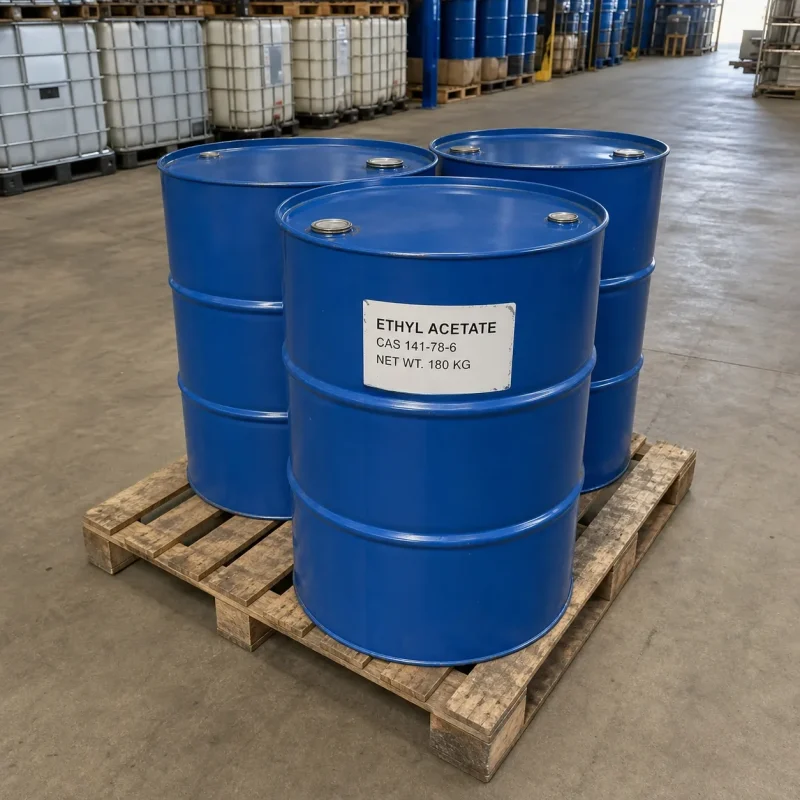
Ethyl Acetate CAS 141-78-6
Ethyl Acetate is a colorless, volatile ester solvent with an acetate group linked to an ethyl chain. It has a fruity odor. Main uses are resin dissolution in coatings and inks and liquid-liquid extraction in pharmaceuticals. Fast evaporation and strong solvency for nitrocellulose and acrylics make it a primary active solvent. We supply COA, TDS, and SDS.
- CAS No: 141-78-6
- Synonyms: EtOAc, ethyl ethanoate, acetic acid ethyl ester
- EINECS: 205-500-4
- Molecular Formula: C4H8O2
- Molecular Weight: 88.11
- Appearance: Colorless clear liquid
- Purity: ≥99.5% (GC)
- Moisture Content: ≤0.05% (typical premium grade)
- Packaging: 160 kg (352 lb) steel drum, 800 kg (1763 lb) IBC tote, ISO tank; Custom packaging available upon request.
- Main Applications: Coatings, inks, adhesives, pharmaceutical extraction, cleaners
Introduction to Ethyl Acetate
Ethyl Acetate is a clear, highly volatile ester solvent. A polar ester group attaches to a short ethyl chain in the molecule. It dissolves many synthetic resins and natural polymers. Formulators use it mostly for surface coatings, gravure inks, and liquid-liquid extraction of active pharmaceutical ingredients.
Compared to acetone, Ethyl Acetate evaporates slower (roughly 4 on a butyl acetate=1 scale vs. 6 for acetone) and smells better, giving coatings more leveling time. The main trap on the factory floor is water ingress. If a drum is left open or poorly sealed, the liquid absorbs ambient humidity and slowly hydrolyzes into acetic acid and ethanol. The acid value goes up, ruining moisture-sensitive systems like two-component polyurethanes. Test moisture (Karl Fischer) and acid value before using old stock.
Key Features of Ethyl Acetate
- Fast evaporation: Evaporates quickly at room temperature, giving adhesives fast tack-free times and allowing higher press speeds in gravure printing.
- Broad solvency: The polar ester group easily dissolves nitrocellulose, acrylics, vinyls, and epoxies, acting as the main active solvent.
- Low toxicity: Exempt from many Hazardous Air Pollutant (HAP) rules, making it a top choice to replace toluene or MEK in compliant formulas.
- Azeotropic behavior: Forms an azeotrope with water and ethanol. Distillation columns use the trait to reach high purity, but the product needs careful drying afterward.
Ethyl Acetate Chemical & Physical Properties
| Property | Value |
|---|---|
| Molecular Formula | C4H8O2 |
| Molecular Weight | 88.11 g/mol (88.11 lb/lbmol) |
| Boiling Point | 77.1 °C (170.8 °F) at 1 atm |
| Density | 0.902 g/cm³ (56.3 lb/ft³) at 20 °C (68 °F) |
| Flash Point | -4 °C (25 °F) closed cup |
| Evaporation Rate | ~4.0 (Butyl Acetate = 1.0) |
| Solubility in Water | 8.3 g/100 mL at 20 °C (68 °F) |
| Refractive Index (n20/D) | 1.372 |
| Acidity (as Acetic Acid) | ≤0.005% typical |
| Autoignition Temperature | 427 °C (800 °F) |
Applications of Ethyl Acetate
Coatings and paints: Dissolves acrylic and alkyd resins, controlling the initial evaporation phase. It leaves the film quickly to prevent sagging, leaving slower solvents to handle leveling. Typical usage is 15–30% of the total solvent blend in wood and industrial topcoats.
Gravure and flexographic inks: Dissolves polyurethane and nitrocellulose binders. Fast evaporation ensures quick drying on non-porous substrates like PET and BOPP films at high press speeds. Formulators usually put 40–60% EtOAc in the blend to hit target speeds without blocking on the rewind roll.
Pharmaceutical extraction: Slightly water-miscible and low in toxicity, so plants use it for liquid-liquid extraction of active ingredients. It pulls polar to semi-polar compounds out of aqueous reaction mixtures. As a Class 3 solvent under ICH Q3C guidelines, residual limits are generally acceptable up to 5000 ppm.
Adhesives and sealants: Lowers the viscosity of neoprene and acrylic contact adhesives. The solvent flashes off right after application, giving immediate grab and green strength. Solvent-based contact cements often contain 50–70% Ethyl Acetate.
Storage & Safety Precautions for Ethyl Acetate
- Storage conditions: Keep in closed, grounded steel drums or IBC totes. Store in a cool, well-ventilated warehouse away from direct sunlight. Keep temperature below 35 °C (95 °F).
- Moisture control: Hydrolyzes slowly into acetic acid and ethanol when exposed to water. Keep drums tightly sealed when not in use. Never leave partially empty drums open in a humid shop.
- Incompatible materials: Keep away from strong oxidizers, strong alkalis, and strong acids. Mixing them accelerates hydrolysis or causes violent reactions.
- Flammability: Highly flammable liquid and vapor (Flash point -4 °C / 25 °F). Use explosion-proof equipment. Bond and ground containers during transfer to prevent static sparks.
- PPE & Spill: Wear splash goggles, nitrile gloves, and an organic vapor respirator in poorly ventilated areas. Contain spills with inert absorbents like sand or earth; never use combustible sawdust.
- Transport: UN 1173, Class 3 Flammable Liquid, Packing Group II.
Ethyl Acetate FAQ
Q: How does moisture in CAS 141-78-6 Ethyl Acetate affect two-component polyurethane coatings?
A: Water reacts with isocyanate in 2K PU, causing CO2 pinholes and tackiness. Keep moisture <0.05% (ASTM E1064). Downgrade wet drums.
Q: Why does Ethyl Acetate smell sour after sitting in an open drum for six months?
A: Sourness is acetic acid from moisture hydrolysis, which poisons catalysts. Reseal drums tightly. Reject sour batches (ASTM D1613) for sensitive uses.
Q: How should I blend Ethyl Acetate with Butyl Acetate for gravure printing inks?
A: EtOAc dries 3x faster. Use 40-60% to prevent blocking, plus 20-30% Butyl Acetate to solvate resin. Reduce EtOAc if high humidity causes film blushing.
Related products
Manufacturer & Exporter Since 2006
Get Tailored Chemical Raw Material Solutions — Reply Within 1 Hour
Factory-direct pricing, stable high-purity supply and complete compliance documentation for your industrial formulations.
- 1000+Products
- 200+QC Protocols
- 7–15Days Delivery
- Factory-Direct Pricing
- COA / TDS / SDS Included
- Free Samples for Testing
- 40+ Export Countries
Request a Free Quote
Our engineers reply within 1 hour during GMT+8 business hours.
Please include in your inquiry:
- Product name or CAS number
- Required quantity
- Destination country or port
- Preferred packaging