
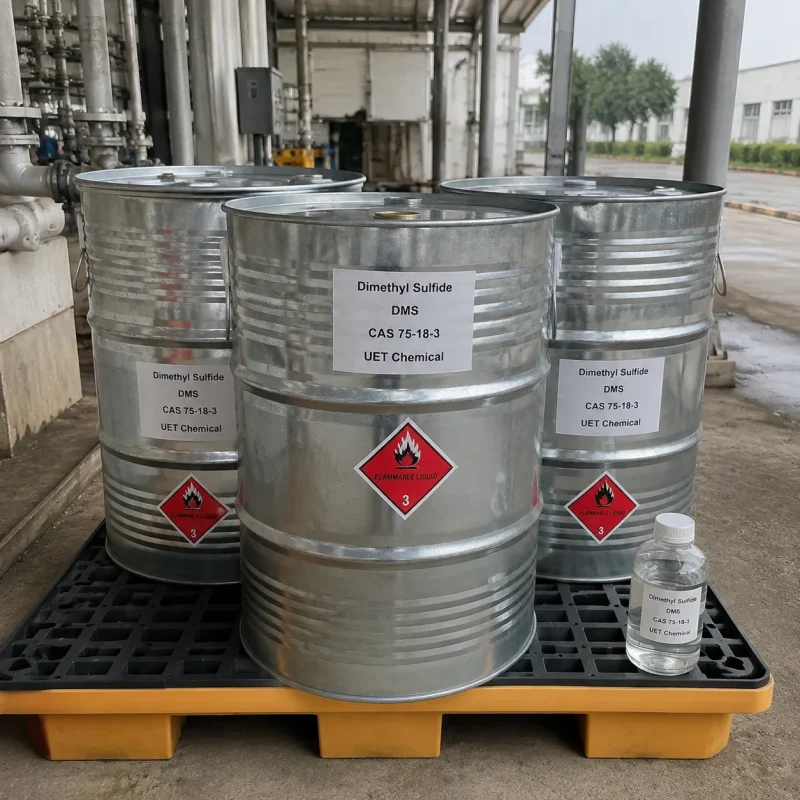
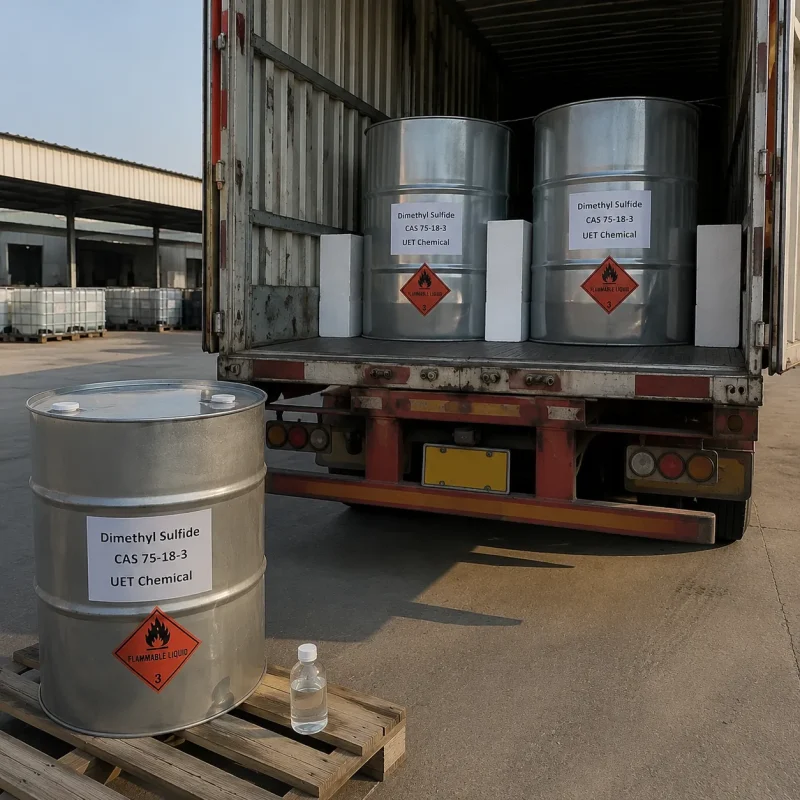
Dimethyl Sulfide (DMS) CAS 75-18-3
Dimethyl Sulfide (DMS) is a highly volatile organosulfur compound that addresses trace gas leak detection, specific sulfur-based synthesis bottlenecks and flavor formulation challenges. It is widely utilized as a natural gas odorant, pharmaceutical intermediate and ozonolysis workup reagent across petrochemical and pharmaceutical industries. UETChem supplies high-purity DMS with strict controls over moisture, purity and trace impurities, ensuring consistent olfactory thresholds and high reaction yields. Each shipment includes COA, TDS, SDS.
- CAS No: 75-18-3
- Synonyms: DMS; Methyl sulfide; Thioether
- EINECS: 200-843-6
- Molecular Formula: C₂H₆S
- Molecular Weight: 62.13 g/mol
- Appearance: Colorless transparent liquid
- Purity (GC): 99.0% min
- Moisture: 0.05% max
- Flash Point (Closed Cup): -36 °C
- Packaging: 150 kg steel drum, ISO tank. Custom packaging available upon request.
- Main Applications: Gas odorants, pharmaceutical intermediates, agrochemical synthesis, ozonolysis reduction, food flavorings
Introduction to Dimethyl Sulfide
Dimethyl Sulfide is an aliphatic organosulfur compound consisting of a central sulfur atom bonded to two methyl groups. Its molecular architecture provides a highly polarizable sulfur center and exceptional volatility. At room temperature, the material appears as a colorless, highly flammable liquid with an intensely pungent, characteristic cabbage-like odor detectable at parts-per-billion concentrations. It remains insoluble in water but mixes completely with alcohols, ethers and most organic solvents.
The lone electron pairs on the sulfur atom deliver strong nucleophilicity and reducing capability, facilitating methylation, oxidation and reductive cleavage reactions. Its extreme volatility generates high vapor pressure, allowing rapid dispersion into gas pipelines and efficient removal from reaction mixtures via distillation.
Dimethyl Sulfide Chemical & Physical Properties
| Property | Value |
|---|---|
| Molecular Formula | C₂H₆S |
| Molecular Weight | 62.13 g/mol |
| Appearance | Colorless transparent liquid |
| Boiling Point | 37 °C |
| Density (20 °C) | 0.85 g/cm³ |
| Flash Point (Closed Cup) | -36 °C |
| Solubility | Insoluble in water; miscible with most organic solvents |
| Purity (GC) | 99.0% min |
Applications of Dimethyl Sulfide
Natural gas and LPG odorization: Injected at trace concentrations into odorless fuel gas distribution networks. Its intense olfactory signature provides an immediate, reliable warning mechanism for micro-leaks in residential and industrial pipeline infrastructure, supporting public gas safety.
Pharmaceutical and agrochemical synthesis: Functions as a vital sulfur donor and methylating agent. It is used to manufacture methionine, an essential amino acid for animal feed, and to synthesize sulfoxides, sulfones and specialized crop protection molecules.
Ozonolysis and organic reduction: Added during the workup phase of alkene ozonolysis. The reagent cleaves the intermediate ozonide ring, selectively yielding aldehydes and ketones while preventing over-oxidation to carboxylic acids.
Storage & Safety Precautions for DMS
- Store in tightly sealed, grounded stainless steel drums or pressure-rated ISO tanks in an explosion-proof, well-ventilated warehouse. Its extremely low flash point requires strict elimination of all ignition sources and static discharge control.
- The human nose detects the vapor at 0.002 ppm; micro-leaks cause severe environmental malodor complaints. Equip all transfer manifolds with closed-loop vapor recovery systems and continuous gas monitors.
- Wear a supplied-air respirator, heavy-duty chemical suit and butyl rubber gloves during drum decanting. Vapor causes severe respiratory tract irritation and central nervous system depression. Maintain storage temperature below 20 °C to limit vapor pressure buildup.
DMS FAQ
Q: How does Dimethyl Sulfide function in chemical synthesis?
A: It acts as a powerful reducing agent in ozonolysis reactions, cleaving ozonides to yield aldehydes and ketones without over-oxidizing them to carboxylic acids. It also serves as a crucial sulfur donor for synthesizing methionine and sulfoxides.
Q: Why is Dimethyl Sulfide used as a gas odorant?
A: It possesses an intensely pungent odor detectable at parts-per-billion concentrations. Utility companies inject trace amounts into odorless natural gas and LPG pipelines to provide a reliable, early warning leak detection mechanism for public safety.
Q: What safety measures are required when handling DMS?
A: It is extremely flammable and emits a severe, nauseating odor even at micro-leaks. Operators must handle it in closed, grounded systems with continuous gas monitoring. Full-face respirators and chemical suits are mandatory to prevent inhalation and skin contact.
Related products
Manufacturer & Exporter Since 2006
Get Tailored Chemical Raw Material Solutions — Reply Within 1 Hour
Factory-direct pricing, stable high-purity supply and complete compliance documentation for your industrial formulations.
- 1000+Products
- 200+QC Protocols
- 7–15Days Delivery
- Factory-Direct Pricing
- COA / TDS / SDS Included
- Free Samples for Testing
- 40+ Export Countries
Request a Free Quote
Our engineers reply within 1 hour during GMT+8 business hours.
Please include in your inquiry:
- Product name or CAS number
- Required quantity
- Destination country or port
- Preferred packaging