
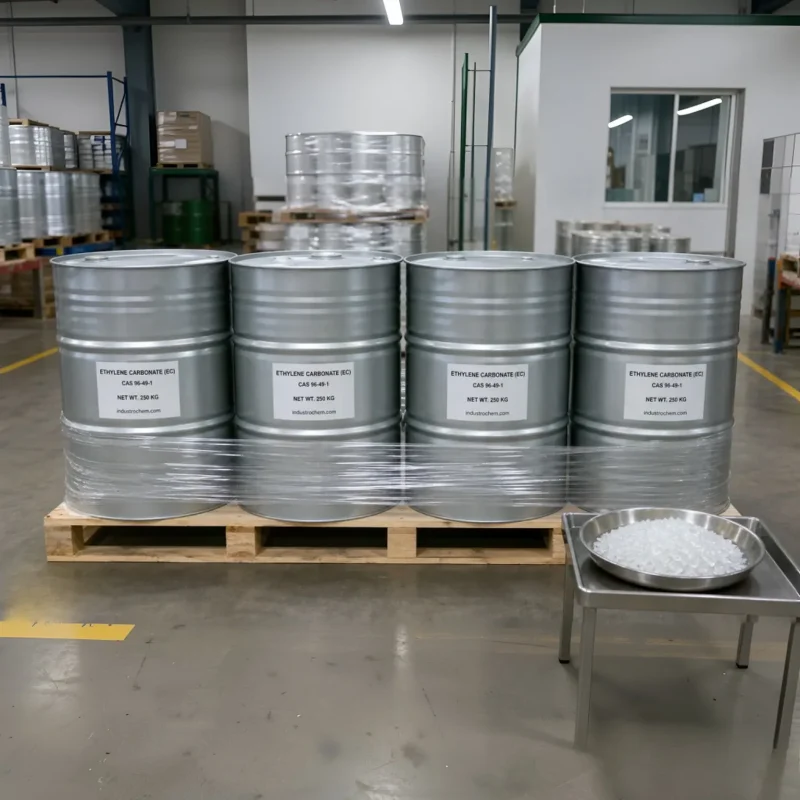
Ethylene Carbonate (EC) CAS 96-49-1
Ethylene Carbonate (EC) is a five-membered cyclic carbonate supplied as colorless crystals or heated liquid. It works as a high-permittivity solvent and SEI film-forming agent in lithium-ion battery electrolytes and specialty polymer synthesis. The 1,3-dioxolan-2-one ring structure provides a dielectric constant near 90, enabling complete lithium salt dissociation. Each lot ships with COA, TDS, and SDS.
- CAS No: 96-49-1
- Synonyms: EC, 1,3-Dioxolan-2-one, Cyclic ethylene carbonate
- EINECS: 202-506-9
- Molecular Formula: C3H4O3
- Molecular Weight: 88.06 g/mol
- Appearance: Colorless transparent crystals or liquid (depends on ambient temperature)
- Purity: 99.95% min (Battery Grade) by GC
- Melting Point: 34-37 °C (93-99 °F)
- Moisture Content: 10 ppm max (Karl Fischer, ASTM E1064)
- Packaging: 200 kg HDPE drum or IBC tote with heating jacket. Custom packaging available upon request.
- Main Applications: Lithium-ion battery electrolytes, polycarbonate synthesis, high-boiling polar solvents
Introduction to Ethylene Carbonate
Ethylene Carbonate is a colorless cyclic carbonate ester with a rigid five-membered 1,3-dioxolan-2-one ring. The high dipole moment makes it a primary dissociating solvent for lithium salts and a critical solid electrolyte interphase (SEI) builder. Formulators use it heavily in lithium-ion battery electrolyte formulations and polycarbonate polymerization. It is supplied as technical or battery-grade material for electrolyte blending and reactor feed.
The main advantage is a high dielectric constant of 89.8 at 40 °C (104 °F), giving strong lithium salt dissociation for high ionic conductivity. The biggest operational trap is the 34-37 °C (93-99 °F) melting point. At standard room temperature, EC solidifies and blocks unheated transfer lines or freezes inside IBC valves when warehouse heating fails during winter transit.
Key Features of Ethylene Carbonate
- High dielectric permittivity: The polar cyclic structure yields a dielectric constant near 90, ensuring complete LiPF6 dissociation into free ions for high ionic conductivity.
- Reductive SEI formation: EC undergoes controlled one-electron reduction on graphite anodes. It polymerizes into a stable, Li2CO3-rich solid electrolyte interphase to prevent continuous solvent co-intercalation.
- Solid-liquid phase transition: EC melts sharply between 34-37 °C (93-99 °F) and requires heated storage with insulated piping. This sharp melt acts as a built-in purity indicator because impurities depress the melting point.
- Low volatility profile: A boiling point of 248 °C (478 °F) and flash point of 150 °C (302 °F) give good thermal stability inside high-voltage battery cells.
- Hydrolytic sensitivity: The cyclic ester bond cleaves with water and trace acids, generating CO2 gas and ethylene glycol. This demands strict moisture control below 20 ppm.
Ethylene Carbonate Chemical & Physical Properties
| Property | Value |
|---|---|
| Molecular Formula | C3H4O3 |
| Molecular Weight | 88.06 g/mol |
| Appearance | Colorless crystals or clear liquid |
| Melting Point | 34-37 °C (93-99 °F) |
| Boiling Point | 248 °C (478 °F) at 101.3 kPa |
| Density | 1.32 g/cm³ (11.0 lb/gal) at 40 °C |
| Flash Point | 150 °C (302 °F), closed cup |
| Dielectric Constant | 89.8 at 40 °C (104 °F) |
| Solubility in Water | Miscible (undergoes slow hydrolysis) |
| Viscosity | 1.9 cP at 40 °C (104 °F) |
Applications of Ethylene Carbonate
Lithium-ion battery electrolytes: EC dissolves LiPF6 and reduces on graphite anodes to form a protective SEI layer. Battery-grade formulations typically use 20-40% EC by weight and blend with linear co-solvents to balance viscosity and low-temperature performance.
Polycarbonate and polymer synthesis: EC works as a green carbonylation agent. It reacts with bisphenol-A or diamines via transesterification to build polycarbonate chains without toxic phosgene. Reaction temperatures usually run between 180-250 °C (356-482 °F) with metal catalysts.
High-boiling polar solvent: High polarity and a 248 °C (478 °F) boiling point make EC an excellent reaction medium for specialized organic syntheses and gas scrubbing. Solvents must remain liquid and stable under severe thermal conditions in these processes.
Storage & Safety Precautions for Ethylene Carbonate
Keep storage temperatures strictly between 40-50 °C (104-122 °F) using heated drums or jacketed IBC totes to maintain EC in liquid form. Material cooling below 34 °C (93 °F) causes crystallization and can crack standard plastic valves upon expansion. Keep containers tightly sealed under dry nitrogen blanketing. Trace moisture ingress hydrolyzes the cyclic ester into ethylene glycol and CO2 gas, building internal pressure and ruining battery-grade specs.
Handle with standard chemical goggles and nitrile gloves. Molten EC causes mild thermal or contact irritation. Sweep solid spills and wipe liquid leaks. Never flush into drains. Ship as Non-DG cargo, but mandate heating containers or thermal blankets for winter ocean freight to prevent irreversible valve freezing and drum deformation.
Ethylene Carbonate FAQ
Q: Why does Ethylene Carbonate freeze in IBC valves during winter transit?
A: EC freezes at 34-37 °C (93-99 °F) and expands, cracking IBC valves. Use winter thermal blankets. Melt frozen drums slowly at 50 °C (122 °F); avoid local heat guns.
Q: How does moisture affect battery-grade Ethylene Carbonate CAS 96-49-1?
A: Water hydrolyzes EC into ethylene glycol and CO2, raising acidity and swelling cells. Keep battery-grade EC below 10-20 ppm water (ASTM E1064), nitrogen sealed; reject high-moisture lots.
Q: What QC parameters define premium battery-grade Ethylene Carbonate?
A: Require GC purity ≥99.95%, moisture <10 ppm, acidity <1 ppm. Verify sharp 34-37 °C (93-99 °F) melting, metals <50 ppb by ICP-MS, and retain heated nitrogen samples.
Related products
Manufacturer & Exporter Since 2006
Get Tailored Chemical Raw Material Solutions — Reply Within 1 Hour
Factory-direct pricing, stable high-purity supply and complete compliance documentation for your industrial formulations.
- 1000+Products
- 200+QC Protocols
- 7–15Days Delivery
- Factory-Direct Pricing
- COA / TDS / SDS Included
- Free Samples for Testing
- 40+ Export Countries
Request a Free Quote
Our engineers reply within 1 hour during GMT+8 business hours.
Please include in your inquiry:
- Product name or CAS number
- Required quantity
- Destination country or port
- Preferred packaging