
N,N-Diethylformamide (DEFA) CAS 617-84-5
N,N-Diethylformamide (DEFA) is a non-protic polar amide solvent—two ethyl groups flank a formyl nitrogen, leaving no N–H bond. Colorless to pale-yellow liquid, ≥99.0% GC purity. Boils at 177 °C, 24 °C higher than DMF, and carries no CMR classification (DMF is EU Repr. 1B). Serves as high-temperature reaction solvent and PU/PAN processing aid. COA, TDS, SDS ship with every drum.
- CAS No.: 617-84-5
- Synonyms: N,N-Diethylformamide; Diethylformamide; DEFA; DEF
- EINECS: 210-539-5
- Molecular Formula: C₅H₁₁NO
- Molecular Weight: 101.15 g/mol
- Appearance: Colorless to pale yellow transparent liquid
- Purity (GC): ≥99.0%
- Boiling Point: 176–178 °C
- Flash Point: 58 °C (closed cup)
- Density (25 °C): 0.908–0.912 g/cm³
- Water Content (KF): ≤0.1%
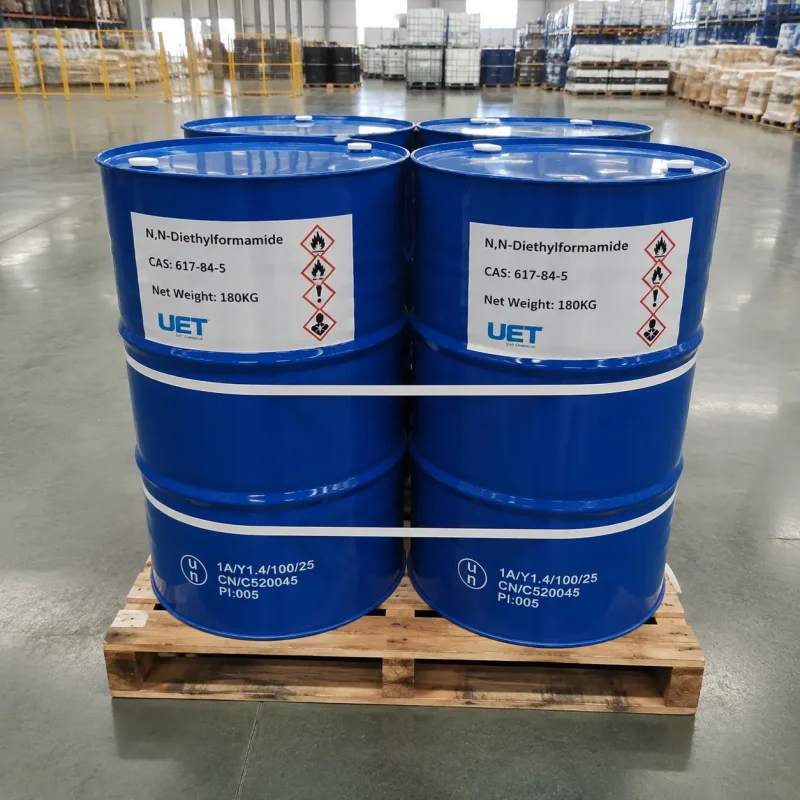
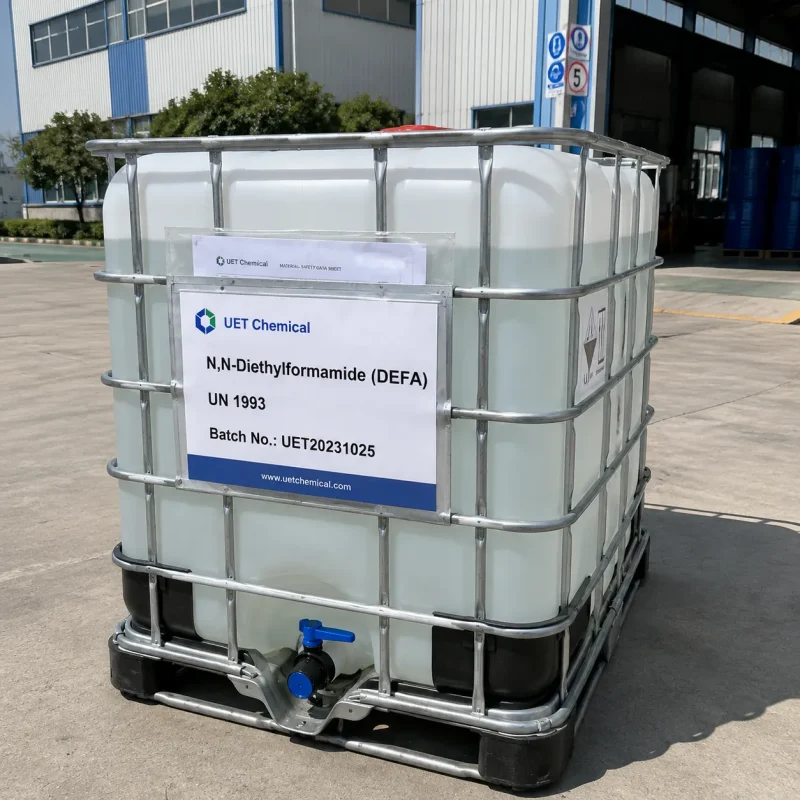
- Packaging: 180 kg steel drum / 900 kg IBC tote. Custom packaging available upon request.
- Main Applications: PU/PAN processing solvent; Vilsmeier formylation; high-temp reaction medium; extraction solvent
Introduction to DEFA
N,N-Diethylformamide is a colorless to pale-yellow liquid belonging to the tertiary amide solvent family. Two ethyl groups on nitrogen eliminate any N–H bond, making DEFA strictly aprotic—no hydrogen-bond donation, no interference with anionic or organometallic intermediates. Boiling point sits at 177 °C, density at 0.91 g/cm³, and the solvent is fully miscible with water, alcohols, ketones, and aromatic hydrocarbons. DEFA serves as a high-boiling reaction medium in fine-chemical synthesis and as a processing solvent for polyurethane and polyacrylonitrile.
Against DMF (bp 153 °C), DEFA runs 24 °C higher in boiling point and roughly one-quarter the vapour pressure at 25 °C (~1 mmHg vs 3.7 mmHg)—less evaporative loss in open-vessel operations. DMF carries EU CMR Repr. 1B; DEFA holds no such classification. One practical caution: DEFA hydrolyses in strong acid (pH <2, >60 °C) to formic acid and diethylamine; keep stored product neutral and dry. Avoid copper-alloy valves—trace amide decomposition products corrode brass over months.
Key Features of DEFA
- Aprotic, no N–H bond. Both substituents on nitrogen are ethyl groups. DEFA cannot donate hydrogen bonds, so it will not quench carbanions, interfere with Grignard-type additions, or shift equilibria in base-catalysed condensations.
- 24 °C thermal headroom over DMF. Boiling point 177 °C vs 153 °C for DMF. Reactions that need 140–170 °C can run at reflux in DEFA without pressurisation—a direct safety gain over sealed-vessel DMF runs.
- Low vapour pressure, low inhalation exposure. ~1 mmHg at 25 °C versus 3.7 mmHg for DMF. Drum-filling and open-batch operations generate roughly 70% less airborne solvent, easing workplace exposure limits.
- No CMR classification. DMF is listed under EU CLP as Repr. 1B (H360D). DEFA is not classified as carcinogenic, mutagenic, or reprotoxic—simplifying REACH registration and downstream regulatory filings for EU-bound products.
- Hydrolytic stability above DMF in neutral media. Ethyl groups create greater steric shielding around the carbonyl than methyl groups. In neutral aqueous media at 40 °C, DEFA hydrolysis rate is roughly half that of DMF over equivalent time frames.
DEFA Chemical & Physical Properties
| Property | Value |
|---|---|
| Molecular Formula | C₅H₁₁NO |
| Molecular Weight | 101.15 g/mol |
| Boiling Point | 176–178 °C |
| Density (25 °C) | 0.908–0.912 g/cm³ (ASTM D1475) |
| Flash Point | 58 °C (closed cup, ASTM D93) |
| Solubility | Miscible with water, ethanol, acetone, toluene; insoluble in hexane |
| Vapour Pressure (25 °C) | ≈1 mmHg |
| Refractive Index (20 °C) | 1.4350–1.4370 |
| Water Content | ≤0.1% (ASTM E203, Karl Fischer) |
| Color | ≤30 APHA (ASTM D1209) |
Applications of DEFA
Polyurethane synthesis and dry-process coating: DEFA dissolves PU prepolymers at 20–35% solids. Boiling point 177 °C allows oven-drying at 120–140 °C without solvent bumping—a common defect when DMF flashes too fast at high line speeds. Typical usage: 100% of the solvent phase in wet/dry PU lamination, replacing DMF at a 1:1 volume ratio with 5–10 °C higher oven setpoint.
Polyacrylonitrile (PAN) fibre spinning: DEFA dissolves PAN at 15–25% polymer concentration for wet or dry spinning. Aprotic character prevents chain-transfer side reactions at the nitrile group. Spinning dope temperature: 60–80 °C. Coagulation bath: water or water/DEFA mixture at 30–40% solvent concentration.
Vilsmeier-Haack formylation: DEFA serves as both solvent and formyl source when combined with POCl₃. Two ethyl groups generate the Vilsmeier iminium salt in situ; aromatic substrates undergo electrophilic formylation at 60–100 °C. Typical DEFA:POCl₃ molar ratio: 1.2–1.5 : 1.
Aromatic extraction and azeotropic separation: DEFA selectively dissolves aromatics over C6–C8 paraffins. In extractive distillation, DEFA raises relative volatility of benzene/cyclohexane from ~1.0 to 2.5–3.0. Solvent-to-feed ratio: 3–6 : 1 by weight.
Pharmaceutical and agrochemical intermediate synthesis: DEFA acts as a high-boiling, non-nucleophilic reaction medium for acylations, alkylations, and cyclisations at 130–170 °C. No N–H proton means no competing N-alkylation of the solvent itself. Typical charge: 20–40% v/v of total reaction mass.
Storage & Safety Precautions for DEFA
Storage conditions. Store in sealed steel or stainless-steel drums at 10–30 °C, under nitrogen blanket if possible. DEFA is mildly hygroscopic—water uptake above 0.3% shifts boiling point and impairs moisture-sensitive reactions. Keep away from strong oxidisers and strong mineral acids; at pH <2 and >60 °C, DEFA hydrolyses to formic acid and diethylamine (fishy odour, pH drift upward). Do NOT use copper, brass, or bronze valves—amide decomposition traces corrode copper alloys over 3–6 months, producing green-blue deposits.
Safety and PPE. GHS: Acute Tox. 4 (oral, H302); combustible liquid (flash point 58 °C). Not classified as CMR. Wear nitrile or butyl rubber gloves, safety goggles, work in ventilated area. Vapour threshold is low (~1 ppm odour detection); use local exhaust for drum-filling exceeding 15 min. Spill: contain with sand or inert absorbent, transfer to labelled waste drum, ventilate area. Do not flush to drain.
Transport classification. Class 3, Packing Group III (flash point 58 °C). Verify UN assignment with carrier—typically UN 1993 (Flammable liquid, n.o.s.). Steel drum or IBC; no plastic drums for ocean freight due to static accumulation risk.
Practitioner note: When switching a PU line from DMF to DEFA, raise oven setpoint by 5–10 °C and extend dwell time by 10–15%. DEFA evaporation rate is roughly 40% slower at equivalent temperature (vapour pressure 1 mmHg vs 3.7 mmHg). Skipping this adjustment leaves residual solvent in the film, causing tack and adhesion failure downstream. Verify residual solvent by GC-headspace (target <500 ppm) before slitting.
DEFA FAQ
Q: Can DEFA replace DMF 1:1 in a PU wet-process line?
A: 1:1 volume swap works for solubility. DEFA boils 24 °C higher, evaporates ~40% slower. Raise oven temp 5–10 °C, extend dwell 10–15%. Confirm residual solvent <500 ppm by GC-headspace before winding—skipping causes surface tack.
Q: How do I detect early hydrolysis in a stored drum of DEFA (CAS 617-84-5)?
A: Diethylamine from hydrolysis raises pH. Drum reads >9 vs COA 7–8 means hydrolysis started. Karl Fischer water >0.3% confirms ingress. Fastest field check: faint fishy odour at the bung. Never store near HCl or H₂SO₄.
Q: Why choose DEFA over NMP or DMAc for high-temperature reactions?
A: DEFA bp 177 °C sits between DMAc (165 °C) and NMP (202 °C). NMP and DMAc both carry EU Repr. 1B; DEFA does not. If reaction tolerates ≤177 °C, DEFA gives the regulatory edge with easier solvent stripping than NMP.
Q: Does DEFA damage stainless-steel reactors or seals?
A: SS304/316 safe. Avoid copper, brass, bronze—copper carboxylate deposits form over months. Seals: PTFE or EPDM. Avoid natural rubber and Buna-N (8–12% swell at 60 °C). FKM is fine if switching from DMF.
Related products
Manufacturer & Exporter Since 2006
Get Tailored Chemical Raw Material Solutions — Reply Within 1 Hour
Factory-direct pricing, stable high-purity supply and complete compliance documentation for your industrial formulations.
- 1000+Products
- 200+QC Protocols
- 7–15Days Delivery
- Factory-Direct Pricing
- COA / TDS / SDS Included
- Free Samples for Testing
- 40+ Export Countries
Request a Free Quote
Our engineers reply within 1 hour during GMT+8 business hours.
Please include in your inquiry:
- Product name or CAS number
- Required quantity
- Destination country or port
- Preferred packaging