
N,N-Dimethylformamide (DMF) CAS 68-12-2
N,N-Dimethylformamide (DMF) is a polar aprotic solvent that solves polymer dissolution, slow reaction kinetics, and fiber spinning challenges in chemical manufacturing. Polyurethane and pharmaceutical manufacturers rely on it for synthetic leather production, acrylic fiber spinning, and API synthesis. UETChem supplies this product with strict control over moisture, dimethylamine content, and color, ensuring high reaction yields and stable spinning dope viscosity. Each shipment includes COA, TDS, SDS.
- CAS No: 68-12-2
- Synonyms: DMF; Dimethyl formamide; N,N-Formamide
- EINECS: 200-679-5
- Molecular Formula: C3H7NO
- Molecular Weight: 73.09 g/mol (73.09 lb/lbmol)
- Appearance: Colorless transparent liquid
- Purity: 99.9% min (GC)
- Moisture: 50 ppm max
- Dimethylamine: 10 ppm max
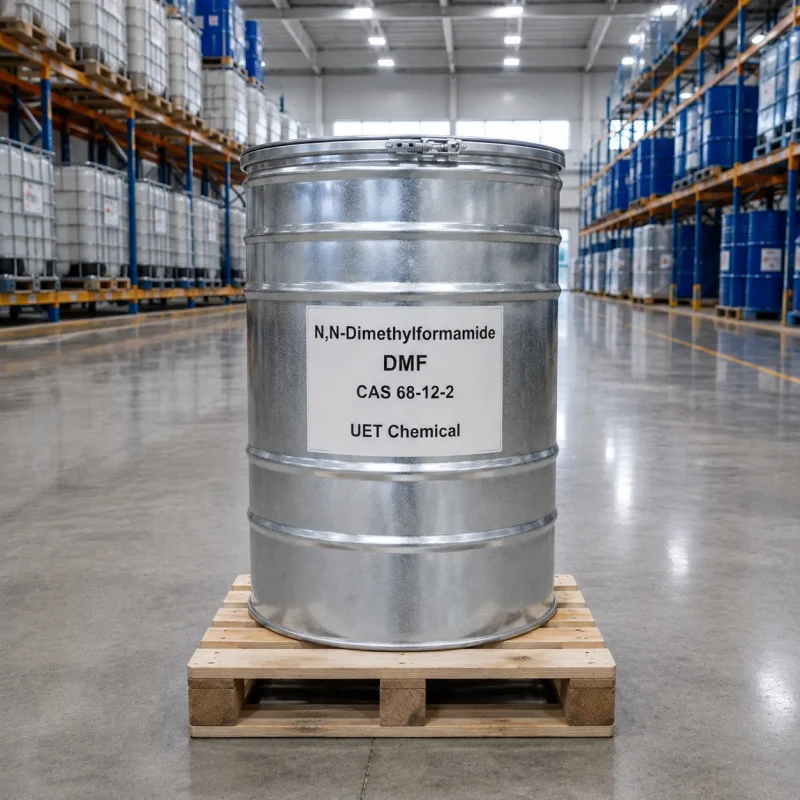
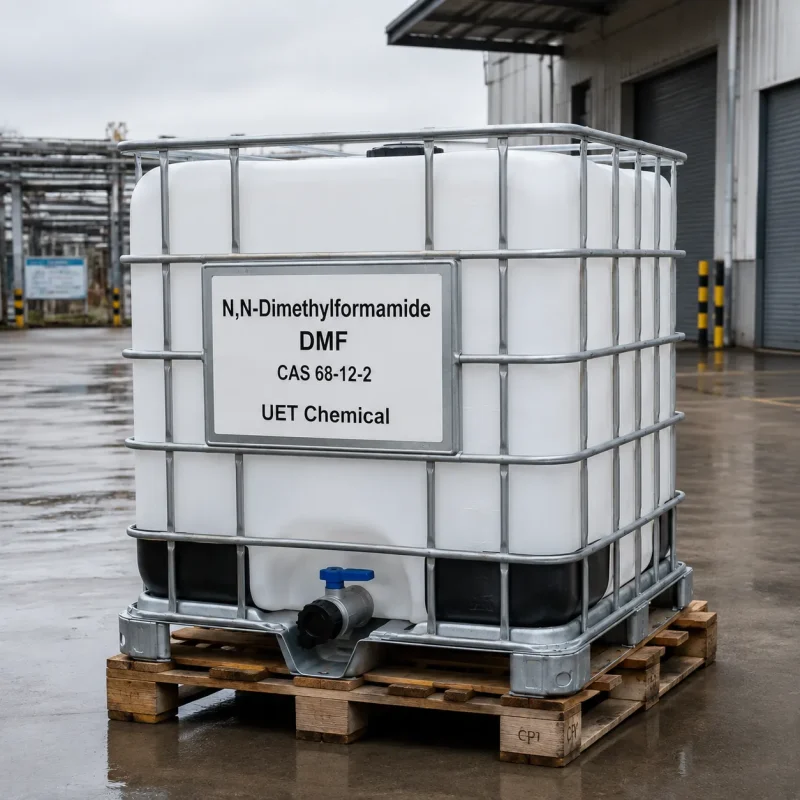
- Packaging: 190 kg (419 lb) HDPE drum, ISO Tank. Custom packaging available upon request.
- Main Applications: Polyurethane synthetic leather, acrylic fiber spinning, pharmaceutical synthesis, electronic chemicals
Introduction to N,N-Dimethylformamide
N,N-Dimethylformamide is a polar aprotic organic solvent featuring a formamide backbone with two methyl groups attached to the nitrogen atom. The molecular structure creates a highly polar environment without providing hydrogen bond donors. This unique architecture allows the liquid to dissolve a vast array of polar and non-polar compounds, including high-molecular-weight polymers and inorganic salts.
The compound exists as a colorless, hygroscopic liquid with a faint, fishy amine odor at room temperature. It mixes completely with water, alcohols, and most organic solvents. Industrial facilities consume this intermediate to engineer advanced polymer matrices, formulate spinning dopes, and accelerate nucleophilic substitution reactions in fine chemical synthesis.
Key Features of DMF
- Polar aprotic nature: Stabilizes cations while leaving anions highly reactive, accelerating condensation and alkylation reactions.
- High dielectric constant: Disrupts strong intermolecular forces within polymer chains, enabling the dissolution of polyurethanes and polyacrylonitriles.
- Thermal stability: Maintains structural integrity at elevated boiling points, facilitating high-temperature chemical syntheses and continuous solvent recovery.
DMF Chemical & Physical Properties
| Property | Value |
|---|---|
| Molecular Formula | C3H7NO |
| Molecular Weight | 73.09 g/mol (73.09 lb/lbmol) |
| Appearance | Colorless transparent liquid |
| Boiling Point | 153 °C (307 °F) |
| Melting Point | -61 °C (-78 °F) |
| Density | 0.94 g/cm³ (7.84 lb/gal) at 20 °C |
| Flash Point | 58 °C (136 °F) closed cup |
Applications of DMF
Polyurethane synthetic leather: Dosed as the primary solvent to dissolve resins for wet and dry process coating lines. The solvent controls the coagulation rate during the water bath phase, dictating the microcellular structure of the final leather grain. Formulators often blend it with specialized resins like Polyurethane to achieve specific softness and tensile strength in the finished textile.
Pharmaceutical and agrochemical synthesis: Acts as a reaction medium for synthesizing active pharmaceutical ingredients (APIs) and crop protection chemicals. The polar environment accelerates complex coupling reactions. Chemists frequently use it to dissolve intermediates before reacting them with functional monomers like Glycidyl Methacrylate (GMA).
Acrylic fiber spinning: Dissolves polyacrylonitrile (PAN) to form a viscous spinning dope. The solution is extruded through spinnerets into a coagulation bath, where the solvent diffuses out, leaving behind continuous synthetic fibers for the textile industry.
Storage & Safety Precautions for DMF
- Moisture and amine control: Store in tightly sealed stainless steel or HDPE drums under a nitrogen blanket. DMF slowly hydrolyzes in the presence of water to form dimethylamine and formic acid, which alters the pH and degrades sensitive catalysts.
- Handling and PPE: The liquid is readily absorbed through the skin and acts as a hepatotoxin. Wear butyl rubber gloves, chemical splash goggles, and organic vapor respirators during drum decanting.
- Field note: When recovering spent DMF via distillation, monitor the bottom temperature closely. Thermal degradation above 180 °C generates dimethylamine gas, which causes severe corrosion in carbon steel reboiler tubes. Formulators often blend recovered solvent streams with fresh batches of Methyl Ethyl Ketone (MEK) to adjust the evaporation rate in specialized coating lines.
DMF FAQ
Q: How does N,N-Dimethylformamide (DMF) dissolve polyurethane resins?
A: DMF acts as a strong polar aprotic solvent that penetrates and disrupts the hydrogen bonding networks between polyurethane chains. This solvation process creates a homogeneous, viscous dope essential for manufacturing synthetic leather and specialized elastomeric coatings.
Q: Why must N,N-Dimethylformamide (DMF) be stored under nitrogen?
A: DMF slowly hydrolyzes when exposed to atmospheric moisture, forming dimethylamine and formic acid. This degradation alters the solvent pH, corrodes storage tanks, and poisons sensitive catalysts in pharmaceutical synthesis. Nitrogen blanketing prevents moisture ingress.
Q: Is N,N-Dimethylformamide (DMF) used in acrylic fiber production?
A: Yes, DMF is the primary solvent for wet-spinning polyacrylonitrile (PAN) fibers. It dissolves the solid polymer into a viscous spinning dope, which is extruded into a coagulation bath. The controlled diffusion of DMF dictates the final fiber morphology and tensile properties.
Related products
Manufacturer & Exporter Since 2006
Get Tailored Chemical Raw Material Solutions — Reply Within 1 Hour
Factory-direct pricing, stable high-purity supply and complete compliance documentation for your industrial formulations.
- 1000+Products
- 200+QC Protocols
- 7–15Days Delivery
- Factory-Direct Pricing
- COA / TDS / SDS Included
- Free Samples for Testing
- 40+ Export Countries
Request a Free Quote
Our engineers reply within 1 hour during GMT+8 business hours.
Please include in your inquiry:
- Product name or CAS number
- Required quantity
- Destination country or port
- Preferred packaging