
2-Butoxyethanol (Butyl Glycol) CAS 111-76-2
2-Butoxyethanol (Butyl Glycol) is a versatile glycol ether solvent with a balanced amphiphilic structure, delivering full water miscibility and excellent solvency for oils, greases and resins. It is widely used as a coalescing agent in water-based coatings, a core component in heavy-duty industrial degreasers, and an additive in oilfield chemicals. UETChem supplies high-purity 2-butoxyethanol with tight moisture and color controls for consistent formulation performance. Each shipment includes COA, TDS, SDS.
- CAS No: 111-76-2
- Synonyms: Butyl Glycol; Ethylene glycol monobutyl ether; EGBE; 2-Butoxy-1-ethanol
- EC Number: 203-905-0
- Molecular Formula: C₆H₁₄O₂
- Molecular Weight: 118.17 g/mol
- Appearance: Clear, colorless liquid with mild ether-like odor
- Purity (GC): ≥ 99.0%
- Water Content: ≤ 0.10%
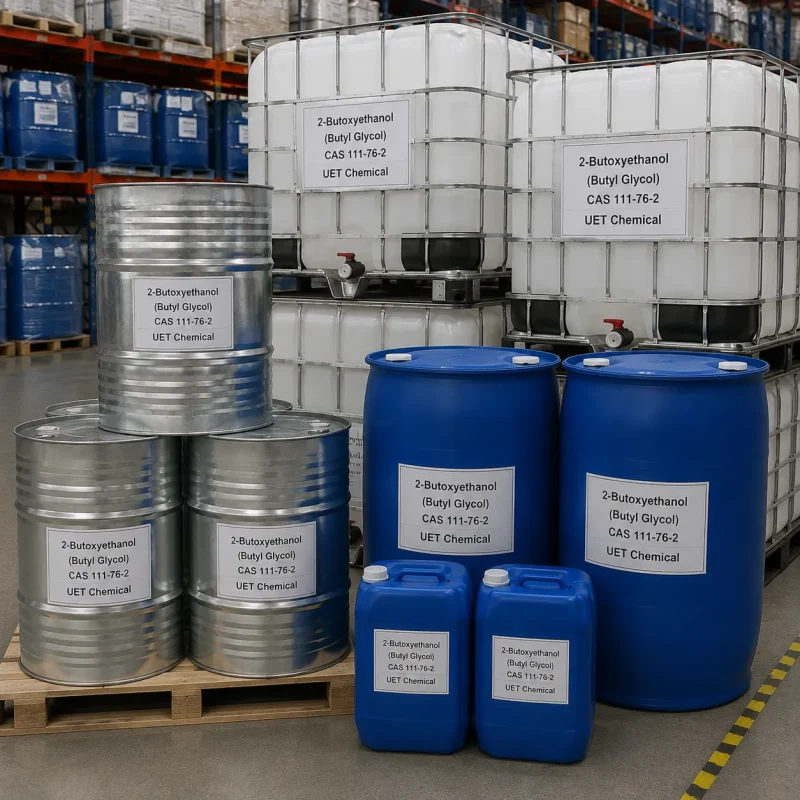
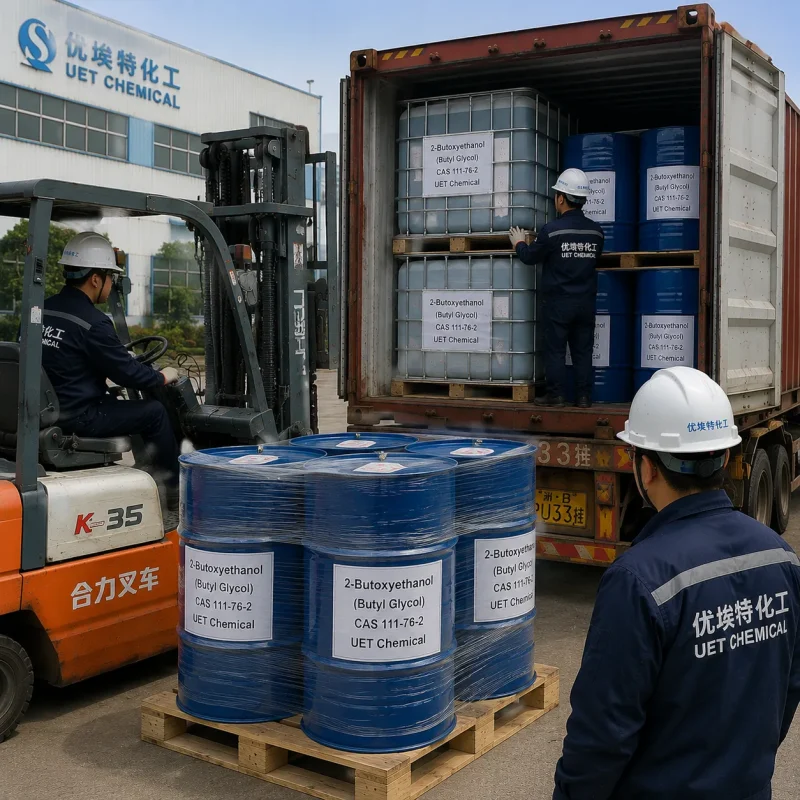
- Packaging: 185 kg galvanized steel drum, 925 kg IBC tote, ISO tank. Custom packaging available upon request.
- Main Applications: Paint & coating coalescent, heavy-duty degreaser, hydraulic fluid additive, textile dye carrier
Introduction to 2-Butoxyethanol
2-Butoxyethanol, commonly known as Butyl Glycol, is the most widely consumed glycol ether in industrial formulations. Its molecule combines a polar hydroxyl group with a four-carbon butyl ether chain, creating a unique amphiphilic structure that dissolves in water while simultaneously solubilizing oils, greases, resins and nitrocellulose. Paint manufacturers use it as a coalescing solvent to ensure smooth film formation, while cleaning chemical formulators rely on it to lift stubborn hydrocarbon soils from metal and concrete surfaces.
Its “middle-of-the-road” evaporation rate — comparable to xylene but fully water-miscible — prevents blistering in baking enamels and improves wet-edge time in architectural latex paints. The liquid is hygroscopic and flammable; vapors can form explosive mixtures above 60 °C. Store drums in a well-ventilated, cool warehouse away from direct sunlight and ignition sources, and always bond and ground containers during transfer.
2-Butoxyethanol Chemical & Physical Properties
| Property | Value |
|---|---|
| Molecular Formula | C₆H₁₄O₂ |
| Molecular Weight | 118.17 g/mol |
| Boiling Point | 171 °C |
| Flash Point (Closed Cup) | 60 °C |
| Auto-ignition Temperature | 235 °C |
| Density (20 °C) | 0.90 g/cm³ |
| Solubility in Water | Fully miscible in all proportions |
| Evaporation Rate (BuAc=1) | ~35 (Slow) |
| Water Content (KF) | ≤ 0.10% |
| Color (APHA) | ≤ 10 |
Applications of 2-Butoxyethanol
Architectural and industrial coatings: Dosed at 2–8% in latex paints, enamels and printing inks. It acts as a coalescing agent that temporarily softens latex particles for film formation, then evaporates slowly to prevent blistering and improve gloss uniformity.
Industrial and institutional cleaning: Blended at 5–30% in alkaline degreasers, floor strippers and oven cleaners. It solubilizes grease and carbonized soils while coupling anionic surfactants and caustic soda into a stable, single-phase liquid.
Oil and gas field chemicals: Added to hydraulic fracturing fluids and drilling muds as a surfactant and shale inhibitor. It prevents clay swelling and improves lubricity in high-pressure downhole environments.
Textile and leather processing: Used as a dye-leveling agent and penetrant at 1–5% in dye baths, ensuring uniform color uptake on synthetic fibers and preventing ring-dyeing.
Storage & Safety Precautions for 2-Butoxyethanol
- Store in tightly sealed, grounded containers in a cool, well-ventilated warehouse below 40 °C. The liquid is hygroscopic and absorbs atmospheric moisture, increasing water content in sensitive formulations. Keep away from strong oxidizers and open flames. Use nitrogen padding for long-term storage if purity must be preserved.
- Harmful if inhaled or absorbed through skin. Causes eye irritation. Wear chemical splash goggles, butyl rubber gloves, and use local exhaust ventilation during transfer. Do not use near open flames or sparks.
- Verify purity by Gas Chromatography and water content by Karl Fischer titration upon receipt. Off-spec water content indicates drum seal failure during transit — evaluate for rejection or re-distillation based on formulation tolerance.
2-Butoxyethanol FAQ
Q: How does 2-Butoxyethanol differ from Propylene Glycol Butyl Ether (DPM)?
A: Both are slow-evaporating glycol ethers, but 2-butoxyethanol (ethylene glycol-based) offers stronger solvency for oils and better coupling in high-pH systems. DPM is less toxic and preferred in consumer products. Use Butyl Glycol for heavy-duty industrial cleaning; use DPM for low-odor, low-toxicity applications.
Q: My Butyl Glycol arrived cloudy. Is it contaminated?
A: Cloudiness usually indicates moisture absorption exceeding 0.5% due to compromised drum seals. Run Karl Fischer testing; if water content exceeds spec, the lot is still usable for water-based cleaners but may cause haze in solvent-only coatings. Reject if used in anhydrous systems.
Q: Can I use 2-Butoxyethanol in food-contact cleaning formulations?
A: Not recommended for direct food contact. It is approved in some regions for indirect food-contact surface cleaners with a mandatory potable water rinse. Always verify local regulations before formulating.
Related products
Manufacturer & Exporter Since 2006
Get Tailored Chemical Raw Material Solutions — Reply Within 1 Hour
Factory-direct pricing, stable high-purity supply and complete compliance documentation for your industrial formulations.
- 1000+Products
- 200+QC Protocols
- 7–15Days Delivery
- Factory-Direct Pricing
- COA / TDS / SDS Included
- Free Samples for Testing
- 40+ Export Countries
Request a Free Quote
Our engineers reply within 1 hour during GMT+8 business hours.
Please include in your inquiry:
- Product name or CAS number
- Required quantity
- Destination country or port
- Preferred packaging