
Methyl D-Lactate Introduction
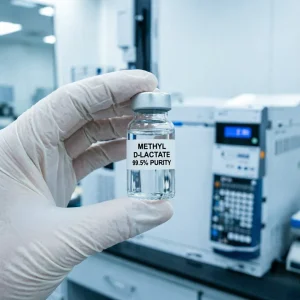
Methyl D-Lactate (CAS 17392-83-5), also known as methyl (R)-(+)-lactate, is the methyl ester of D-lactic acid with a defined (R)-configuration at the α-carbon. It is a colorless to slightly yellow liquid (bp 145°C / 293°F, density ~1.10 g/mL) that is miscible with water and most organic solvents. As a single-enantiomer α-hydroxy ester, it serves as a versatile chiral building block in asymmetric synthesis, providing a readily accessible C3 chiral synthon with both a hydroxyl and an ester functional group available for further transformation.
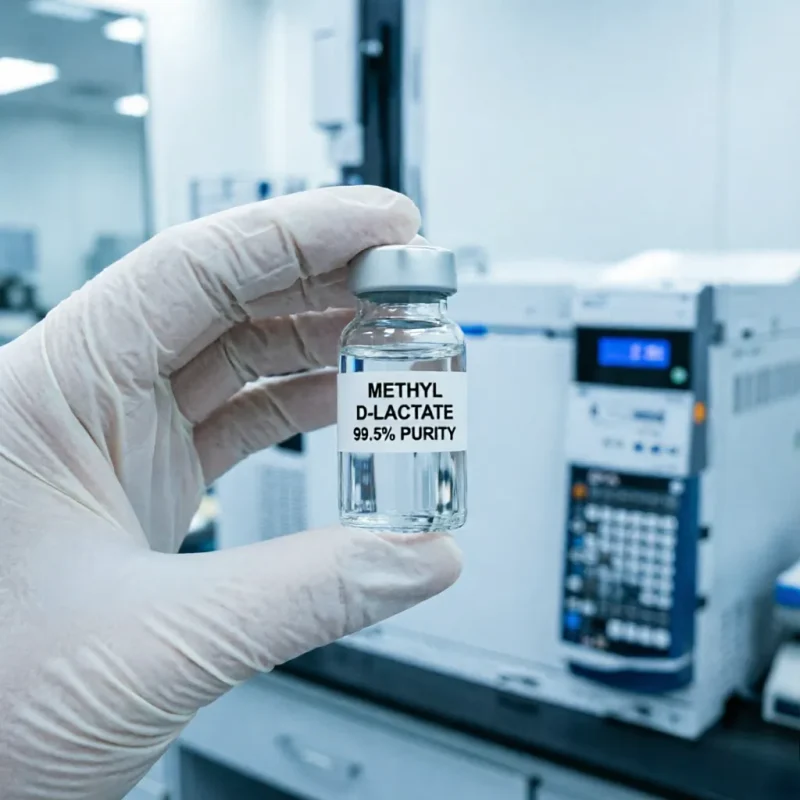
The compound is produced via enzymatic resolution or asymmetric fermentation of D-lactic acid followed by esterification. UET Chemical supplies Methyl D-Lactate at ≥99.0% chemical purity (GC) and ≥99% enantiomeric excess (chiral GC), manufactured under controlled conditions with full batch traceability. Each shipment includes COA, GC chromatogram, chiral GC report (ee value), optical rotation data, and SDS. This material is widely used by contract research organizations (CROs), API manufacturers, and polymer research laboratories.
Chemical Information
| Item | Details |
|---|---|
| CAS No. | 17392-83-5 |
| EINECS No. | 241-420-6 |
| MDL No. | MFCD00004517 |
| IUPAC Name | Methyl (2R)-2-hydroxypropanoate |
| Synonyms | Methyl (R)-(+)-lactate; D-Methyl Lactate; D-Lactic Acid Methyl Ester; (R)-Methyl 2-hydroxypropanoate; DLAM |
| Molecular Formula | C₄H₈O₃ |
| Molecular Weight | 104.10 |
| Melting Point | −66.2°C |
| Boiling Point | 145.3°C (293°F) at 760 mmHg |
| Density | 1.10 g/mL (25°C) |
| Flash Point | 49°C (120°F), closed cup |
| Refractive Index | n²⁰/D 1.413 |
| Optical Rotation | [α]²⁰/D +7° to +9° (neat) |
| LogP | −0.46 |
| Chemical Class | Chiral α-hydroxy ester |
| GHS Classification | GHS02 (Flammable liquid), GHS07 (Irritant) |
Methyl D-Lactate Specifications
| Test Item | Specification |
|---|---|
| Appearance | Colorless to slightly yellow transparent liquid |
| Assay (GC) | ≥99.0% |
| Enantiomeric Excess (chiral GC) | ≥99% ee |
| Optical Rotation [α]²⁰/D | +7.0° to +9.0° (neat) |
| Water Content (Karl Fischer) | ≤0.5% |
| Acidity (as lactic acid) | ≤0.1% |
| Color (APHA) | ≤30 |
| Residue on Evaporation | ≤0.05% |
Methyl D-Lactate Specifications
| Test Item | Specification |
|---|---|
| Appearance | Colorless to slightly yellow transparent liquid |
| Assay (GC) | ≥99.0% |
| Enantiomeric Excess (chiral GC) | ≥99% ee |
| Optical Rotation [α]²⁰/D | +7.0° to +9.0° (neat) |
| Water Content (Karl Fischer) | ≤0.5% |
| Acidity (as lactic acid) | ≤0.1% |
| Color (APHA) | ≤30 |
| Residue on Evaporation | ≤0.05% |
Methyl D-Lactate Applications
| Application | Role | Typical Use Level |
|---|---|---|
| Pharmaceutical Intermediates | Chiral C3 synthon for API synthesis | As per synthetic route |
| Asymmetric Catalysis Research | Chiral ligand/substrate precursor | Lab to pilot scale |
| Biodegradable Polymers (PLA) | Monomer precursor for poly(D-lactic acid) | Per polymerization protocol |
| Agrochemical Synthesis | Chiral intermediate for herbicides/fungicides | As per formulation |
| Green Solvent Applications | Bio-based replacement for petroleum solvents | 5%–100% in solvent blends |
Key Advantages
Defined stereochemistry — ≥99% ee ensures predictable stereoselectivity in downstream synthesis. Critical for API intermediates where enantiomeric purity directly impacts drug efficacy and regulatory acceptance.
Dual functional groups — Both the hydroxyl and ester moieties are available for selective transformation (reduction, oxidation, transesterification, protection/deprotection), enabling diverse synthetic routes from a single starting material.
Bio-based origin — Derived from fermentation-produced D-lactic acid, supporting sustainability claims and green chemistry initiatives. Suitable for projects requiring renewable carbon content documentation.
Low toxicity profile — Methyl lactate is classified as a low-toxicity solvent (LD₅₀ oral rat >2,000 mg/kg). Listed on several “green solvent” recommendation lists as a replacement for dichloromethane, DMF, and NMP.
Methyl D-Lactate Storage and Stability
| Item | Guideline |
|---|---|
| Shelf Life | 12 months (unopened, from manufacture date) |
| Temperature | 2–25°C (36–77°F); avoid freezing |
| Container | Keep tightly sealed; HDPE or glass with PTFE-lined cap |
| Atmosphere | Nitrogen blanket recommended for long-term storage |
| Light | No special requirement; amber glass optional |
Stability notes:
- Methyl D-Lactate hydrolyzes slowly in the presence of water, especially under acidic or basic conditions. Keep container sealed and minimize headspace moisture.
- Avoid contact with strong acids, strong bases, and strong oxidizers. Hydrolysis accelerates at pH < 3 or pH > 10.
- Flash point is 49°C (120°F) — store away from ignition sources. Classify as flammable liquid (Category 3) per GHS.
- Optical rotation should be verified upon receipt and periodically during storage. A drift in [α]D may indicate racemization or contamination.
- For long-term storage (>6 months), nitrogen headspace and refrigeration (2–8°C / 36–46°F) are recommended to minimize hydrolysis and preserve ee.
Methyl D-Lactate Usage Guide
Step 1 – Verify upon receipt: Check optical rotation ([α]²⁰/D +7° to +9°) and chiral GC (≥99% ee) against the COA. Confirm water content ≤0.5% by Karl Fischer titration.
Step 2 – Handling precautions: Work in a well-ventilated area or fume hood. Wear nitrile gloves and safety glasses. Flash point 49°C (120°F) — keep away from open flames and hot surfaces. Ground containers during transfer to prevent static discharge.
Step 3 – Synthetic use: Methyl D-Lactate can be used directly or after hydroxyl protection (e.g., TBDMS, benzyl, acetyl). Common transformations include:
- Reduction (LiAlH₄, DIBAL-H) → chiral diols
- Ester hydrolysis → D-lactic acid
- Transesterification → other chiral esters
- Tosylation/mesylation of OH → chiral leaving group intermediates
Step 4 – Waste disposal: Collect waste in labeled containers. Biodegradable; incineration or approved chemical waste disposal per local regulations.
Compatibility
| ✅ Compatible | ⚠️ Caution | ❌ Incompatible |
|---|---|---|
| Most organic solvents (THF, DCM, EtOAc, toluene), inert atmospheres (N₂, Ar), common protecting group reagents | Prolonged aqueous exposure, mild acids/bases at elevated temperature | Strong mineral acids, concentrated NaOH/KOH, strong oxidizers (KMnO₄, CrO₃) |
Why Source Methyl D-Lactate from UET Chemical
| Advantage | Details |
|---|---|
| Chiral Purity Guaranteed | Every batch tested by chiral GC; ≥99% ee verified and reported with chromatogram |
| Full Chiral Documentation | COA includes assay (GC), ee (chiral GC), optical rotation, water content, acidity |
| GMP-Aligned Production | Manufactured in ISO 22716 / GMP-certified facility with dedicated chiral synthesis line |
| Batch Consistency | [α]D variation < ±0.3° between batches; ee variation < 0.5% |
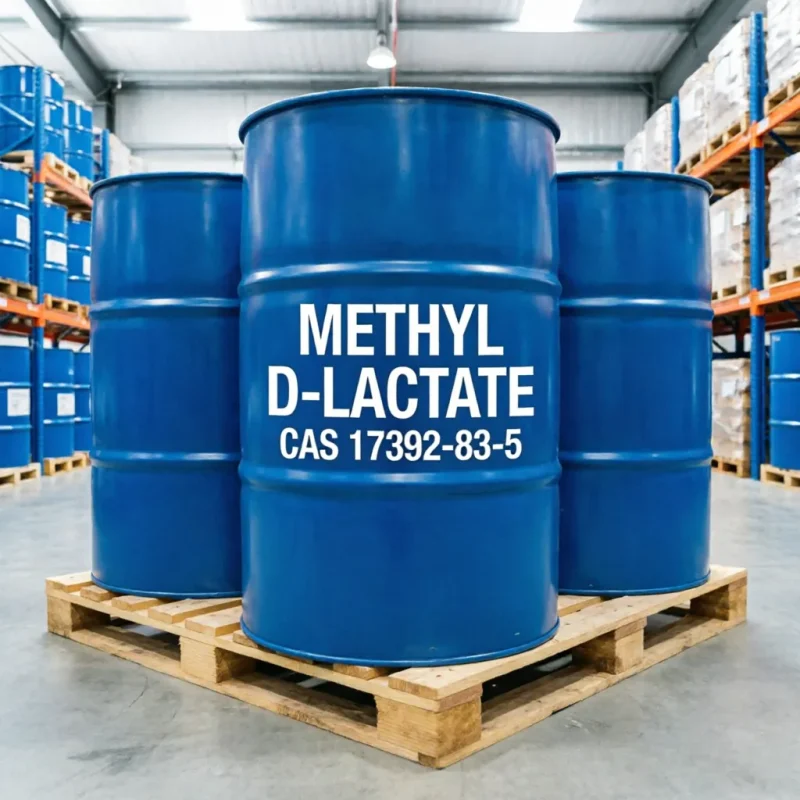
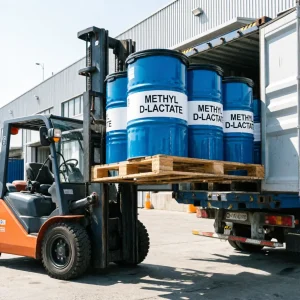
| Flexible MOQ | 1 kg sample bottle; 25 kg or 200 kg drum for bulk; custom volumes on request |
| Regulatory Support | REACH registered; documentation for DMF filing and CRO audits |
| Fast Response | Inquiry answered within 12 hours; sample ships in 1–3 days |
Methyl D-Lactate FAQ
Q1: What is the difference between Methyl D-Lactate and Methyl L-Lactate?
They are enantiomers — mirror-image isomers. Methyl D-Lactate (CAS 17392-83-5) has the (R)-configuration and positive optical rotation ([α]D +7° to +9°). Methyl L-Lactate (CAS 27871-49-4) has the (S)-configuration and negative rotation. The choice depends on the target molecule’s required stereochemistry. We supply both enantiomers.
Q2: How is enantiomeric excess (ee) measured?
We use chiral GC (e.g., Chirasil-DEX CB or equivalent cyclodextrin-based column) to separate and quantify the R and S enantiomers. The ee value is calculated as |R − S| / (R + S) × 100%. A full chiral GC chromatogram is included with every COA.
Q3: What is the hydrolysis risk during storage?
Methyl D-Lactate hydrolyzes slowly in the presence of moisture, forming D-lactic acid and methanol. At neutral pH and sealed conditions, hydrolysis is minimal (<0.1% over 6 months). To minimize risk: keep container sealed, use nitrogen blanket, and store at 2–25°C (36–77°F). Water content is tested by Karl Fischer (≤0.5%) before shipment.
Q4: Can this material be used for GMP pharmaceutical manufacturing?
Yes. Our Methyl D-Lactate is produced in a GMP-aligned facility. We provide full documentation packages including COA, chiral GC, TDS, SDS, residual solvent statement, and elemental impurity data (ICH Q3D) to support DMF filing and regulatory submissions.
Q5: What is the lead time for bulk orders?
- In-stock (25 kg drum): Ships in 5–7 business days after payment.
- 200 kg drum or custom specs: 10–15 business days production.
- Sea freight: 25–35 days (North America), 20–30 days (Europe), 7–15 days (SE Asia).
Q6: Is Methyl D-Lactate classified as a dangerous good for shipping?
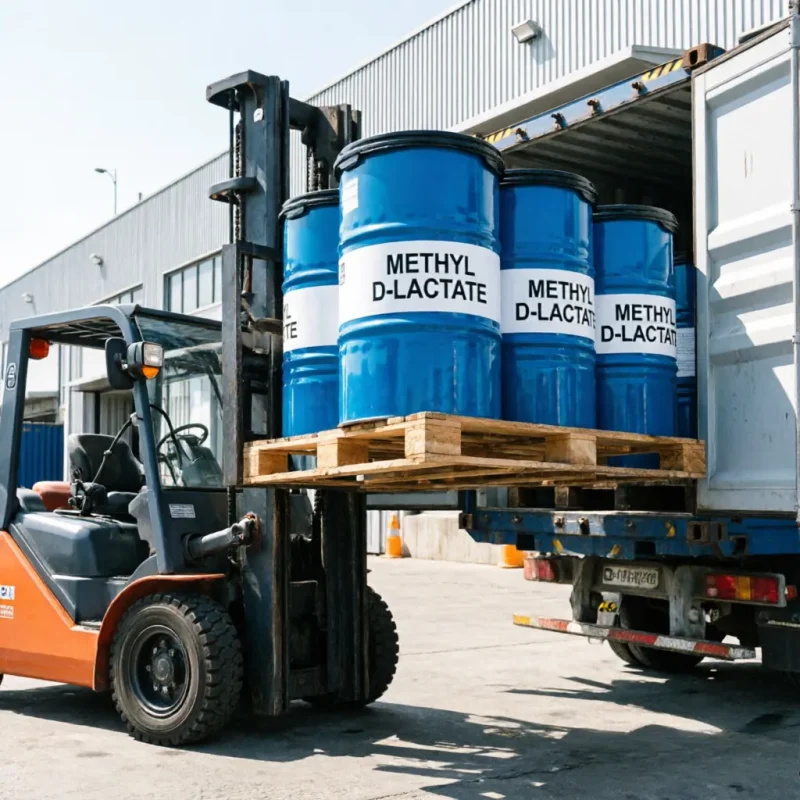
Yes. It is classified as UN 1993, Flammable Liquid, N.O.S., Class 3, PG III (flash point 49°C / 120°F). We provide full shipping documentation including UN-certified packaging, MSDS, and dangerous goods declaration. Air freight is possible with IATA-compliant packaging.

Reviews
There are no reviews yet.