
Trimethylolpropane Triacrylate (TMPTA) CAS 15625-89-5
Trimethylolpropane Triacrylate (TMPTA) is a trifunctional acrylate crosslinker and reactive diluent supplied as a colorless to pale yellow transparent liquid. Its three acrylate groups enable fast radical polymerization, high crosslink density and excellent surface hardness in UV-curable systems. It serves as a core raw material for UV coatings, printing inks, pressure-sensitive adhesives and electronic encapsulation resins. UETChem supplies TMPTA with consistent purity and controlled inhibitor content for reliable curing performance. Each shipment includes COA, TDS, SDS.
- CAS No: 15625-89-5
- Synonyms: TMPTA; TMP Triacrylate; Trimethylolpropane triacrylate ester
- EC Number: 239-698-9
- Molecular Formula: C₁₈H₂₆O₆
- Molecular Weight: 338.40 g/mol
- Appearance: Colorless to pale yellow transparent liquid
- Purity (GC): ≥ 95.0%
- Functionality: Trifunctional (3 acrylate groups)
- Inhibitor: MEHQ 200 ± 50 ppm (standard grade)
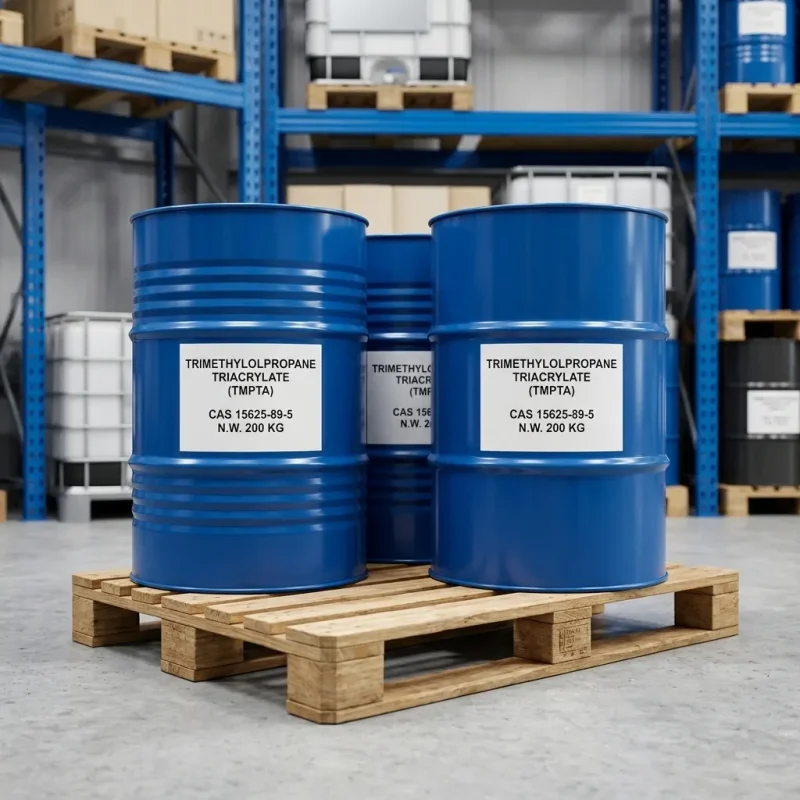
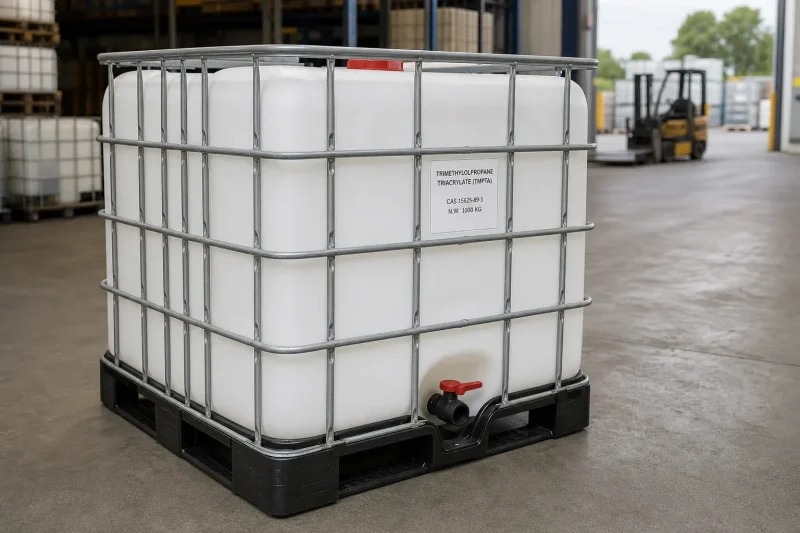
- Packaging: 25 kg / 200 kg steel drum; 1000 kg IBC tote. Custom packaging available.
- Main Applications: UV-curable coatings & inks, PSA crosslinker, electronic encapsulation, 3D printing resins
Introduction to Trimethylolpropane Triacrylate
Trimethylolpropane Triacrylate (TMPTA) is a trifunctional monomer produced via esterification of trimethylolpropane with acrylic acid. Its three acrylate double bonds build tightly crosslinked polymer networks during free-radical polymerization, delivering films with outstanding hardness, chemical resistance and low shrinkage. In UV-curable formulations, it acts both as a reactive diluent that cuts viscosity without VOC emissions and as a primary crosslinking node.
Oxygen inhibition and inhibitor levels are critical processing parameters. Standard grades contain MEHQ stabilizer for storage stability. The material undergoes slow exothermic homopolymerization at elevated temperatures, so cool storage is required. It is compatible with most acrylate oligomers and performs best in formulations kept below pH 9 to avoid ester hydrolysis.
Trimethylolpropane Triacrylate Chemical & Physical Properties
| Property | Value |
|---|---|
| Molecular Formula | C₁₈H₂₆O₆ |
| Molecular Weight | 338.40 g/mol |
| Functionality | 3 (trifunctional acrylate) |
| Viscosity (25 °C) | 60 – 120 mPa·s |
| Density (20 °C) | 1.020 – 1.050 g/cm³ |
| Flash Point (Closed Cup) | ~ 150 °C |
| Acid Value | ≤ 0.2 mg KOH/g |
| Water Content | ≤ 0.2% |
Applications of Trimethylolpropane Triacrylate
UV-curable coatings & overprint varnishes
Used as a crosslinker and reactive diluent in wood, plastic and metal UV coating formulations. It boosts cure speed, increases film hardness and improves solvent and abrasion resistance of finished coatings.
Pressure-sensitive adhesives
Serves as a crosslinking modifier in acrylic pressure-sensitive adhesive systems. It balances tack, peel adhesion and cohesive shear strength after UV curing, supporting clear, high-performance adhesive films.
Electronic encapsulation & conformal coatings
Formulated into UV-curable conformal coatings for PCB assemblies. It delivers fast cure, reliable moisture barrier properties and good dielectric strength for electronic component protection.
3D printing & stereolithography resins
Incorporated into acrylate-based SLA/DLP 3D printing resins. It increases cured part modulus and heat deflection temperature, producing rigid, dimensionally stable parts for prototyping and model applications.
Storage & Safety Precautions for Trimethylolpropane Triacrylate
- Store in tightly sealed containers at 5–25 °C in a cool, dry, well-ventilated warehouse. Protect from direct sunlight, heat sources, peroxides, amines and strong acids. Maintain stabilizer levels to prevent premature polymerization. Typical shelf life is 12 months under proper conditions.
- Causes skin sensitization and serious eye irritation. Wear nitrile gloves, chemical splash goggles and protective clothing during handling. Wash skin immediately with soap and water in case of contact. Ensure local exhaust ventilation at dispensing points.
- Classified as flammable liquid in some jurisdictions. Keep segregated from oxidizers and initiators during transit. Avoid prolonged exposure to temperatures above 35 °C in shipping containers.
- Verify purity, viscosity and inhibitor content upon receipt. Reject lots showing discoloration, gelation or significant viscosity increase, which indicate partial polymerization.
Trimethylolpropane Triacrylate FAQ
Q: How does TMPTA compare to HDDA in UV coatings?
A: TMPTA is trifunctional while HDDA is difunctional. TMPTA delivers faster cure, higher crosslink density and better hardness/chemical resistance, but slightly higher viscosity. Blending the two balances hardness, flexibility and cure speed.
Q: Why does my TMPTA formulation remain tacky after UV cure?
A: Surface tack usually stems from oxygen inhibition. Increase photoinitiator loading, add an amine synergist, cure under nitrogen inerting, or apply a higher UV dose to resolve the issue.
Q: Can TMPTA be used in aqueous UV systems?
A: TMPTA is hydrophobic and not directly water-dispersible. Use ethoxylated/propoxylated derivatives for aqueous systems, or pre-emulsify TMPTA with surfactants via high-shear mixing.
Related products
Manufacturer & Exporter Since 2006
Get Tailored Chemical Raw Material Solutions — Reply Within 1 Hour
Factory-direct pricing, stable high-purity supply and complete compliance documentation for your industrial formulations.
- 1000+Products
- 200+QC Protocols
- 7–15Days Delivery
- Factory-Direct Pricing
- COA / TDS / SDS Included
- Free Samples for Testing
- 40+ Export Countries
Request a Free Quote
Our engineers reply within 1 hour during GMT+8 business hours.
Please include in your inquiry:
- Product name or CAS number
- Required quantity
- Destination country or port
- Preferred packaging