
Isophorone Diisocyanate (IPDI) CAS 4098-71-9
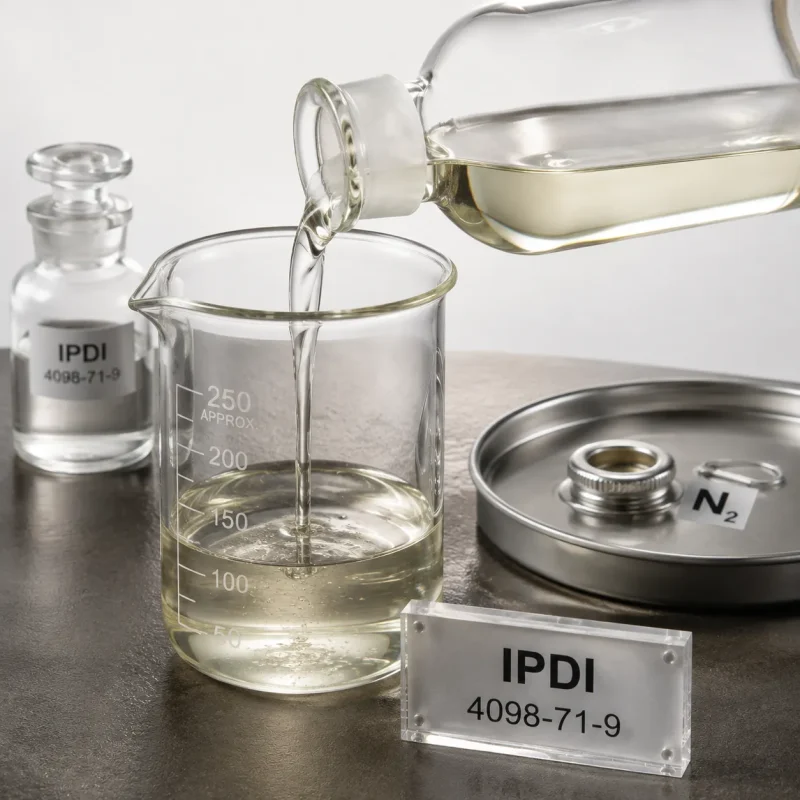
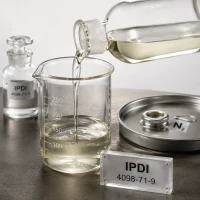
Isophorone Diisocyanate (IPDI) is an aliphatic cycloaliphatic diisocyanate supplied as a colorless to pale yellow liquid, carrying two non-equivalent NCO groups with a reactivity ratio near 4:1. The isophorone ring backbone delivers UV stability and non-yellowing in cured polyurethane films, making IPDI the backbone monomer for automotive clearcoats, industrial coatings, and aliphatic elastomers. Each shipment includes COA, TDS, and SDS.
- CAS No: 4098-71-9
- Synonyms: IPDI, 3-Isocyanatomethyl-3,5,5-trimethylcyclohexyl isocyanate, Isophorone diisocyanate
- EC Number: 223-861-6
- Molecular Formula: C12H18N2O2
- Molecular Weight: 222.28 g/mol
- Appearance: Colorless to pale yellow transparent liquid
- NCO Content: ≥ 37.8%
- Viscosity: Approx. 6.6 mPa·s at 25 °C (77 °F)
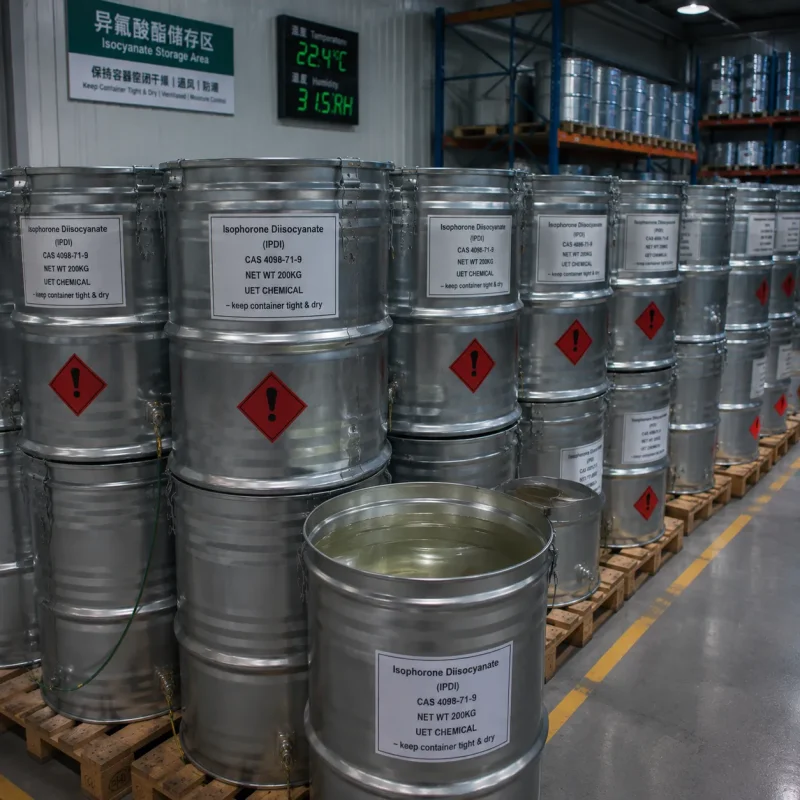
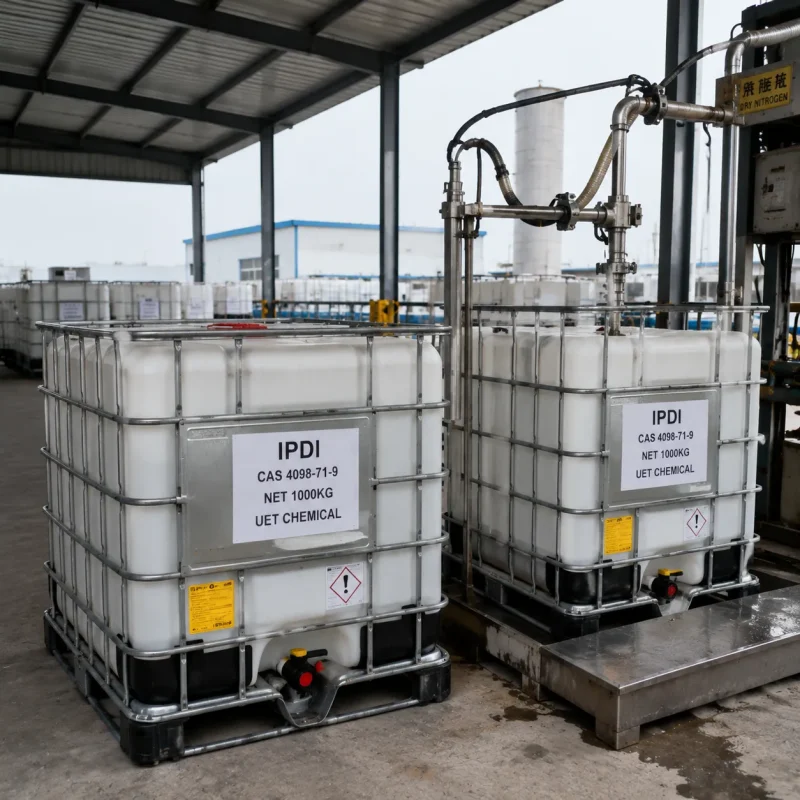
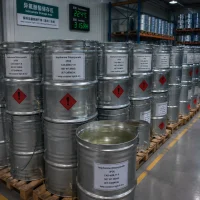
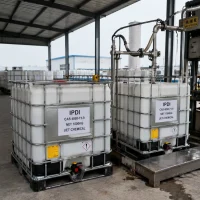
- Packaging: 200 kg (440 lb) HDPE drum; 1000 kg (2,200 lb) IBC tote. Custom packaging available upon request.
- Main Applications: Automotive clearcoats, industrial PU coatings, elastomers, adhesives, waterborne PU dispersions
Introduction to Isophorone Diisocyanate
Isophorone Diisocyanate (IPDI) is a colorless-to-pale-yellow aliphatic diisocyanate built on a 3,5,5-trimethylcyclohexane ring. Two chemically non-equivalent NCO groups sit on this ring—one on the ring carbon, one on the pendant methylene—with a reactivity ratio of roughly 4:1. Automotive OEMs and industrial coating formulators consume most global output, dosing IPDI into clearcoat and topcoat systems where UV stability and non-yellowing are non-negotiable.
The 4:1 NCO reactivity gap gives formulators a selective reaction window: with proper catalyst control, the more reactive methylene NCO can be consumed first, leaving the ring NCO available for crosslinking. The critical handling risk is moisture. IPDI reacts with trace water to form urea and CO2, which pressurises sealed containers, gels storage lines, and causes pinhole defects in coatings. Keep drums sealed under dry nitrogen at 5–30 °C (41–86 °F); never leave an open drum in humid air.
Key Features of Isophorone Diisocyanate
- Two non-equivalent NCO groups with 4:1 reactivity ratio. The methylene NCO reacts about four times faster than the ring NCO, allowing controlled step-growth polymerisation and selective half-adduct formation for pre-polymer synthesis.
- UV-stable, non-yellowing aliphatic backbone. The saturated cyclohexane ring absorbs no UV in the 300–400 nm solar range, so cured PU films retain gloss and colour for years outdoors without chalking.
- Low viscosity for easy processing. At 6.6 mPa·s (25 °C / 77 °F), IPDI pours and meters without heating, simplifying solvent-free and high-solids coating formulations.
- Excellent weathering and chemical resistance. IPDI-based PU clearcoats pass 2,000+ hours of QUV-A testing (ASTM G154) with minimal gloss loss, resisting acid rain, fuel splash, and alkaline detergents.
- Fast cure at moderate temperatures. Reactivity with hydroxyl-functional acrylics and polyesters allows 80–120 °C (176–248 °F) baking schedules, shorter than many aliphatic alternatives.
Isophorone Diisocyanate Chemical & Physical Properties
| Property | Value |
|---|---|
| Molecular Formula | C12H18N2O2 |
| Molecular Weight | 222.28 g/mol |
| Boiling Point | 295 °C (563 °F) at 760 mmHg; typically distilled under vacuum at 158 °C (316 °F) / 10 mmHg. |
| Density | 1.06 g/cm³ (8.8 lb/gal) at 20 °C (68 °F) |
| Flash Point | 153 °C (307 °F) closed cup |
| Viscosity | Approx. 6.6 mPa·s at 25 °C (77 °F) |
| NCO Content | ≥ 37.8% (titration per ISO 14896) |
| Solubility | Reacts with water; miscible with esters, ketones, aromatics, and chlorinated solvents. |
| Color (APHA) | ≤ 30 |
Applications of Isophorone Diisocyanate
Automotive OEM and refinish clearcoats: Blended at 15–25% with hydroxyl-functional acrylic resins (OH value 80–120 mg KOH/g), IPDI crosslinks into a dense urethane network. The aliphatic ring prevents UV-induced quinone-imine formation, keeping clearcoats water-white for 10+ years of outdoor exposure. Typical bake: 120 °C (248 °F) for 20 min.
Industrial and protective coatings: In coil coatings, wind-turbblade topcoats, and marine finishes, IPDI-based PU systems deliver 2,000+ hour salt-spray resistance (ASTM B117) and flexibility (T-bend ≤ 2T). Dosage: 1.0–1.2 NCO/OH equivalent ratio.
Aliphatic polyurethane elastomers and adhesives: Reacted with polyester or polyether polyols at 60–90 °C (140–194 °F), IPDI produces elastomers with 85–95 Shore A hardness and excellent abrasion resistance. In structural adhesives, the 4:1 NCO reactivity gap enables controlled pre-polymer build-up before chain extension.
Waterborne polyurethane dispersions (PUDs): IPDI reacts with DMPA-containing polyesters, then the pre-polymer is dispersed and chain-extended with water. The resulting anionic PUDs (20–35% solids) form flexible, non-yellowing films for textile lamination and wood coatings.
Storage & Safety Precautions for Isophorone Diisocyanate
- Storage: Keep drums tightly sealed under dry nitrogen at 5–30 °C (41–86 °F), relative humidity below 60%. IPDI reacts with moisture to form urea and CO2; a drum left open in 70% RH can gel within 48 hours and build internal pressure. Store away from amines, strong acids, alcohols, and oxidisers. Use opened drums within 7 days.
- Safety: Classified as skin/respiratory sensitiser (GHS H317, H334), eye irritant (H319), harmful if inhaled (H332), suspected carcinogen (H351), and aquatic chronic toxicity (H411). Wear full-face shield, organic-vapour respirator, and chemical-resistant gloves. Never heat sealed IPDI containers—CO2 buildup can rupture them.
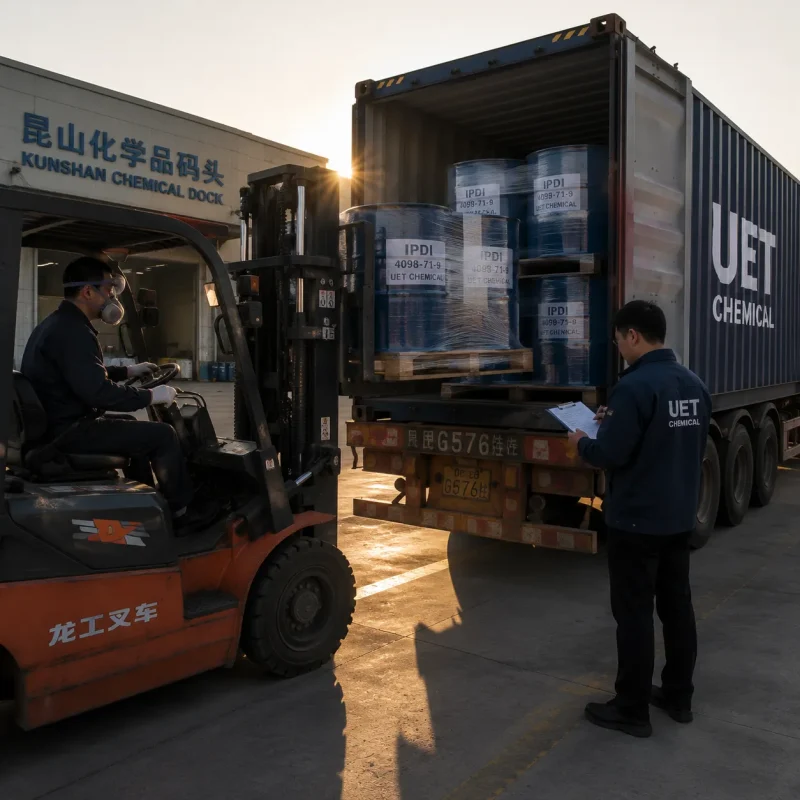
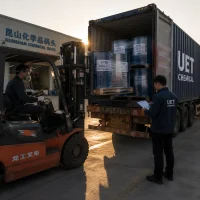
- Transport: IPDI is classified as Non-DG under IATA/IMDG/ADR (flash point 153 °C / 307 °F exceeds flammable-liquid threshold). Not a marine pollutant. Ship in HDPE drums or IBC totes with vented caps to relieve trace CO2 pressure.
- QC note: Verify NCO content by titration per ISO 14896 and colour by APHA (ASTM D1209) on receipt. A fresh lot is water-white (APHA ≤ 30). Yellow tint above APHA 50 or NCO below 37.0% indicates moisture ingress or thermal degradation during transit—reject such lots.
Isophorone Diisocyanate FAQ
Q: Why does my IPDI drum swell or hiss when I open it?
A: Moisture ingress. IPDI reacts with water to form urea and CO2 gas. The hissing is CO2 escaping. If the liquid is still clear and NCO ≥ 37.0%, it is usable. If cloudy or gelled, reject. Always purge with dry nitrogen after sampling.
Q: How do I exploit the 4:1 NCO reactivity ratio of IPDI (CAS 4098-71-9)?
A: Use a tin catalyst (e.g., DBTDL 0.05–0.1%) at 50–60 °C (122–140 °F). The methylene NCO reacts first, forming a mono-adduct. Stop the reaction at ~50% NCO consumption to get a controlled half-adduct pre-polymer, then react the remaining ring NCO with a crosslinker.
Q: Can I substitute IPDI with HDI in a clearcoat formula?
A: Not directly. IPDI’s rigid cyclohexane ring gives higher hardness and Tg; HDI’s linear chain gives more flexibility. Swapping changes pot life, cure speed, and film properties. Re-run full formulation trials before switching.
Related products
Manufacturer & Exporter Since 2006
Get Tailored Chemical Raw Material Solutions — Reply Within 1 Hour
Factory-direct pricing, stable high-purity supply and complete compliance documentation for your industrial formulations.
- 1000+Products
- 200+QC Protocols
- 7–15Days Delivery
- Factory-Direct Pricing
- COA / TDS / SDS Included
- Free Samples for Testing
- 40+ Export Countries
Request a Free Quote
Our engineers reply within 1 hour during GMT+8 business hours.
Please include in your inquiry:
- Product name or CAS number
- Required quantity
- Destination country or port
- Preferred packaging