
High Purity Ferrous Lactate Powder (CAS 5905-52-2)
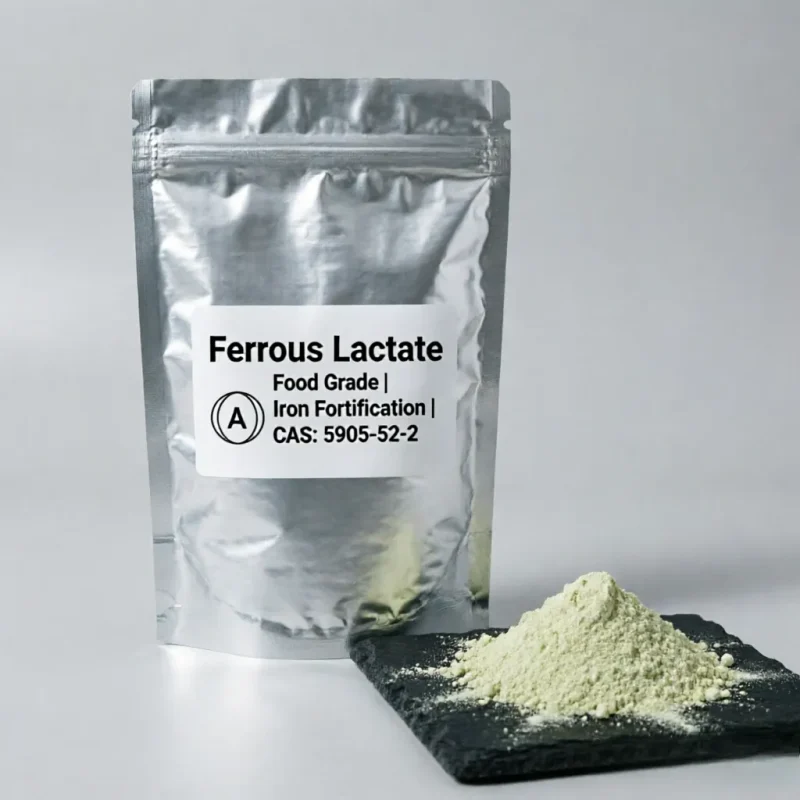
High Purity Ferrous Lactate is a premium organic divalent iron (Fe²⁺) source supplied as light green to yellowish-green crystalline powder. Featuring a lactic acid chelate structure, it delivers exceptional bioavailability and gastrointestinal tolerance without the metallic aftertaste associated with inorganic salts, making it the industry standard for food fortification, pharmaceutical supplements, and premium animal feed. Each shipment includes COA, TDS, and SDS.
- CAS No: 5905-52-2
- Synonyms: Iron(II) lactate, Lactic acid iron(II) salt, E585
- EC Number: 227-608-0
- Molecular Formula: C6H10FeO6 (typically as trihydrate C6H10FeO6·3H2O)
- Molecular Weight: 288.02 g/mol (anhydrous) / 342.07 g/mol (trihydrate)
- Appearance: Light green to yellowish-green crystalline powder
- Purity (Assay): ≥ 98.0%
- Iron (Fe) Content: 15.0% – 19.0%
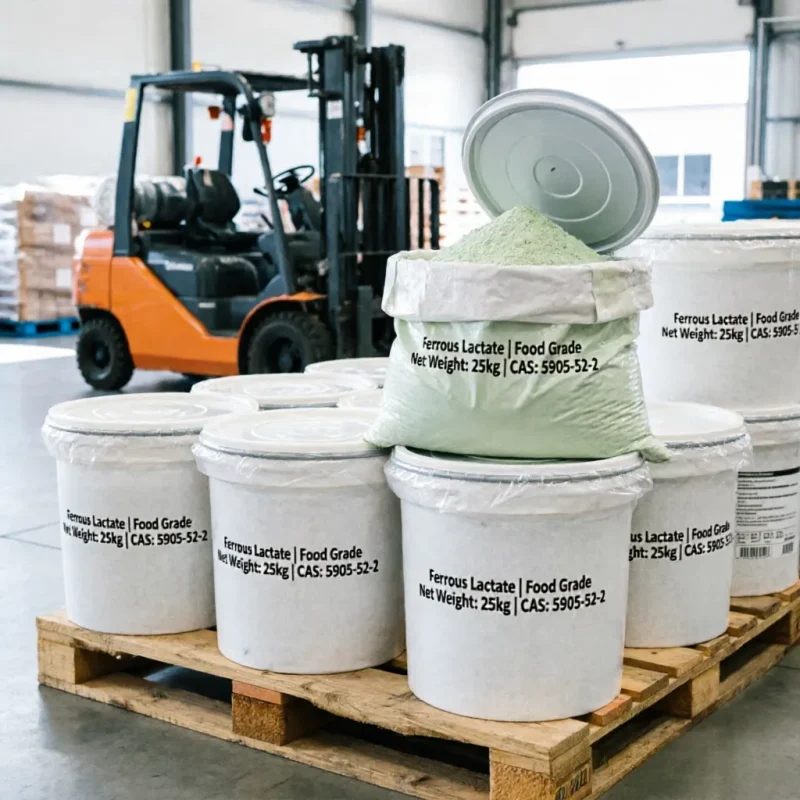
- Packaging: 25 kg (55 lb) fiber drum with PE liner; 25 kg (55 lb) woven PP bag with PE liner. Custom packaging available upon request.
- Main Applications: Food and beverage fortification, pharmaceutical iron supplements, pet food and livestock feed additives, agricultural foliar fertilizers
Introduction to Ferrous Lactate
Ferrous Lactate is a highly water-soluble organic iron salt formed by the reaction of lactic acid with divalent iron. Unlike inorganic iron sources like ferrous sulfate, its organic chelate structure protects the Fe²⁺ ion from premature oxidation in the stomach and ensures high intestinal absorption rates. Nutraceutical manufacturers and food processors rely on it to formulate iron-fortified products that do not trigger gastrointestinal distress or impart a harsh metallic taste to the final matrix.
The primary processing advantage is its excellent compatibility with sensitive food matrices; it does not catalyze lipid oxidation or cause off-flavors in dairy, cereal, and beverage applications. The critical storage risk is oxidative degradation: exposure to oxygen, light, or high humidity will oxidize the divalent iron (Fe²⁺) into trivalent iron (Fe³⁺), turning the powder from light green to yellowish-brown and severely reducing its bioavailability. Store strictly in sealed, oxygen-barrier packaging in a cool, dry environment.
Key Features of Ferrous Lactate
- Superior bioavailability and GI tolerance. The organic lactate ligand facilitates active transport across the intestinal mucosa, achieving high absorption rates while causing minimal gastric irritation, nausea, or constipation compared to ferrous sulfate.
- Neutral sensory profile. Lacks the strong astringency and metallic aftertaste of inorganic iron salts, making it ideal for fortifying clear beverages, infant formulas, and chewable tablets without masking agents.
- Low pro-oxidant activity. Does not aggressively catalyze the oxidation of vitamins (like Vitamin C or A) or unsaturated fats in complex food matrices, preserving the nutritional integrity and shelf-life of the final product.
- Strict heavy metal control. Manufactured via controlled fermentation and synthesis routes to ensure lead (Pb) and arsenic (As) levels remain well below food and pharmacopeia safety thresholds.
Ferrous Lactate Chemical & Physical Properties
| Property | Value |
|---|---|
| Molecular Formula | C6H10FeO6 (anhydrous) / C6H10FeO6·3H2O (trihydrate) |
| Molecular Weight | 288.02 g/mol (anhydrous) / 342.07 g/mol (trihydrate) |
| Thermal Behaviour | Dehydrates gradually above 100 °C (212 °F); decomposes above 200 °C (392 °F). Avoid high-heat drying processes. |
| Density | Bulk density approx. 0.70–0.85 g/cm³ (43–53 lb/ft³). |
| Solubility in Water | Soluble, approx. 5 g / 100 mL at 20 °C (68 °F); practically insoluble in ethanol. |
| pH (5% aqueous solution) | 4.5 – 6.5 |
| Iron (Fe) Content | 15.0% – 19.0% (depending on hydration state) |
| Heavy Metals (as Pb) | ≤ 2 ppm (Food/Pharma Grade) |
| Arsenic (as As) | ≤ 1 ppm (Food/Pharma Grade) |
Applications of Ferrous Lactate
Food and beverage fortification: Dosed at 10–50 ppm (elemental iron basis) in infant cereals, milk powders, nutritional bars, and fruit juices. Its mild reactivity prevents the degradation of added vitamins and avoids the “rusty” off-flavor common with ferrous sulfate.
Pharmaceutical and nutraceutical supplements: Used as the active pharmaceutical ingredient (API) in oral liquid iron syrups, capsules, and chewable gummies for treating iron-deficiency anemia. The high absorption rate allows for lower total dosing, reducing gastrointestinal side effects.
Premium pet food and livestock feed: Incorporated into puppy milk replacers and high-performance animal feeds to prevent neonatal anemia and support hemoglobin synthesis without causing oxidative rancidity in high-fat feed pellets.
Agricultural foliar fertilizers: Applied as a highly bioavailable micronutrient in hydroponic systems and foliar sprays to correct iron chlorosis (yellowing of leaves) in high-value crops like citrus and ornamental plants.
Storage & Safety Precautions for Ferrous Lactate
- Storage: Keep tightly sealed in original PE-lined drums or bags in a cool, dry, and dark warehouse below 25 °C (77 °F). Divalent iron is highly susceptible to oxidation; prolonged exposure to air or high humidity will turn the powder brown and render it nutritionally inactive. Use nitrogen flushing if repackaging in bulk.
- Safety: Classified as non-hazardous (Food Grade E585). Wear standard dust masks and safety goggles when handling dry powder to avoid inhalation and eye irritation. Keep out of reach of children, as accidental overdose of iron-containing products is a leading cause of fatal poisoning in young children.
- Transport: Ferrous Lactate is Non-DG under IATA/IMDG/ADR. Not a marine pollutant. Standard 25 kg (55 lb) drums or bags ship in standard dry containers. Avoid prolonged transit in unventilated containers where extreme heat and condensation could trigger oxidation.
- QC note: Verify iron content (15.0–19.0%) via redox titration and check heavy metals upon receipt. A distinct yellow or brown color shift indicates severe Fe²⁺ to Fe³⁺ oxidation during transit; reject such lots for food and pharmaceutical applications.
Ferrous Lactate FAQ
Q: How does Ferrous Lactate differ from Ferrous Sulfate and Ferric Pyrophosphate?
A: Ferrous Sulfate is cheap but causes GI distress, metallic taste, and lipid oxidation. Ferric Pyrophosphate is extremely stable and tasteless but has very low bioavailability unless micronized. Ferrous Lactate sits in the “sweet spot”: it offers the high bioavailability of a divalent organic salt with a neutral taste and low pro-oxidant activity.
Q: The powder arrived with yellow/brown spots instead of uniform light green. Is it still usable?
A: Yellow or brown spots indicate that moisture and oxygen have oxidized the active Fe²⁺ into inactive Fe³⁺. While not toxic, its bioavailability is severely compromised, and it may introduce off-flavors. Reject the lot for human consumption or premium supplements.
Q: Can Ferrous Lactate be used in clear, acidic beverages like sports drinks?
A: Yes. Unlike ferrous sulfate, which can precipitate or react with tannins and colorants, ferrous lactate remains highly soluble and stable in acidic environments (pH 3–5), making it suitable for vitamin waters and fruit-flavored sports drinks without causing cloudiness or metallic aftertaste.
Related products
Manufacturer & Exporter Since 2006
Get Tailored Chemical Raw Material Solutions — Reply Within 1 Hour
Factory-direct pricing, stable high-purity supply and complete compliance documentation for your industrial formulations.
- 1000+Products
- 200+QC Protocols
- 7–15Days Delivery
- Factory-Direct Pricing
- COA / TDS / SDS Included
- Free Samples for Testing
- 40+ Export Countries
Request a Free Quote
Our engineers reply within 1 hour during GMT+8 business hours.
Please include in your inquiry:
- Product name or CAS number
- Required quantity
- Destination country or port
- Preferred packaging