
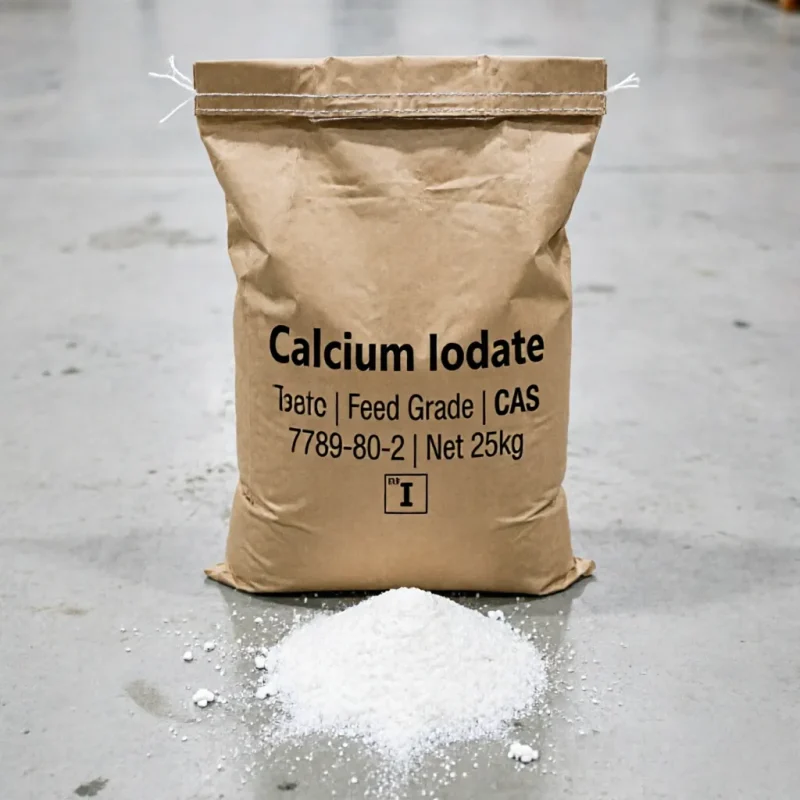
Calcium Iodate (Feed & Food Grade) CAS 7789-80-2
Calcium Iodate (Feed & Food Grade) is a highly stable inorganic iodine supplement supplied as white to slightly yellowish crystalline powder. Its low hygroscopicity and excellent compatibility with trace minerals make it the premier iodine source for animal feed premixes, table salt iodization, and bakery dough conditioning. Each shipment includes COA, TDS, and SDS.
- CAS No: 7789-80-2
- Synonyms: Calcium diiodate, Iodic acid calcium salt, Calcium iodate anhydrous
- EC Number: 232-192-1
- Molecular Formula: Ca(IO3)2
- Molecular Weight: 389.89 g/mol
- Appearance: White to slightly yellowish crystalline powder or granules
- Purity: ≥ 99.0% (Feed & Food Grade)
- Packaging: 25 kg (55 lb) fiber drum with PE liner; 25 kg (55 lb) woven PP bag with PE liner. Custom packaging available upon request.
- Main Applications: Animal feed iodine supplement, food fortification (salt/bakery), pharmaceutical raw material
Introduction to Calcium Iodate
Calcium Iodate is an odorless, slightly water-soluble inorganic salt that serves as a critical bioavailable source of elemental iodine. In the animal nutrition industry, it is heavily favored over potassium iodide (KI) because it does not readily oxidize or react destructively with trace transition metals (like copper and iron) in complex mineral premixes. In human food applications, it functions as a reliable fortificant in iodized salt and as a slow-acting oxidizing dough conditioner in commercial baking.
The primary processing advantage is its exceptional chemical stability in dry, multi-ingredient blends, ensuring consistent iodine delivery from the feed mill to the animal. The critical storage risk is exposure to reducing agents, excessive moisture, and direct UV light, which can trigger the slow release of free iodine gas, causing the powder to turn yellow-brown and lose potency. Store drums in a dry, shaded warehouse below 30 °C (86 °F) and reseal the PE liner immediately after scooping.
Key Features of Calcium Iodate
- Superior premix stability. Unlike highly reactive potassium iodide, calcium iodate remains inert when blended with aggressive trace minerals (e.g., copper sulfate), preventing iodine loss during feed storage.
- Low hygroscopicity. The crystalline structure resists moisture absorption, preventing caking and ensuring excellent flowability in automated micro-dosing and blending equipment.
- Controlled dough oxidation. In baking, it acts as a slow-release oxidizing agent that strengthens gluten networks, improving dough tolerance and loaf volume without over-bleaching the flour.
- High elemental iodine content. Contains approximately 64% elemental iodine by weight, allowing for precise, low-volume dosing in concentrated nutritional supplements.
Calcium Iodate Chemical & Physical Properties
| Property | Value |
|---|---|
| Molecular Formula | Ca(IO3)2 |
| Molecular Weight | 389.89 g/mol |
| Thermal Behaviour | Decomposes above 540 °C (1,004 °F) releasing oxygen and iodine vapors. Thermally stable under standard feed pelleting temperatures. |
| Density | Crystal density approx. 4.52 g/cm³; bulk powder density 1.20–1.50 g/cm³ (75–94 lb/ft³). |
| Solubility in Water | Slightly soluble, approx. 0.1 g / 100 mL at 20 °C (68 °F); soluble in dilute acids and aqueous solutions of alkali iodides. |
| pH (saturated aqueous solution) | ~ 6.0 – 7.5 (Neutral to slightly acidic) |
| Heavy Metals (as Pb) | ≤ 5 ppm (Feed/Food Grade) |
| Arsenic (as As) | ≤ 3 ppm (Feed/Food Grade) |
| Free Iodine | Passes test (No yellow/brown discoloration) |
Applications of Calcium Iodate
Animal feed and mineral premixes: Dosed at micro-levels (typically 0.5–2.0 ppm of elemental iodine in final feed) to prevent goiter, ensure proper thyroid function, and promote optimal growth rates in poultry, swine, and ruminants. Preferred in premixes containing high levels of copper or iron.
Food fortification (Table salt and flour): Added at 20–50 mg/kg in edible salt for human consumption to prevent iodine deficiency disorders (IDD). More stable than KI in humid climates, preventing the salt from turning yellow and smelling of iodine.
Bakery and dough conditioning: Used at 10–30 ppm in commercial bread formulations. It oxidizes sulfhydryl groups in gluten proteins, improving dough elasticity, gas retention, and final loaf volume.
Storage & Safety Precautions for Calcium Iodate
- Storage: Keep tightly sealed in a cool, dry, and well-ventilated warehouse below 30 °C (86 °F). Protect from direct sunlight, moisture, and reducing agents. If the white powder develops a distinct yellow or purple tint, it indicates the release of free iodine due to degradation—evaluate for rejection.
- Safety: Mild irritant. Avoid generating dust during transfer. Wear standard dust masks, safety goggles, and nitrile gloves. Ingestion of large, undiluted quantities can cause gastrointestinal distress and thyroid dysfunction; handle pure concentrate with care.
- Transport: Calcium Iodate is Non-DG under IATA/IMDG/ADR. Not a marine pollutant. Standard 25 kg (55 lb) drums or bags ship in standard dry containers. Avoid shipping in containers prone to extreme heat or condensation.
- QC note: Verify assay via iodometric titration (using sodium thiosulfate) upon receipt. Inspect for any yellowish discoloration or iodine odor, which indicates poor stabilization or moisture ingress during transit.
Calcium Iodate FAQ
Q: Why choose Calcium Iodate over Potassium Iodide (KI) for feed premixes?
A: KI is highly reactive and easily oxidized by trace minerals like copper and iron, leading to severe iodine loss and yellowing of the premix. Calcium iodate is chemically stable, ensuring the iodine survives months of storage in complex mineral blends.
Q: My calcium iodate powder has a slight yellow tint. Is it safe to use?
A: A yellow tint indicates the presence of free iodine, meaning the compound has partially degraded due to moisture, heat, or contact with reducing agents. Run an iodometric titration; if the assay drops below specification, reject the lot.
Q: Is this product suitable for both human food and animal feed?
A: Yes, our ≥ 99.0% grade meets both FCC (Food Chemicals Codex) and typical feed-grade purity standards, including strict limits on heavy metals (Pb, As). Always verify local regulatory compliance for specific fortification limits.
Related products
Manufacturer & Exporter Since 2006
Get Tailored Chemical Raw Material Solutions — Reply Within 1 Hour
Factory-direct pricing, stable high-purity supply and complete compliance documentation for your industrial formulations.
- 1000+Products
- 200+QC Protocols
- 7–15Days Delivery
- Factory-Direct Pricing
- COA / TDS / SDS Included
- Free Samples for Testing
- 40+ Export Countries
Request a Free Quote
Our engineers reply within 1 hour during GMT+8 business hours.
Please include in your inquiry:
- Product name or CAS number
- Required quantity
- Destination country or port
- Preferred packaging