
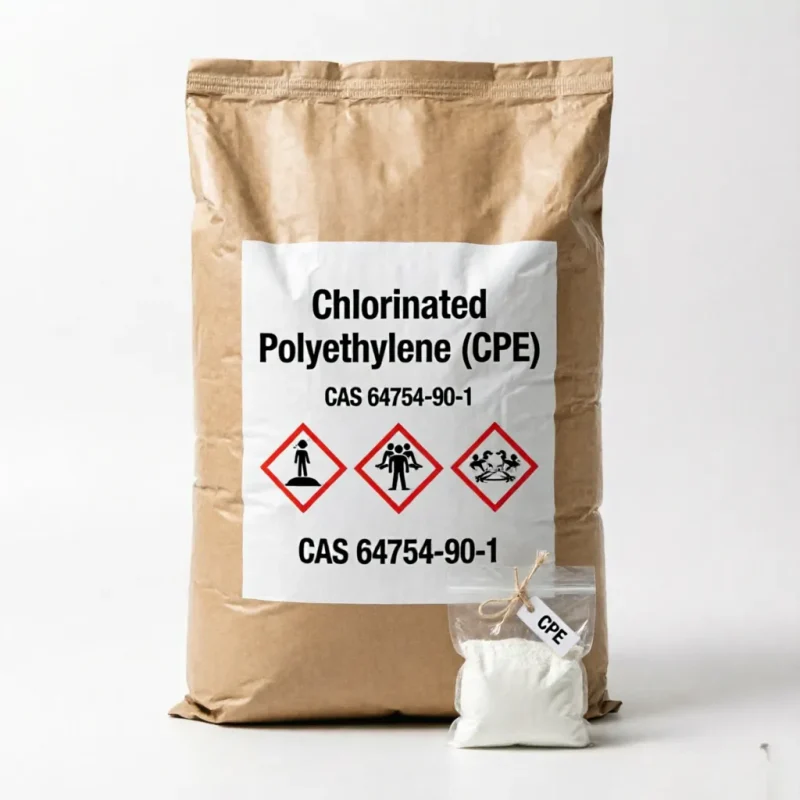
Chlorinated Polyethylene (CPE) CAS 64754-90-1
Chlorinated Polyethylene (CPE) is a saturated elastomeric polymer supplied as a free-flowing white powder. Produced by the controlled chlorination of high-density polyethylene (HDPE), it combines the chemical resistance of PVC with the flexibility of polyethylene. Core uses include PVC impact modification, wire & cable jacketing, and specialty rubber compounding. Each shipment includes COA, TDS, and SDS.
- CAS No: 64754-90-1
- Synonyms: CPE, Polyethylene chlorinated, CPE 135A, Chlorinated PE elastomer
- EC Number: Polymer Exempt / Registered
- Molecular Formula: [CH2-CHCl-CH2-CH2]n
- Appearance: White, free-flowing powder or granules
- Chlorine Content: 34.0% – 36.0% (Standard Grade 135A)
- Volatile Matter: ≤ 0.30%
- Packaging: 25 kg (55 lb) PP woven bag with PE liner; 1000 kg (2200 lb) jumbo bag (ton bag). Custom packaging available upon request.
- Main Applications: PVC impact modifier (profiles, pipes, sheets), wire & cable insulation, roofing membranes, CM rubber compounding
Introduction to Chlorinated Polyethylene (CPE)
Chlorinated Polyethylene (CPE) is a saturated elastomeric polymer obtained by the substitution of hydrogen atoms in high-density polyethylene (HDPE) with chlorine atoms. The random distribution of chlorine along the polymer chain prevents crystallization, yielding a flexible, rubber-like material at room temperature. The most widely used grade, CPE 135A (containing ~35% chlorine), acts as a highly efficient impact modifier for rigid PVC, significantly improving low-temperature toughness and weatherability without sacrificing tensile strength.
In the wire and cable industry, CPE serves as a premium halogenated elastomer for jacketing and insulation, offering inherent flame retardancy, oil resistance, and excellent ozone stability. For rubber applications, it can be crosslinked using peroxide or thiadiazole curing systems to produce Chlorinated Polyethylene Rubber (CM), which is extensively used in automotive hoses, magnetic strips, and heavy-duty conveyor belts. The critical processing parameter is maintaining extrusion temperatures below 180 °C (356 °F) to prevent dehydrochlorination and subsequent discoloration.
Key Features of Chlorinated Polyethylene
- Exceptional PVC impact modification. Adding 5–15 phr of CPE 135A to rigid PVC formulations increases notched Izod impact strength by 300–500%, enabling the extrusion of durable window profiles and pressure pipes that withstand sub-zero temperatures.
- Inherent flame retardancy and oil resistance. The high chlorine content (34–36%) provides self-extinguishing properties (UL 94 V-0 rating in formulated compounds) and excellent resistance to mineral oils and greases, making it ideal for industrial cable sheathing.
- Superior weather and ozone stability. The fully saturated polymer backbone lacks double bonds, rendering CPE completely immune to ozone cracking and UV degradation, outperforming unsaturated rubbers like NBR or SBR in outdoor applications.
- Excellent filler acceptance. CPE can accept high loadings of calcium carbonate, alumina trihydrate (ATH), or carbon black without severe loss of mechanical properties, allowing compounders to optimize material costs in rubber and plastic profiles.
- Good low-temperature flexibility. Maintains elastomeric properties and flexibility down to -40 °C (-40 °F), ensuring reliable performance of wire insulation and roofing membranes in freezing climates.
Chlorinated Polyethylene Chemical & Physical Properties
| Property | Value |
|---|---|
| Molecular Formula | [CH2-CHCl-CH2-CH2]n |
| Chlorine Content | 34.0% – 36.0% (Standard Grade 135A) |
| Volatiles | ≤ 0.30% |
| Ash Content | ≤ 0.10% |
| Bulk Density | 0.45 – 0.55 g/cm³ (28.1 – 34.3 lb/ft³) |
| Specific Gravity | 1.15 – 1.20 g/cm³ (71.8 – 74.9 lb/ft³) |
| Mooney Viscosity (ML 1+4 125°C) | 70 – 90 (for rubber grades) |
| Shore A Hardness (Vulcanized) | 60 – 85 (depending on formulation) |
| Thermal Decomposition | Onset of dehydrochlorination above 180 °C (356 °F). |
Applications of Chlorinated Polyethylene
PVC Impact Modification (Profiles, Pipes, and Sheets): Blend 5–15 phr of CPE 135A with PVC resin, stabilizers, and lubricants during high-speed mixing. Extrude into window profiles, corrugated roofing sheets, or pressure pipes. CPE forms a co-continuous network phase that absorbs impact energy, preventing brittle fracture at -20 °C (-4 °F) and improving weld-line strength.
Wire & Cable Jacketing and Insulation: Compound CPE with plasticizers (e.g., TOTM or DOP), flame retardants (ATH/Sb2O3), and stabilizers for continuous vulcanization (CV) lines. Used for mining cables, welding cables, and automotive ignition wires, providing oil resistance, flame retardancy, and flexibility from -40 °C to +105 °C (-40 °F to +221 °F).
Specialty Rubber (CM) Compounding: Crosslink CPE using peroxide (e.g., DCP) or thiadiazole curing systems to manufacture automotive coolant hoses, magnetic strips for refrigerator doors, and heavy-duty conveyor belts. Offers superior heat aging and weather resistance compared to EPDM or Neoprene (CR) in specific cost-performance matrices.
Waterproofing Membranes and Sealants: Calendered or extruded CPE sheets are used in geomembranes for landfills, artificial lakes, and tunnel waterproofing due to their excellent chemical resistance to soil acids and alkalis, and long-term UV stability.
Storage & Safety Precautions for Chlorinated Polyethylene
- Storage: Store in original woven bags or jumbo bags in a cool, dry, and well-ventilated warehouse below 35 °C (95 °F). Protect from direct sunlight and moisture. Although CPE is non-hygroscopic, moisture absorption exceeding 0.3% will cause surface defects (blisters) during high-temperature extrusion. Reseal opened bags tightly.
- Safety: Non-toxic and not classified as hazardous under GHS. Avoid inhalation of dust during pneumatic conveying or high-speed mixing; wear standard dust masks (N95) and safety glasses. In case of thermal degradation above 200 °C (392 °F), it may release hydrogen chloride (HCl) gas—ensure adequate exhaust ventilation in extrusion facilities.
- Transport: Chlorinated Polyethylene is Non-DG under IATA/IMDG/ADR. No UN number, no packing group. Standard dry cargo transport is acceptable. Avoid stacking jumbo bags more than two high to prevent compaction and liner rupture.
- QC note: Verify chlorine content (34–36%) and volatile matter (≤ 0.30%) upon receipt. Run a standard Brabender plastograph or torque rheometer test with your baseline PVC formulation to confirm fusion time and impact compatibility before approving the lot for full-scale production.
Chlorinated Polyethylene FAQ
Q: What is the difference between CPE 135A and CPE 135C?
A: Both have ~35% chlorine content, but they differ in residual crystallinity and molecular weight distribution. CPE 135A has lower crystallinity and is primarily used as a PVC impact modifier. CPE 135C has higher molecular weight and is optimized for rubber compounding (CM rubber) where higher green strength and mechanical properties are required after vulcanization.
Q: Why did my PVC extrusion profile show yellowing and black specks when using CPE?
A: This indicates thermal degradation (dehydrochlorination) of the CPE. CPE begins releasing HCl above 180 °C (356 °F). Ensure your PVC thermal stabilizer package (e.g., lead-based, Ca/Zn, or organotin) is sufficient to neutralize the HCl released by both the PVC and the CPE, and verify that extrusion barrel temperatures do not exceed safe processing limits.
Q: Can CPE be used as a standalone rubber without blending with PVC?
A: Yes. When compounded with appropriate fillers, plasticizers, and a peroxide or thiadiazole curing system, CPE acts as a standalone specialty elastomer (CM rubber). It is widely used for automotive hoses, magnetic strips, and industrial wire jacketing where oil, ozone, and weather resistance are critical.
Related products
Manufacturer & Exporter Since 2006
Get Tailored Chemical Raw Material Solutions — Reply Within 1 Hour
Factory-direct pricing, stable high-purity supply and complete compliance documentation for your industrial formulations.
- 1000+Products
- 200+QC Protocols
- 7–15Days Delivery
- Factory-Direct Pricing
- COA / TDS / SDS Included
- Free Samples for Testing
- 40+ Export Countries
Request a Free Quote
Our engineers reply within 1 hour during GMT+8 business hours.
Please include in your inquiry:
- Product name or CAS number
- Required quantity
- Destination country or port
- Preferred packaging