
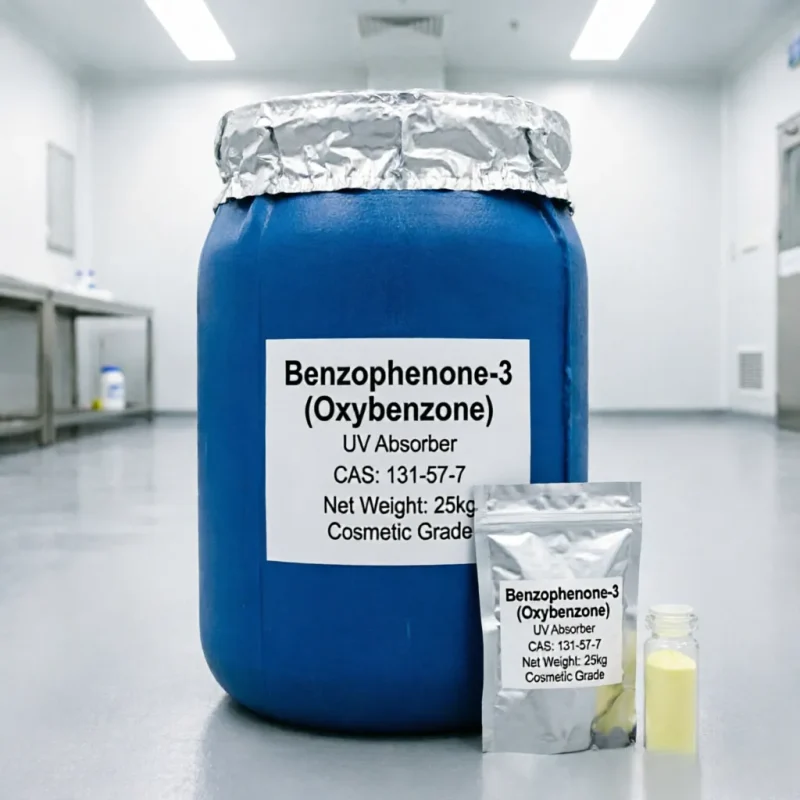
Benzophenone-3 (Oxybenzone) | UV Absorber CAS 131-57-7
Benzophenone-3 (Oxybenzone) is a benzophenone-class UV absorber supplied as light yellow crystalline powder. The 2-hydroxy-4-methoxybenzophenone structure creates an intramolecular hydrogen bond that dissipates UVB (288 nm) and partial UVA (350 nm) radiation as harmless heat. Core uses include plastic anti-weathering, industrial coatings, and cosmetic sunscreens. Each shipment includes COA, TDS, and SDS.
- CAS No: 131-57-7
- Synonyms: Oxybenzone, 2-Hydroxy-4-methoxybenzophenone, Eusolex 4360, UV-9
- EC Number: 205-031-5
- Molecular Formula: C14H12O3
- Molecular Weight: 228.24 g/mol
- Appearance: Light yellow to pale yellow crystalline powder
- Purity (HPLC): ≥ 99.0%
- Melting Point: 62–65 °C (144–149 °F)
- Packaging: 25 kg (55 lb) fiber drum with PE liner; 500 kg (1,100 lb) pallet. Custom packaging available upon request.
- Main Applications: PVC/PE/PP stabilization, automotive coatings, sunscreen formulations
Introduction to Benzophenone-3
Benzophenone-3 (Oxybenzone) is a light yellow crystalline UV absorber built on a diaryl ketone backbone with a hydroxyl group ortho to the carbonyl. This specific ortho-hydroxy arrangement enables rapid keto-enol tautomerization, converting absorbed ultraviolet energy into thermal dissipation without degrading the molecule. Polymer compounders and coating formulators use this material to block UVB and short-wave UVA, preventing yellowing and embrittlement in outdoor plastics and clear coats.
The main formulation advantage is broad resin compatibility, dissolving cleanly into PVC, polyolefins, and solvent-borne acrylics without blooming at standard loadings. The critical processing risk is sublimation. At extrusion temperatures above 200 °C (392 °F), Benzophenone-3 vaporizes and condenses on chill rolls or mold surfaces, causing plate-out. Keep processing temperatures controlled and pair with a hindered amine light stabilizer (HALS) for synergistic long-term weatherability.
Key Features of Benzophenone-3
- Broad-spectrum UV absorption. The conjugated ketone system captures photons at 288 nm (UVB) and 350 nm (UVA), shielding underlying polymer chains from photo-oxidative cleavage.
- Intramolecular energy dissipation. The ortho-hydroxy hydrogen bond acts as a reversible thermal switch, returning the molecule to its ground state after each UV exposure cycle without permanent chemical fatigue.
- High compatibility with non-polar resins. The lipophilic methoxy and phenyl groups ensure complete solubility in polyolefins and PVC plastisols, preventing surface migration and bloom.
- Synergy with HALS. Benzophenone-3 scavenges UV photons at the surface, while hindered amine light stabilizers neutralize bulk radicals, doubling the service life of agricultural films and automotive profiles.
- Low volatility at coating cure temperatures. The 228 g/mol molecular weight provides sufficient vapor pressure stability during 150 °C (302 °F) bake cycles for industrial powder and liquid coatings.
Benzophenone-3 Chemical & Physical Properties
| Property | Value |
|---|---|
| Molecular Formula | C14H12O3 |
| Molecular Weight | 228.24 g/mol |
| Melting Point | 62–65 °C (144–149 °F) |
| Thermal Behaviour | Decomposes above 300 °C (572 °F); prone to sublimation at processing temperatures exceeding 200 °C (392 °F). |
| Density | Crystal density approx. 1.22 g/cm³ (76.2 lb/ft³); bulk powder density 0.50–0.60 g/cm³ (31.2–37.5 lb/ft³). |
| Solubility | Insoluble in water; highly soluble in ethanol, acetone, toluene, and most organic solvents. |
| Absorption Maximum | 288 nm and 350 nm (in methanol) |
| Ash Content | ≤ 0.10% (ASTM D482) |
Applications of Benzophenone-3
PVC and polyolefin weatherability: Dosed at 0.2–0.5 phr, the ortho-hydroxy ketone absorbs incident UV before it reaches the polymer backbone, preventing carbonyl formation and chain scission. Essential for agricultural greenhouse films and outdoor window profiles.
Automotive and industrial clear coats: Added at 1.0–3.0% by weight in acrylic or polyurethane topcoats, it blocks UV-induced yellowing and gloss loss. The molecule remains stable through standard 150 °C (302 °F) forced-dry bake cycles.
Cosmetic sunscreen formulations: Used at 2.0–10.0% in oil-in-water emulsions, it provides primary UVB protection and secondary UVA shielding. Formulators must solubilize it completely in the oil phase at 80 °C (176 °F) to prevent crystallization upon cooling.
Adhesives and sealants: Blended at 0.5–1.5% in polyurethane and silicone sealants, it prevents UV-induced loss of adhesion and surface chalking on exterior building joints.
Storage & Safety Precautions for Benzophenone-3
- Storage: Keep sealed in original fiber drums at 5–30 °C (41–86 °F). The powder is stable but can absorb trace moisture if left open, which complicates dispersion in moisture-sensitive polyurethane systems. Keep away from strong oxidizers.
- Safety: Classified as a skin sensitiser and aquatic toxin (GHS H317, H411). Wear nitrile gloves and dust masks during weighing. Oxybenzone dust easily becomes airborne due to low bulk density; use local exhaust ventilation.
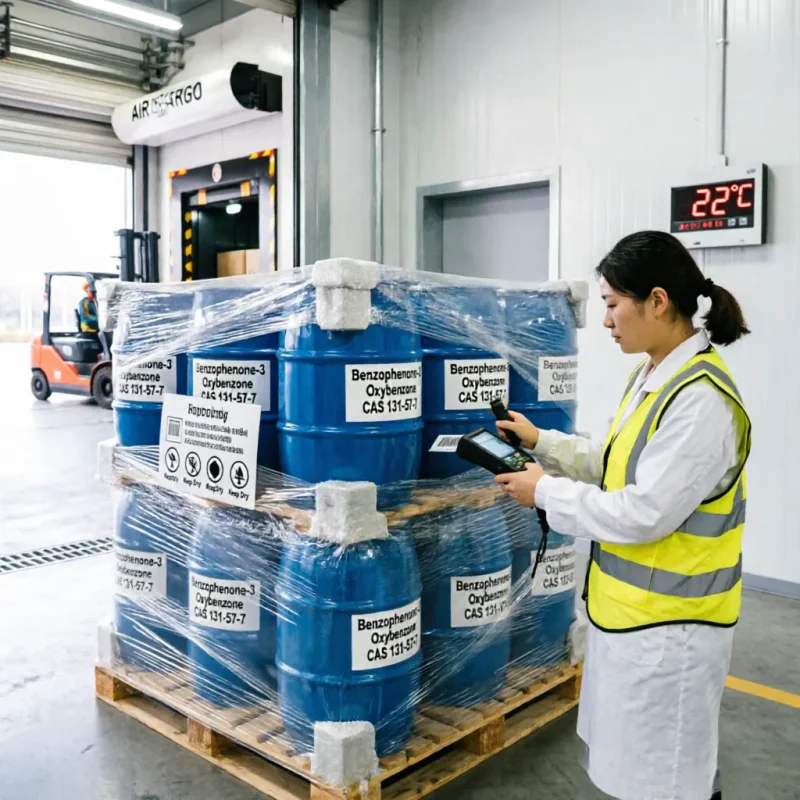
- Transport: Benzophenone-3 is Non-DG under IATA/IMDG/ADR. Ship in standard dry containers. Avoid stowing near heat sources to prevent localized melting and caking inside the drums.
- QC note: Verify purity and melting point upon receipt. A depressed melting point (below 60 °C / 140 °F) or dark yellow color indicates thermal degradation or solvent residue from the crystallization step. Reject lots showing signs of drum-internal sublimation (crystals on the lid).
Benzophenone-3 FAQ
Q: Why does Benzophenone-3 (CAS 131-57-7) cause plate-out on my extrusion die?
A: Sublimation causes this. Above 200 °C (392 °F), the molecule vaporizes and condenses on cooler metal surfaces. Lower the processing temperature, reduce the dosage, or switch to a higher molecular weight UV absorber like Benzophenone-12 to prevent die buildup.
Q: Can I use Benzophenone-3 alone for long-term outdoor plastic exposure?
A: Not recommended alone. It absorbs UV but does not neutralize bulk free radicals. Combine with a HALS (Hindered Amine Light Stabilizer) for synergistic protection. This dual-action approach stops surface degradation and prevents long-term polymer embrittlement.
Q: My cosmetic emulsion turned grainy after adding Oxybenzone. What happened?
A: Incomplete solubilization. Oxybenzone requires heat to dissolve in oils. Heat the oil phase to at least 80 °C (176 °F) to dissolve the powder completely before emulsification. Cool the batch slowly with continuous stirring to prevent the UV filter from recrystallizing.
Related products
Manufacturer & Exporter Since 2006
Get Tailored Chemical Raw Material Solutions — Reply Within 1 Hour
Factory-direct pricing, stable high-purity supply and complete compliance documentation for your industrial formulations.
- 1000+Products
- 200+QC Protocols
- 7–15Days Delivery
- Factory-Direct Pricing
- COA / TDS / SDS Included
- Free Samples for Testing
- 40+ Export Countries
Request a Free Quote
Our engineers reply within 1 hour during GMT+8 business hours.
Please include in your inquiry:
- Product name or CAS number
- Required quantity
- Destination country or port
- Preferred packaging