
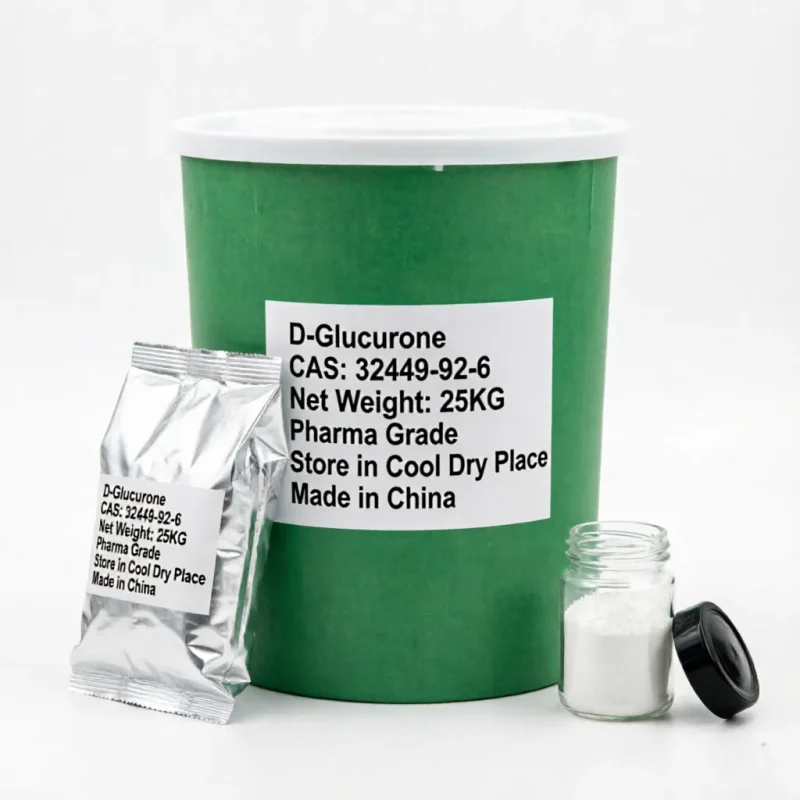
D-Glucurone CAS 32449-92-6
D-Glucurone is a cyclic ester of D-glucuronic acid supplied as white to off-white crystalline powder. It serves as a vital biochemical precursor in the glucuronidation detoxification pathway and is a key intermediate for synthesizing hepatoprotective drugs. Each shipment includes COA, TDS, and SDS.
- CAS No: 32449-92-6
- Synonyms: D-Glucurono-1,4-lactone, D-Glucuronic acid gamma-lactone, Glucurone
- EC Number: 251-053-4
- Molecular Formula: C6H8O6
- Molecular Weight: 176.12 g/mol
- Appearance: White to off-white crystalline powder
- Purity: ≥ 99.0%
- Specific Rotation: +18° to +22°
- Packaging: 25 kg (55 lb) fiber drum with PE liner; 25 kg (55 lb) woven PP bag with PE liner. Custom packaging available upon request.
- Main Applications: Hepatoprotective drug synthesis, biochemical research, organic chiral building block
Introduction to D-Glucurone
D-Glucurone is a highly water-soluble organic compound featuring a stable gamma-lactone ring. In mammalian metabolism, it acts as the functional precursor for UDP-glucuronic acid, enabling the liver to conjugate and excrete toxins, drugs, and bilirubin. Pharmaceutical manufacturers and biochemical laboratories consume the bulk of global output, utilizing it as the primary raw material for synthesizing hepatoprotective agents like Glucurolactone.
The primary processing advantage is its stable crystalline solid form, which prevents the rapid degradation seen in open-chain D-glucuronic acid solutions. The critical storage risk is moisture-induced hydrolysis. If exposed to humid air, the lactone ring slowly opens to form D-glucuronic acid, leading to powder clumping and altered optical rotation. Store drums in a climate-controlled warehouse below 25 °C (77 °F) and reseal the PE liner immediately after scooping.
Key Features of D-Glucurone
- Essential detoxification precursor. Serves as the foundational building block for hepatic glucuronidation, facilitating the water-solubilization and excretion of endogenous and exogenous toxins.
- High-purity pharmaceutical intermediate. Manufactured to strict specifications to ensure consistent yields in the synthesis of liver-protecting drugs and vitamin C derivatives.
- Stable lactone structure. The 1,4-lactone ring provides superior shelf-life and handling characteristics compared to the highly hygroscopic and unstable free acid form.
- Chiral synthesis building block. Utilized in advanced organic synthesis to introduce specific carbohydrate stereocenters into complex natural products and glycosides.
D-Glucurone Chemical & Physical Properties
| Property | Value |
|---|---|
| Molecular Formula | C6H8O6 |
| Molecular Weight | 176.12 g/mol |
| Melting Point | 165 – 170 °C (329 – 338 °F) with decomposition. |
| Density | Bulk density approx. 0.70–0.85 g/cm³ (43–53 lb/ft³). |
| Solubility in Water | Highly soluble, approx. 50 g / 100 mL at 20 °C (68 °F); slightly soluble in ethanol. |
| pH (5% aqueous solution) | 2.0 – 3.0 |
| Specific Rotation | [α]D20 +18° to +22° (c=10, H2O) |
| Heavy Metals (as Pb) | ≤ 10 ppm |
| Residual Solvents | Meets ICH Q3C guidelines for pharmaceutical intermediates. |
Applications of D-Glucurone
Pharmaceutical synthesis (Hepatoprotective drugs): Used as the primary starting material to manufacture Glucurolactone. This active pharmaceutical ingredient (API) is widely prescribed to treat chronic hepatitis, cirrhosis, and liver damage caused by toxins, as it directly replenishes the liver’s detoxification reserves.
Biochemical and enzymatic research: Serves as a reference standard and substrate for studying UDP-glucuronosyltransferase (UGT) enzyme kinetics. Researchers use it to map drug metabolism pathways and predict the clearance rates of new chemical entities in pre-clinical trials.
Organic and carbohydrate synthesis: Acts as a versatile chiral pool intermediate for synthesizing complex oligosaccharides, glycosides, and modified sugar analogs required in antiviral and anticancer drug development.
Storage & Safety Precautions for D-Glucurone
- Storage: Keep tightly sealed in a cool, dry warehouse below 25 °C (77 °F). The lactone ring is susceptible to hydrolysis in the presence of moisture; an opened drum left in humid conditions will absorb water, clump, and convert partially into D-glucuronic acid. Stack pallets away from exterior walls and use desiccants if necessary.
- Safety: Classified as non-hazardous. Wear standard dust masks and safety goggles when handling dry powder to avoid respiratory and eye irritation. Wash skin with water after contact.
- Transport: D-Glucurone is Non-DG under IATA/IMDG/ADR. Not a marine pollutant. Standard 25 kg (55 lb) drums or bags ship in standard dry containers.
- QC note: Verify specific rotation (+18° to +22°) and assay by HPLC upon receipt. Significant clumping or a shift in pH indicates moisture ingress and partial hydrolysis; evaluate carefully before use in sensitive API synthesis.
D-Glucurone FAQ
Q: How does D-Glucurone differ from D-Glucuronic Acid?
A: D-Glucurone is the stable, solid cyclic ester (lactone) form, whereas D-glucuronic acid is the open-chain acid form. In aqueous solutions, they slowly equilibrate, but the solid powder is supplied as the stable lactone for superior shelf-life and handling.
Q: Can it be used directly as a dietary supplement or drug?
A: It is sold as a pharmaceutical intermediate and chemical reagent. For therapeutic use, it must be formulated and approved as an API (like Glucurolactone) under strict GMP conditions by licensed pharmaceutical manufacturers.
Q: What happens if the powder is exposed to high humidity?
A: Prolonged exposure to moisture causes the lactone ring to hydrolyze into D-glucuronic acid, leading to powder clumping, altered specific rotation, and acidic degradation. Store tightly sealed below 25 °C (77 °F) with desiccants.
Related products
Manufacturer & Exporter Since 2006
Get Tailored Chemical Raw Material Solutions — Reply Within 1 Hour
Factory-direct pricing, stable high-purity supply and complete compliance documentation for your industrial formulations.
- 1000+Products
- 200+QC Protocols
- 7–15Days Delivery
- Factory-Direct Pricing
- COA / TDS / SDS Included
- Free Samples for Testing
- 40+ Export Countries
Request a Free Quote
Our engineers reply within 1 hour during GMT+8 business hours.
Please include in your inquiry:
- Product name or CAS number
- Required quantity
- Destination country or port
- Preferred packaging