
Paraffin Wax CAS 8002-74-2
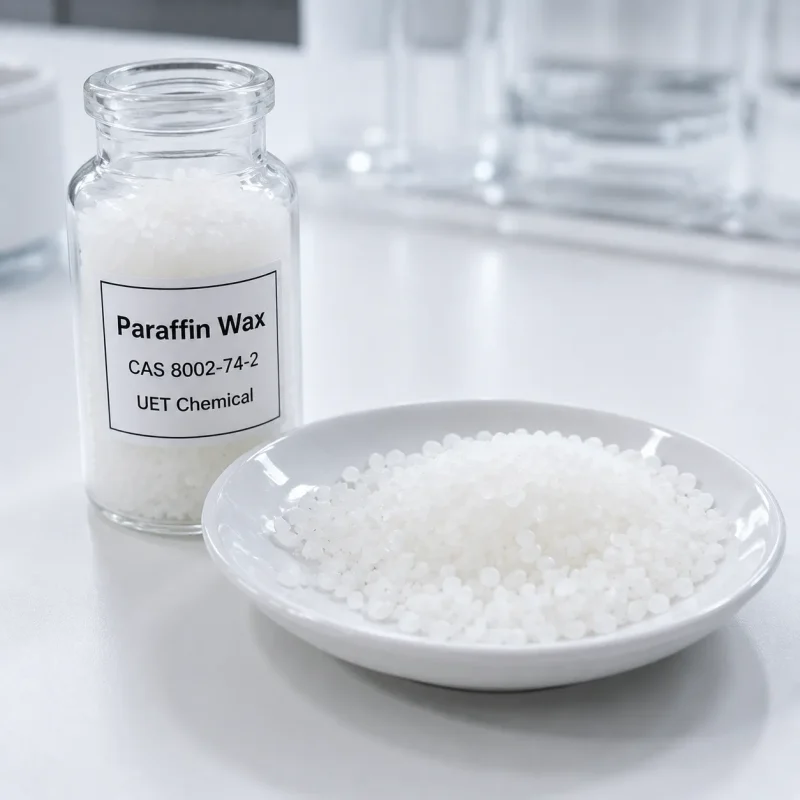
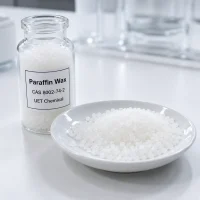
Paraffin Wax is a mixture of solid saturated hydrocarbons (alkanes) supplied as white slabs, pellets, or granules. UETChem supplies both fully refined and semi-refined grades with tight control over oil content and melting point, making it a core material for candle manufacturing, PVC lubrication, and hot melt adhesives. Each shipment includes COA, TDS, SDS.
- CAS No: 8002-74-2
- Synonyms: Paraffin wax; Petroleum wax; Alkane wax
- EINECS: 232-315-6
- Molecular Formula: CnH2n+2 (typically C20 to C40)
- Molecular Weight: 300-500 g/mol (average)
- Appearance: White solid (slabs, pellets, or granules)
- Melting Point: 58-62 °C (136-144 °F)
- Oil Content: 0.5% max (Fully Refined)
- Saybolt Color: +30 min
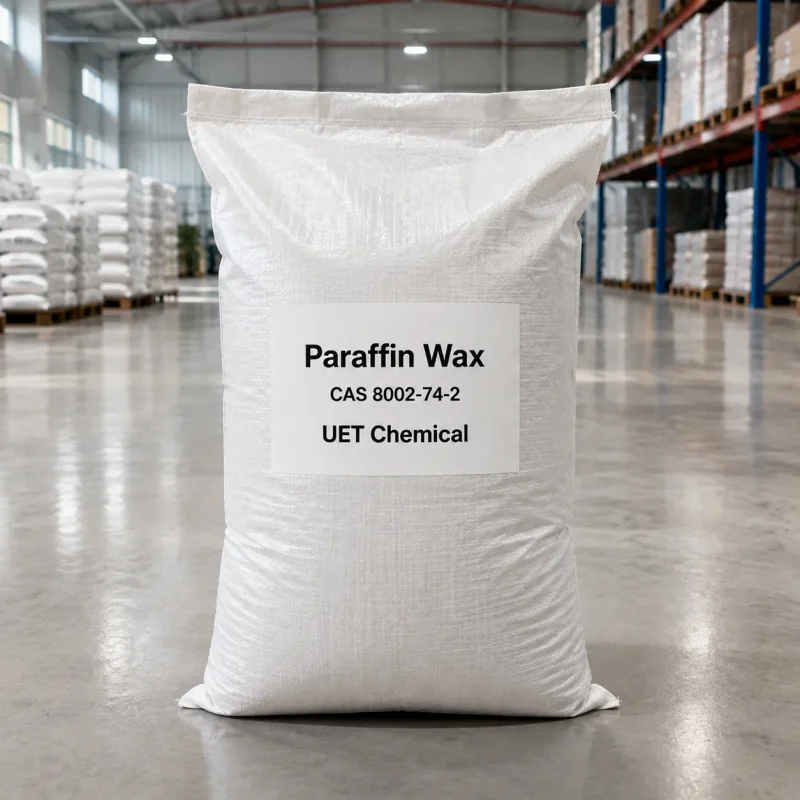
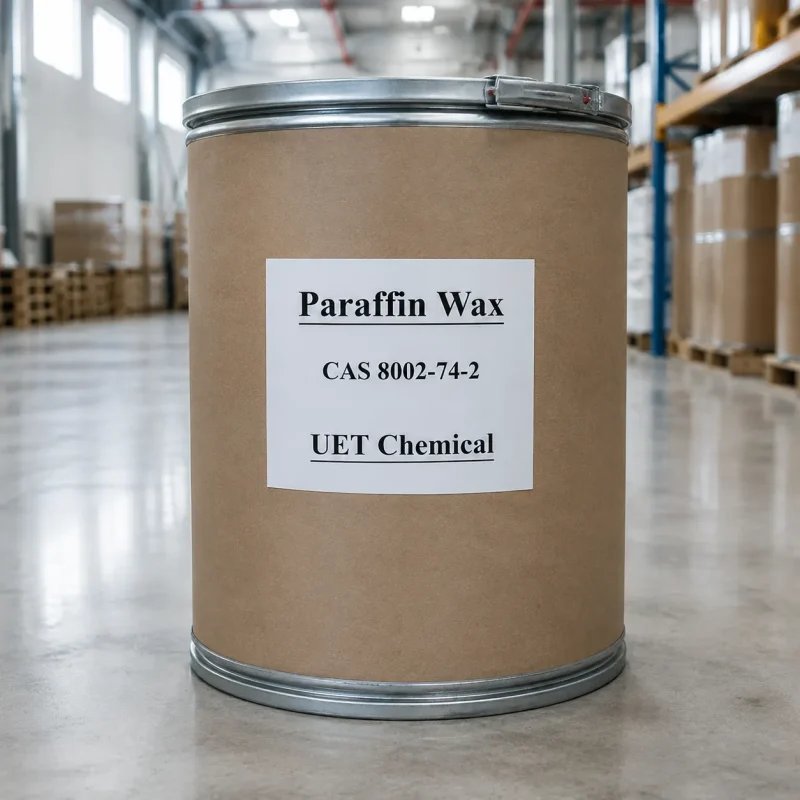
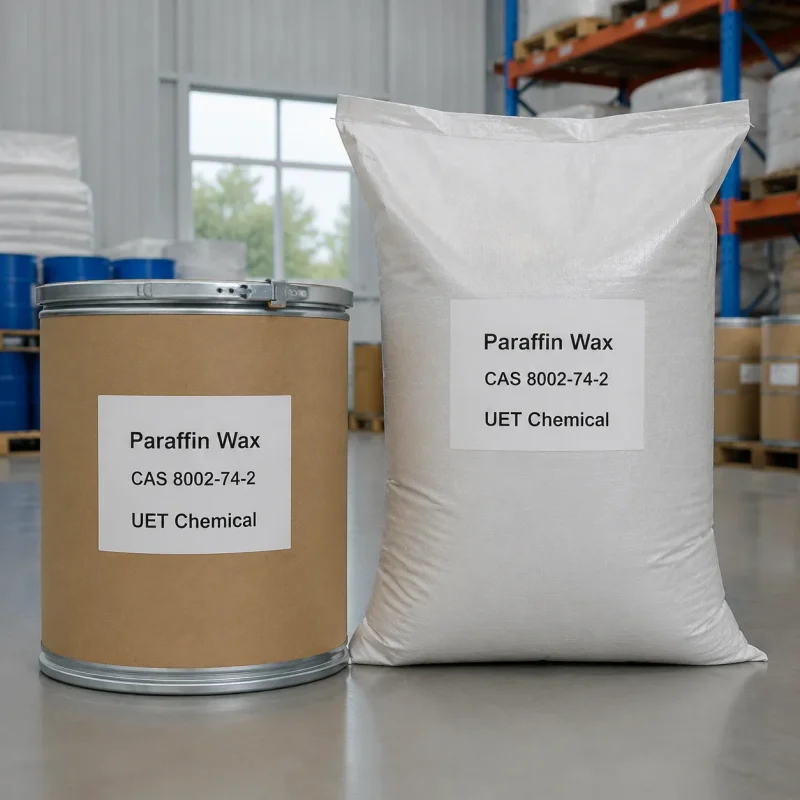
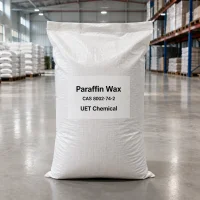
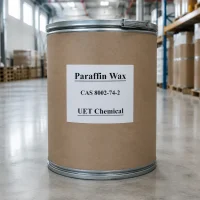
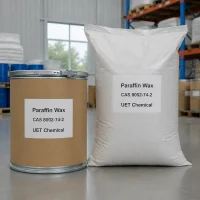
- Packaging: 25 kg (55 lb) bag, 50 kg (110 lb) carton. Custom packaging available upon request.
- Main Applications: Candle making, PVC processing, hot melt adhesives, packaging coatings
Introduction to Paraffin Wax
Paraffin Wax consists of straight-chain and branched saturated hydrocarbons extracted from petroleum distillates. The carbon chain length typically ranges from C20 to C40. Candle makers and plastic compounders rely on it for clean combustion, low melt viscosity, and excellent moisture barrier properties.
Fully refined grades contain less than 0.5% oil, ensuring no smoking or odor during candle burning. The main handling challenge is temperature control. Stacking heavy pallets in a hot warehouse causes the bottom slabs to fuse together into a solid block, while direct sunlight triggers UV degradation and yellowing. Always store pallets in shaded, ventilated areas.
Key Features of Paraffin Wax
- Low oil content: Fully refined grades keep oil below 0.5%, preventing wick clogging and smoke in container candles.
- Sharp melting transition: The narrow melting range allows precise control during hot-melt coating and PVC extrusion.
- High Saybolt color: A +30 color rating guarantees bright white slabs without the need for heavy optical brightener loading.
- Excellent moisture barrier: The non-polar hydrocarbon structure blocks water vapor transmission in paper and cardboard packaging.
Paraffin Wax Chemical & Physical Properties
| Property | Value |
|---|---|
| Molecular Formula | CnH2n+2 (C20-C40) |
| Average Molecular Weight | 300-500 g/mol |
| Melting Point | 58-62 °C (136-144 °F) |
| Flash Point | >200 °C (>392 °F) closed cup |
| Density | 0.90 g/cm³ at 20 °C (68 °F) |
| Oil Content | 0.5% max (Fully Refined) |
| Saybolt Color | +30 min |
| Penetration | 15-25 dmm at 25 °C (77 °F) |
Applications of Paraffin Wax
Candle manufacturing: Acts as the primary fuel source and structural matrix. Fully refined 58-60 °C grades provide rigid pillars, while softer blends suit container candles. Formulators often add Anatase Titanium Dioxide to achieve opaque white colors and Stearic Acid to increase hardness and opacity. Typical loading is 70-90% of the wax blend.
PVC external lubricant: Reduces friction between the polymer melt and the extruder barrel. Adding 0.1-0.5 phr improves output rates and prevents melt fracture in pipe and profile extrusion without delaying fusion time.
Hot melt adhesives and coatings: Lowers melt viscosity and sets rapidly upon cooling. Blends with EVA resins and tackifiers at 20-40% loading to formulate packaging seals and bookbinding glues.
Storage & Safety Precautions for Paraffin Wax
- Storage and heat management: Keep pallets in a dry, shaded warehouse below 35 °C (95 °F). Paraffin Wax softens near 45 °C (113 °F). Stacking heavy bags on top of each other in summer causes the bottom layers to fuse into a solid mass. Keep away from direct sunlight to prevent UV-induced yellowing.
- Safety and dust control: The solid wax is non-hazardous (Non-DG) for transport. However, fine wax dust generated during pellet grinding or slab cutting can form explosive mixtures in air. Ground all milling equipment and maintain dust collection systems. Molten wax causes severe thermal burns; wear heat-resistant gloves when handling dipping vats.
- Field note: When testing penetration or melting point, ensure the sample is fully melted and cooled at a controlled rate. Rapid cooling traps amorphous structures, skewing the penetration needle reading and giving false hardness data.
Paraffin Wax FAQ
Q: Why does my Paraffin Wax candle crack after cooling?
A: Cracking happens when Paraffin Wax cools too fast, creating internal stress. Pour at lower temperatures or pre-heat containers. Adding 3-5% Stearic Acid improves flexibility and prevents shrinkage cracks.
Q: What is the difference between fully refined and semi-refined Paraffin Wax?
A: Fully refined Paraffin Wax (CAS 8002-74-2) has an oil content below 0.5% and a Saybolt color of +30, making it odorless for candles. Semi-refined Paraffin Wax contains up to 1.5% oil and has a lower color grade, suiting industrial applications.
Q: Can Paraffin Wax be used as an internal lubricant in PVC?
A: No, Paraffin Wax is strictly an external lubricant. It migrates to the melt surface to reduce metal friction but does not interact with PVC chains. For internal lubrication to lower melt viscosity, use oxidized PE wax instead of Paraffin Wax.
Related products
Manufacturer & Exporter Since 2006
Get Tailored Chemical Raw Material Solutions — Reply Within 1 Hour
Factory-direct pricing, stable high-purity supply and complete compliance documentation for your industrial formulations.
- 1000+Products
- 200+QC Protocols
- 7–15Days Delivery
- Factory-Direct Pricing
- COA / TDS / SDS Included
- Free Samples for Testing
- 40+ Export Countries
Request a Free Quote
Our engineers reply within 1 hour during GMT+8 business hours.
Please include in your inquiry:
- Product name or CAS number
- Required quantity
- Destination country or port
- Preferred packaging