
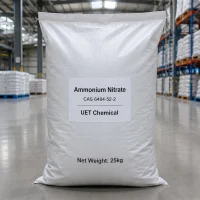
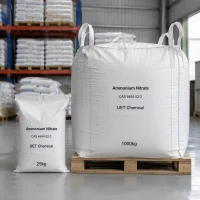
Ammonium Nitrate CAS 6484-52-2
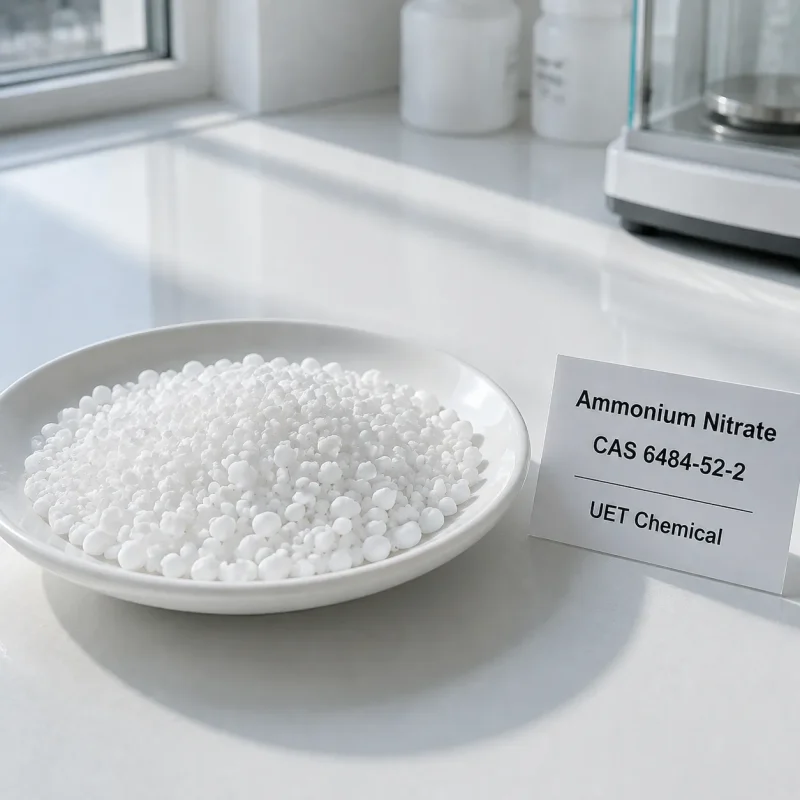
Ammonium Nitrate is a highly soluble inorganic salt providing dual-form nitrogen (ammonium and nitrate). Supplied as white prills or granules (≥34.4% total N), it serves as a fast-acting agricultural fertilizer, the primary oxidizer in ANFO industrial explosives, and the endothermic core of instant cold packs. We supply industrial and agricultural grades with strict moisture control and anti-caking treatment. As a Class 5.1 Oxidizer, each shipment includes full DG compliance documentation, COA, TDS, and SDS.
- CAS No.: 6484-52-2
- Synonyms: Nitrate of ammonia; Ammonium saltpeter
- EINECS: 229-347-8
- Molecular Formula: NH₄NO₃
- Molecular Weight: 80.04 g/mol
- Appearance: White crystalline prills or granules
- Total Nitrogen: ≥34.4%
- pH (10% aq.): 4.0–6.0
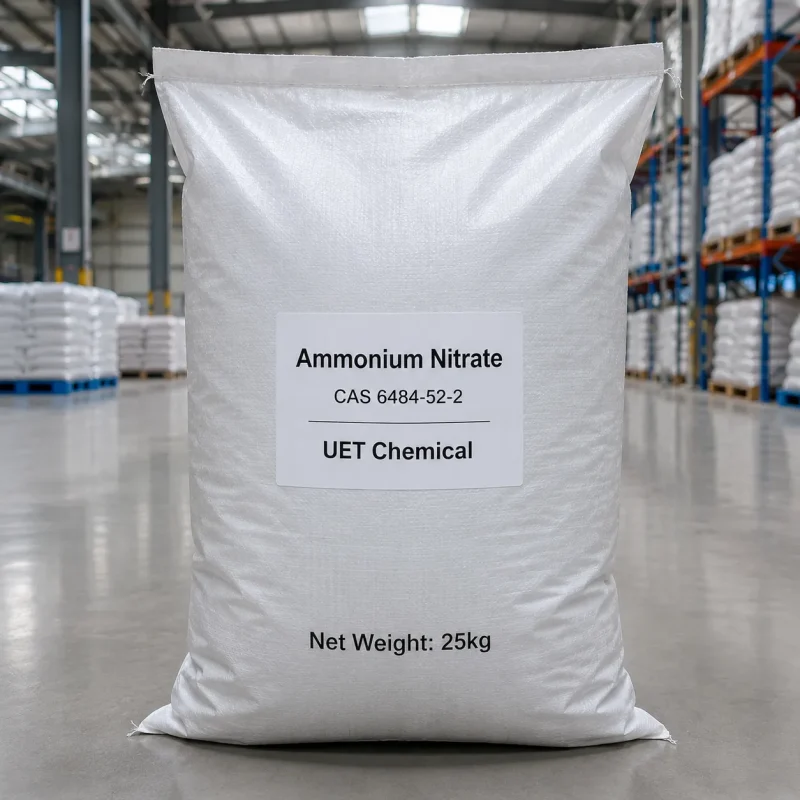
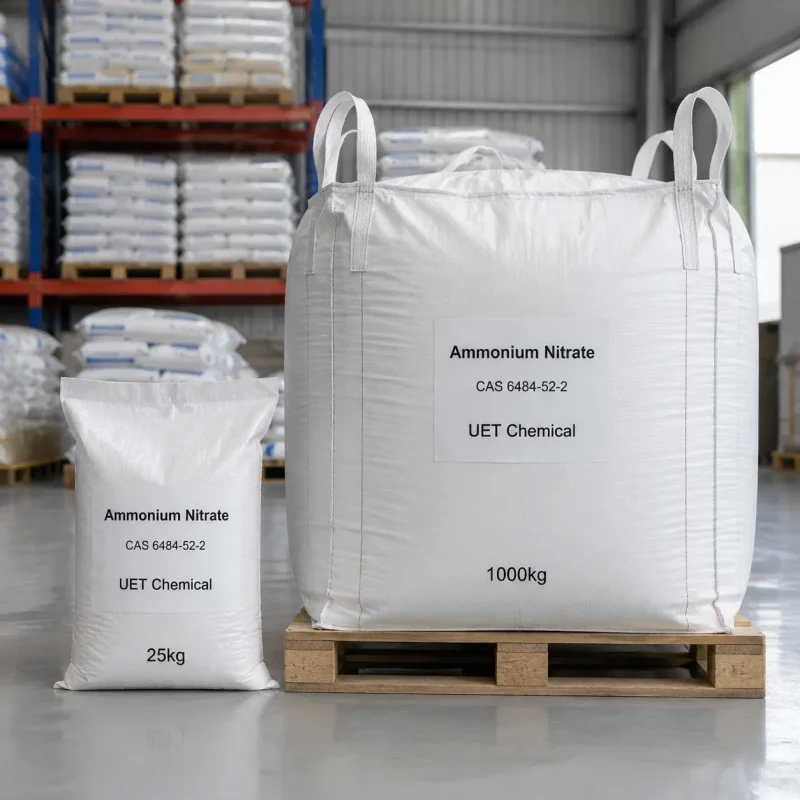
- Packaging: 25 kg / 50 kg UN-certified PP/PE woven bags / 1000 kg FIBC. Custom packaging available upon request.
- Main Applications: NPK fertilizer blends; ANFO blasting explosives; instant cold packs; nitrous oxide precursor
Introduction to Ammonium Nitrate
Ammonium Nitrate is supplied as white, free-flowing prills or granules, an inorganic salt composed of ammonium and nitrate ions. Delivering exactly half of its 34.4% nitrogen content as fast-acting nitrate and half as soil-retained ammonium, it is the backbone of high-analysis straight fertilizers and NPK compound blends. Beyond agriculture, its potent oxygen-releasing capability makes it the essential oxidizer in ANFO (Ammonium Nitrate Fuel Oil) blasting agents for mining, while its highly endothermic dissolution drives instant cold pack technology.
Because it is a powerful oxidizer, thermal stability and contamination control are non-negotiable. Pure Ammonium Nitrate melts at 169–170 °C [[1]] and remains stable under normal storage; however, contact with combustible organics, reducing agents, chlorides, or strong acids drastically lowers its decomposition threshold and can trigger catastrophic detonation under confinement or intense heat. We supply prills treated with trace anti-caking agents to prevent moisture-induced caking, packed in UN-certified, moisture-barrier liners to maintain free-flowing integrity during ocean transit.
Key Features of Ammonium Nitrate
- Dual-action nitrogen profile. Nitrate-N provides immediate vegetative uptake, while Ammonium-N binds to soil clay particles, preventing rapid leaching and extending the nutrient release window.
- High-energy oxidizer. Contains ~34% active oxygen by weight; rapidly decomposes to release N₂, H₂O, and O₂ gases, providing the oxygen balance required to detonate fuel oils in mining and quarrying operations.
- Endothermic dissolution. Absorbs roughly 330 J/g when dissolved in water, dropping the temperature of water-based mixtures below freezing within seconds for medical and athletic cold therapy.
- Extreme water solubility. Dissolves at ~200 g/100 mL at 20 °C [[6]], allowing rapid formulation of liquid nitrogen fertilizer solutions (UAN) when blended with urea.
- Moisture management. Highly hygroscopic; commercial prills are coated with microscopic clay or diatomaceous earth anti-caking agents to maintain bulk density and prevent rock-hard agglomeration in humid warehouses.
Ammonium Nitrate Chemical & Physical Properties
| Property | Value |
|---|---|
| Molecular Formula | NH₄NO₃ |
| Molecular Weight | 80.04 g/mol |
| Appearance | White prills or granules |
| Total Nitrogen | ≥34.4% (17.2% Nitrate-N, 17.2% Ammonium-N) |
| Melting Point | 169–170 °C [[1]] |
| Density (solid) | ~1.72 g/cm³ [[3]] |
| Bulk Density | 0.90–1.05 g/cm³ (prilled) |
| Solubility in Water | ~200 g/100 mL (20 °C) [[6]] |
| pH (10% aq. solution) | 4.0–6.0 |
| Moisture Content | ≤0.5% |
Applications of Ammonium Nitrate
Agricultural fertilizers: Broadcast-applied as a straight 34-0-0 top-dress for cereals and pastures, or granulated with phosphates and potash to manufacture high-analysis NPK complexes.
Mining and quarrying explosives: Crushed and blended with 6% fuel oil to manufacture ANFO. The nitrate ion supplies the oxygen to oxidise the hydrocarbon fuel, generating high-pressure shockwaves for rock fragmentation.
Instant cold packs: Packed in a sealed inner plastic pouch surrounded by water. Rupturing the pouch initiates an endothermic dissolution, dropping the pack temperature to 2–4 °C for acute sports injury compression.
Chemical synthesis and propellants: Serves as the precursor for nitrous oxide (N₂O, laughing gas) via controlled thermal decomposition at 200–250 °C, and as an oxidizer in certain solid rocket propellant formulations.
Wastewater treatment: Dosed into anoxic biological treatment zones as a soluble electron acceptor, supporting denitrifying bacteria in converting organic carbon to CO₂ while reducing nitrate to N₂ gas.
Storage & Safety Precautions for Ammonium Nitrate
Storage conditions. Store in a dedicated, single-story, fire-resistant warehouse with excellent ventilation, strictly below 30 °C. Keep completely isolated from combustible materials (wood, paper, oils, sulfur), chlorides, strong acids, and metallic powders. Do not stack bulk bags on wooden pallets if the wood is treated or degraded; use plastic or clean, untreated timber.
Safety and PPE. GHS: Ox. Sol. 2 (H272); Acute Tox. 4 (H302, H332). May intensify fire; toxic nitrogen oxide (NOx) fumes are generated during combustion. Wear heavy-duty nitrile gloves, safety goggles, and a particulate respirator during handling. In case of fire involving Ammonium Nitrate, evacuate immediately and fight the fire with massive quantities of water from a safe distance—never use extinguishers or smothering agents.
Transport classification. UN 1942 (Ammonium Nitrate) or UN 2067 (Fertilizer), Class 5.1 Oxidizer, Packing Group III [[10]]. Strict DG declaration, placarding, and segregation rules apply for ocean and air freight. Vessel stowage must be “away from” heat sources and organic cargo.
Practitioner note: Never attempt to melt or grind Ammonium Nitrate in confined steel vessels where rust, organic grease, or chloride contamination may be present. Localized heating above 210 °C initiates autocatalytic decomposition that can transition to detonation. If prills cake into a solid mass, dissolve them in warm water for liquid application; do not use dynamite, blasting caps, or heavy mechanical force to break the block.
Ammonium Nitrate FAQ
Q: How do I prevent Ammonium Nitrate (CAS 6484-52-2) from turning into a solid rock in my warehouse?
A: Ammonium Nitrate is extremely hygroscopic and undergoes temperature-dependent crystal phase transitions that lock prills together. Store strictly below 30 °C in a dry warehouse (RH < 60%), keep bags sealed on plastic pallets off the floor, and never expose the cargo to diurnal temperature swings. If caking occurs, the chemical is still active but must be dissolved in water for liquid side-dressing rather than dry broadcasting.
Q: Can I store Ammonium Nitrate in the same bay as urea or superphosphate?
A: No. Mixing Ammonium Nitrate with urea creates a highly hygroscopic mixture that will liquefy and form corrosive, unstable solutions. Contact with superphosphate or chlorides introduces acidic and catalytic impurities that drastically lower the thermal decomposition threshold. Always maintain strict physical segregation in dedicated oxidizer bays.
Q: Why is it classified as an explosive in some regions but a fertilizer in others?
A: Pure Ammonium Nitrate (UN 1942) is a Class 5.1 Oxidizer [[13]]. It only becomes a Class 1 Explosive (blasting agent) when intentionally sensitized with fuel oil (ANFO) or aluminum, or when heavily contaminated with organics and subjected to intense confinement and a strong initiating shock. Agricultural grades are strictly regulated globally to prevent diversion and accidental contamination.
Related products
Manufacturer & Exporter Since 2006
Get Tailored Chemical Raw Material Solutions — Reply Within 1 Hour
Factory-direct pricing, stable high-purity supply and complete compliance documentation for your industrial formulations.
- 1000+Products
- 200+QC Protocols
- 7–15Days Delivery
- Factory-Direct Pricing
- COA / TDS / SDS Included
- Free Samples for Testing
- 40+ Export Countries
Request a Free Quote
Our engineers reply within 1 hour during GMT+8 business hours.
Please include in your inquiry:
- Product name or CAS number
- Required quantity
- Destination country or port
- Preferred packaging