
BWD-01 Water Decoloring Agent (Cationic Polymer) CAS 55295-98-2
BWD-01 Water Decoloring Agent is a highly efficient cationic polymer supplied as a colorless to light yellow viscous liquid. Functioning via electrostatic neutralization and adsorption bridging, it rapidly destabilizes colloidal dye molecules, achieving >95% color removal and significant COD reduction in textile, printing, and dyeing wastewater. Each shipment includes COA, TDS, and SDS.
- CAS No: 55295-98-2
- Synonyms: BWD-01, Dicyandiamide formaldehyde resin, Polyamine decolorant, Cationic coagulant
- EC Number: N/A (Polymer mixture)
- Appearance: Colorless to light yellow viscous liquid
- Active Content (Solid Content): ≥ 50.0%
- pH (as supplied): 3.0 – 6.0
- Viscosity (25 °C / 77 °F): 50 – 500 cps
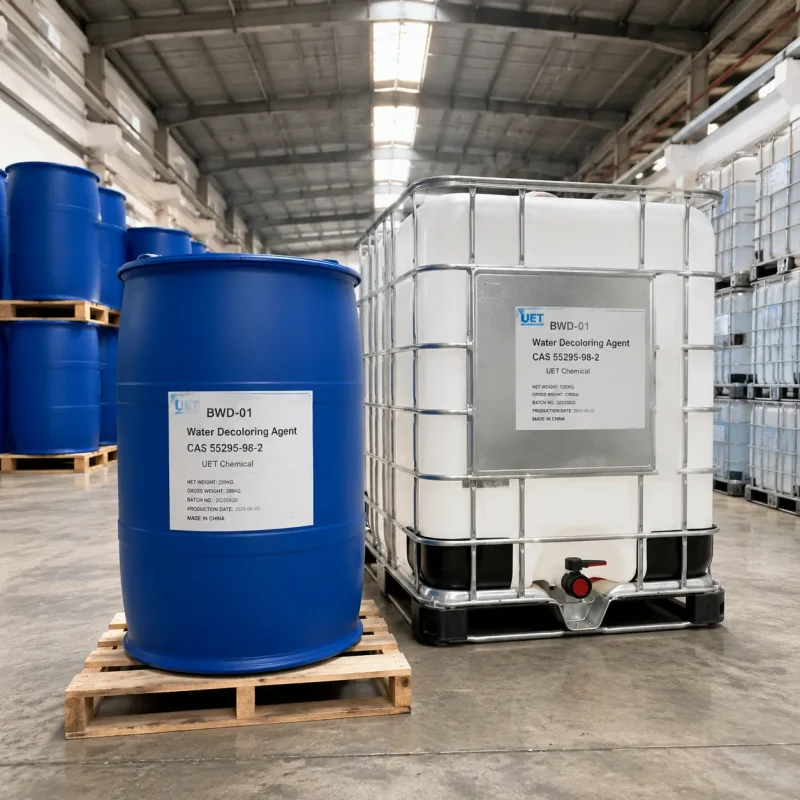
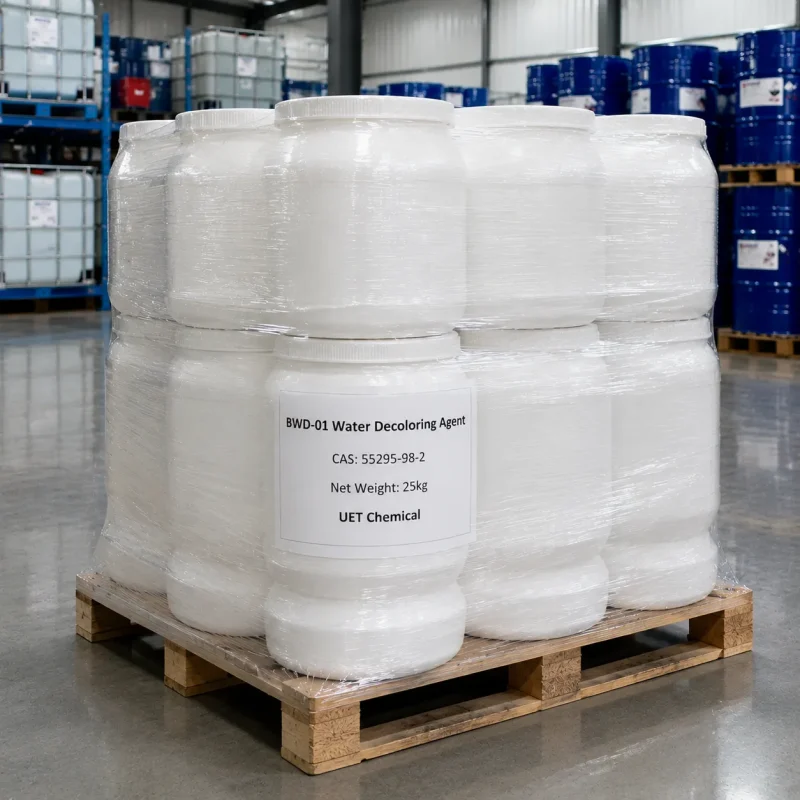
- Packaging: 200 kg (440 lb) HDPE drum; 1000 kg (2200 lb) IBC tote. Custom packaging available upon request.
- Main Applications: Textile wastewater decolorization, paper mill effluent treatment, high-COD industrial wastewater
Introduction to BWD-01 Water Decoloring Agent
BWD-01 is a specialized cationic polymeric coagulant designed specifically for the treatment of high-color, high-COD industrial wastewater. Unlike traditional inorganic coagulants (like alum or ferric chloride) that struggle with water-soluble dyes, BWD-01 features strong cationic charge density and long polymer chains. It works by neutralizing the negative surface charge of colloidal dye molecules and bridging them together to form large, dense flocs that settle rapidly or can be easily filtered.
The primary formulation advantage for wastewater engineers is its exceptional efficacy against stubborn anionic dyes (reactive, acid, and direct dyes) while simultaneously reducing Chemical Oxygen Demand (COD). The critical storage risk is temperature sensitivity; freezing can cause irreversible phase separation or polymer chain degradation, while prolonged exposure to extreme heat accelerates cross-linking and gelation. Store IBC totes and drums in a shaded, temperature-controlled area between 5 °C (41 °F) and 30 °C (86 °F).
Key Features of BWD-01
- Exceptional decolorization efficiency. Achieves 95–99% color removal for wastewater containing reactive, acid, and direct dyes, which are notoriously difficult to treat with standard biological or inorganic methods.
- Simultaneous COD and BOD reduction. The strong flocculation action precipitates not only the chromophores but also dissolved organic matter, significantly lowering the COD load before biological treatment stages.
- Compact sludge volume. Produces dense, heavy flocs with high shear strength. This improves sludge dewaterability in filter presses and reduces overall sludge disposal costs compared to the voluminous, watery sludge generated by PAC/PFS alone.
- Broad pH adaptability. Maintains high decolorization efficiency across a wide pH range (4.0–10.0), with optimal performance typically observed between pH 6.0 and 8.0, minimizing the need for expensive pH adjustment chemicals.
BWD-01 Chemical & Physical Properties
| Property | Value |
|---|---|
| Chemical Nature | Cationic polyamine / Dicyandiamide-formaldehyde condensation polymer |
| Appearance | Colorless to light yellow viscous liquid |
| Active Content (Solid) | ≥ 50.0% |
| pH (as supplied) | 3.0 – 6.0 |
| Viscosity (25 °C / 77 °F) | 50 – 500 cps (mPa·s) |
| Specific Gravity | 1.10 – 1.25 g/cm³ (68.7 – 78.0 lb/ft³) |
| Solubility | Fully miscible in water; insoluble in organic solvents. |
| Shelf Life | 12 months in sealed original packaging |
Applications of BWD-01 Water Decoloring Agent
Textile and dyeing wastewater treatment: Dosed at 50–300 ppm depending on the dye concentration. It is highly effective in treating effluent from yarn dyeing, fabric printing, and finishing processes. Often added before or alongside inorganic coagulants (like PAC) to break the stable dye-water emulsion and precipitate the color.
Paper and pulp mill effluent: Used to remove lignin-based color, ink residues, and suspended fibers from black liquor and de-inking wastewater. Improves the clarity of the treated water for reuse in the papermaking process.
Other high-color industrial wastewater: Applied in the pre-treatment of coking wastewater, coal chemical wastewater, and ink/paint manufacturing effluent where high concentrations of recalcitrant organic pigments require aggressive chemical oxidation or flocculation prior to biological treatment.
Storage & Safety Precautions for BWD-01
- Storage: Keep tightly sealed in original HDPE drums or IBC totes between 5 °C (41 °F) and 30 °C (86 °F). Do not allow to freeze. Freezing can cause the polymer to precipitate or lose its charge density. Avoid direct sunlight and extreme heat, which can cause the liquid to gel or cross-link inside the container.
- Safety: The liquid is mildly acidic and can cause skin and eye irritation. Operators handling bulk liquids or dosing pumps must wear chemical splash goggles, PVC/nitrile gloves, and protective aprons. In case of skin contact, wash immediately with plenty of soap and water.
- Transport: BWD-01 is Non-DG under IATA/IMDG/ADR. Not a marine pollutant. Ship in standard dry containers. During winter transit to cold climates, insulated containers or heated trailers are strongly recommended to prevent freezing.
- QC note: Verify viscosity, solid content, and pH upon receipt. Perform a standard jar test (beaker flocculation test) using your specific site wastewater to confirm dosage requirements. If the liquid shows irreversible phase separation, crystallization, or gelation upon warming to room temperature, reject the lot.
BWD-01 FAQ
Q: Can BWD-01 be used alone, or does it require PAC and PAM?
A: BWD-01 is the primary decolorizing agent and can work alone. However, in most full-scale wastewater treatment plants, it is used in combination with a small dose of PAC (Polyaluminium Chloride) to coagulate fine particles, followed by an anionic PAM (Polyacrylamide) to bridge the flocs for rapid settling. Jar testing is required to optimize the exact sequence and dosage for your specific effluent.
Q: Which types of dyes does BWD-01 remove most effectively?
A: As a strong cationic polymer, it exhibits the highest affinity and removal rates for anionic water-soluble dyes, specifically reactive dyes, acid dyes, and direct dyes. It is less effective on cationic (basic) dyes or non-ionic disperse dyes, which may require different chemical precipitation or advanced oxidation processes.
Q: The liquid arrived with a white precipitate at the bottom of the IBC tote. Is it ruined?
A: This is likely caused by freezing or cold-temperature crystallization during transit. Move the tote to a warm room (20–25 °C / 68–77 °F) and agitate vigorously or use a drum mixer. If the precipitate fully redissolves and the liquid returns to a uniform, viscous state, the product is fully functional. If it remains separated or forms hard gel lumps, the polymer structure is compromised; reject the lot.
Related products
Manufacturer & Exporter Since 2006
Get Tailored Chemical Raw Material Solutions — Reply Within 1 Hour
Factory-direct pricing, stable high-purity supply and complete compliance documentation for your industrial formulations.
- 1000+Products
- 200+QC Protocols
- 7–15Days Delivery
- Factory-Direct Pricing
- COA / TDS / SDS Included
- Free Samples for Testing
- 40+ Export Countries
Request a Free Quote
Our engineers reply within 1 hour during GMT+8 business hours.
Please include in your inquiry:
- Product name or CAS number
- Required quantity
- Destination country or port
- Preferred packaging