
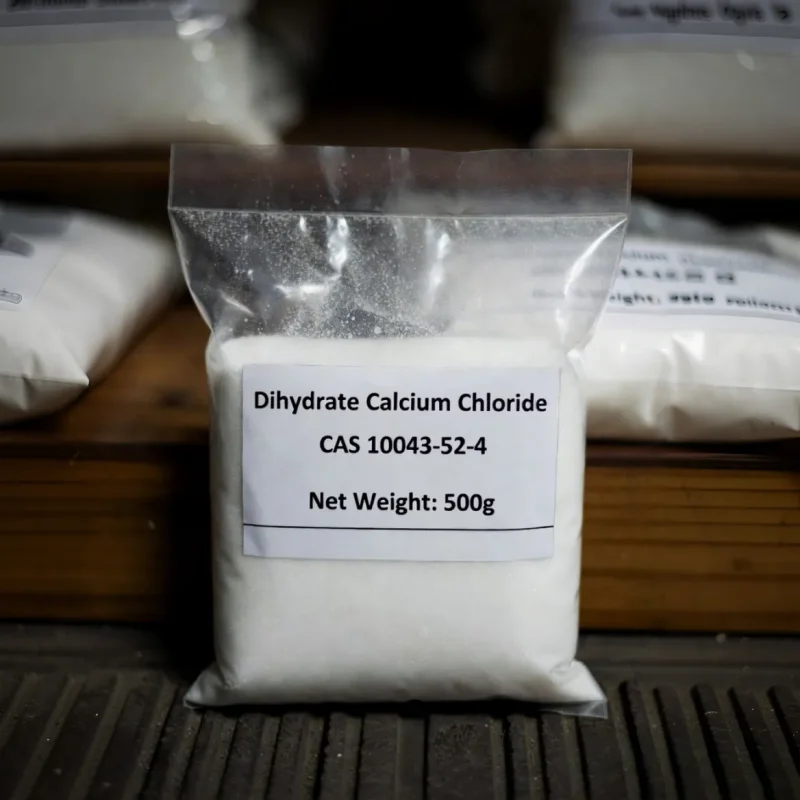

Calcium Chloride Dihydrate CAS 10035-04-8
Calcium Chloride Dihydrate is a highly hygroscopic inorganic salt supplied as white flakes or prills, containing two crystal water molecules. Rapid dissolution and strong exothermic reaction make it ideal for concrete acceleration, de-icing, and brine refrigeration. The dihydrate form offers controlled heat release versus anhydrous grades, reducing thermal shock. Each shipment includes COA, TDS, and SDS.
- CAS No: 10035-04-8
- Synonyms: Calcium chloride 2-hydrate, Dowflake, E509
- EC Number: 233-140-8
- Molecular Formula: CaCl2·2H2O
- Molecular Weight: 147.01 g/mol
- Appearance: White to off-white flakes, prills, or powder
- Purity (as CaCl2): 74.0% – 77.0%
- Packaging: 25 kg (55 lb) PE-lined bag; 1000 kg (2,200 lb) jumbo bag. Custom packaging available upon request.
- Main Applications: Concrete acceleration, de-icing, drilling fluids, refrigeration brine
Introduction to Calcium Chloride Dihydrate
Calcium Chloride Dihydrate is a white, highly deliquescent inorganic salt with two water molecules locked in the crystal lattice. Contact with moisture or water breaks the ionic Ca2+ and Cl- bonds rapidly, releasing heavy hydration heat and depressing the freezing point of the solution. Construction sites and oilfields consume most of the global output, dosing the salt to accelerate cement hydration or increase drilling mud density.
The main processing advantage is a balanced dissolution profile. Crystal water buffers the exothermic reaction, preventing localized boiling when mixing high-concentration brines. The critical storage risk is extreme deliquescence. An opened bag left in 70% relative humidity turns into a liquid puddle within 12 hours if left unsealed. Store the product in a dry, climate-controlled area, tie the inner PE liner tightly, and use opened bags immediately.
Key Features of Calcium Chloride Dihydrate
- Extreme freezing point depression. A 30% (w/w) aqueous solution drops the freezing point to approximately -50 °C (-58 °F), making the salt highly effective for low-temperature de-icing and secondary refrigeration loops.
- Exothermic dissolution for cold-weather concreting. Dissolving in mix water releases roughly 82 kJ/mol of heat. This thermal boost accelerates tricalcium silicate (C3S) hydration in Portland cement, cutting initial set time by up to 50% in sub-zero conditions.
- High ionic density for drilling fluids. Dissolved Ca2+ and Cl- ions increase brine density up to 1.40 g/cm³ (11.7 lb/gal) without adding insoluble solids, providing wellbore stability and shale inhibition in oilfield completions.
- Rapid moisture scavenging. Strong affinity for water molecules allows the salt to lower the dew point of natural gas streams or dry solvents, transitioning from solid flakes to a concentrated liquid brine as H2O is absorbed.
Calcium Chloride Dihydrate Chemical & Physical Properties
| Property | Value |
|---|---|
| Molecular Formula | CaCl2·2H2O |
| Molecular Weight | 147.01 g/mol |
| Melting Point / Thermal Behaviour | Loses crystal water stepwise between 175 °C (347 °F) and 200 °C (392 °F); anhydrous salt melts at 772 °C (1,422 °F). |
| Density | Crystal density 1.83 g/cm³ (114 lb/ft³); bulk density of flakes approx. 0.85–0.95 g/cm³ (53–59 lb/ft³). |
| Solubility in Water | Highly soluble, 74.5 g / 100 mL at 20 °C (68 °F); dissolution is strongly exothermic. |
| pH (5% aqueous solution) | 8.0 – 10.0 (slightly alkaline due to trace calcium hydroxide). |
| Insolubles | ≤ 0.05% (filtered through 0.45 µm membrane). |
| Sulfate (as SO4) | ≤ 0.05% |
Applications of Calcium Chloride Dihydrate
Concrete acceleration and cold-weather pouring: Added at 1.0–2.0% by weight of cement, Cl- ions penetrate the C3S grain boundary and accelerate the precipitation of calcium silicate hydrate (C-S-H) gel. Exothermic dissolution also raises the initial mix temperature. Note: Chlorides corrode rebar, so restrict use to plain concrete, precast non-structural elements, or where local codes (like ACI 318) permit.
Winter de-icing and dust control: Broadcast at 15–30 g/m² on roads, flakes draw moisture from the air to form a dense brine that melts ice down to -25 °C (-13 °F). The heavy brine resists wind scatter better than sodium chloride. For unpaved roads, a 38% liquid spray binds surface dust by keeping the topsoil hygroscopic.
Oilfield completion and workover fluids: Blended to 1.20–1.40 g/cm³ (10.0–11.7 lb/gal) clear brines, high calcium concentration inhibits clay swelling in shale formations. The fluid provides hydrostatic overbalance without the formation damage caused by solid weighting agents like barite.
Refrigeration brine and HVAC chillers: Circulated as a 25–30% (w/w) aqueous solution in secondary cooling loops. Low freezing point prevents pipe blockage at -20 °C (-4 °F), while high specific heat capacity (approx. 2.8 J/g·K) efficiently transfers thermal energy from the process to the chiller.
Storage & Safety Precautions for Calcium Chloride Dihydrate
- Storage: Keep tightly sealed in a cool, dry warehouse below 35 °C (95 °F). The product is extremely deliquescent; an opened bag left in 70% relative humidity turns into a liquid puddle within 12 hours. Stack pallets away from exterior walls to avoid condensation.
- Safety: Classified as an eye irritant (GHS H319). Wear splash goggles, PVC gloves, and long sleeves. When mixing brine, ALWAYS add calcium chloride to water slowly while stirring; adding water to a pile of dry flakes causes violent localized boiling and splashing.
- Transport: Calcium Chloride Dihydrate is Non-DG under IATA/IMDG/ADR. Not a marine pollutant. Standard 25 kg (55 lb) bags or 1000 kg (2,200 lb) jumbo bags ship in standard dry containers.
- QC note: When testing purity by EDTA titration (ASTM D3612 or similar), weigh the sample immediately after opening the container. Exposure to lab air for even 5 minutes increases water content, causing the calculated CaCl2 assay to read artificially low.
Calcium Chloride Dihydrate FAQ
Q: Why does concrete set too fast when using Calcium Chloride Dihydrate (CAS 10035-04-8) in summer?
A: Cl- ions and dissolution heat cause flash set in hot weather. Reduce dosage to 0.5–1.0%, pre-cool water, or switch to non-chloride accelerators. Never use in reinforced concrete due to rebar corrosion.
Q: Flakes turned into a hard block inside the bag. Is the product ruined?
A: Not ruined. Moisture ingress and temperature swings caused recrystallization. Chemistry remains unchanged. Break the block or dissolve it whole; it works fine. Store below 35 °C (95 °F) and seal bags tightly.
Q: Can I use this dihydrate grade to make a 40% clear brine for oilfield completion?
A: Yes. Account for 26% bound water by increasing charge weight based on the 74–77% COA assay. Filter through 5 µm before downhole use to prevent pore plugging by insolubles.
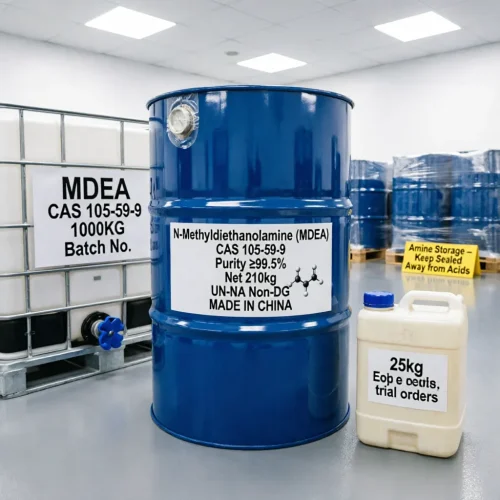
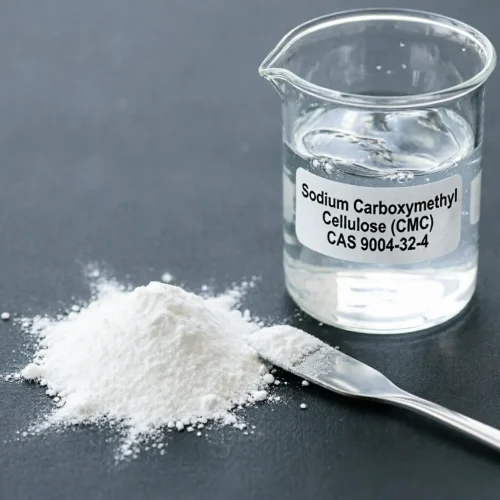
Related products
Manufacturer & Exporter Since 2006
Get Tailored Chemical Raw Material Solutions — Reply Within 1 Hour
Factory-direct pricing, stable high-purity supply and complete compliance documentation for your industrial formulations.
- 1000+Products
- 200+QC Protocols
- 7–15Days Delivery
- Factory-Direct Pricing
- COA / TDS / SDS Included
- Free Samples for Testing
- 40+ Export Countries
Request a Free Quote
Our engineers reply within 1 hour during GMT+8 business hours.
Please include in your inquiry:
- Product name or CAS number
- Required quantity
- Destination country or port
- Preferred packaging