
N-Methyldiethanolamine CAS 105-59-9
N-Methyldiethanolamine (MDEA) is a tertiary alkanolamine carrying one N-methyl group and two hydroxyethyl groups, supplied as a colorless to pale yellow viscous liquid. Its lack of N-H bonds lets it selectively absorb H₂S while taking up CO₂ mainly through bicarbonate chemistry, making it a workhorse in natural gas and refinery gas treating. Each shipment includes COA, TDS, SDS.
- CAS No: 105-59-9
- Synonyms: MDEA; N-Methyl-2,2′-iminodiethanol; N-Methylbis(2-hydroxyethyl)amine
- EINECS: 203-312-7
- Molecular Formula: C5H13NO2
- Molecular Weight: 119.16 g/mol (119.16 lb/lbmol)
- Appearance: Colorless to pale yellow viscous liquid
- Purity: 99.0% min (GC)
- Amine Value: 460-480 mg KOH/g
- Hydroxyl Number: 930-950 mg KOH/g
- Water Content: 0.5% max
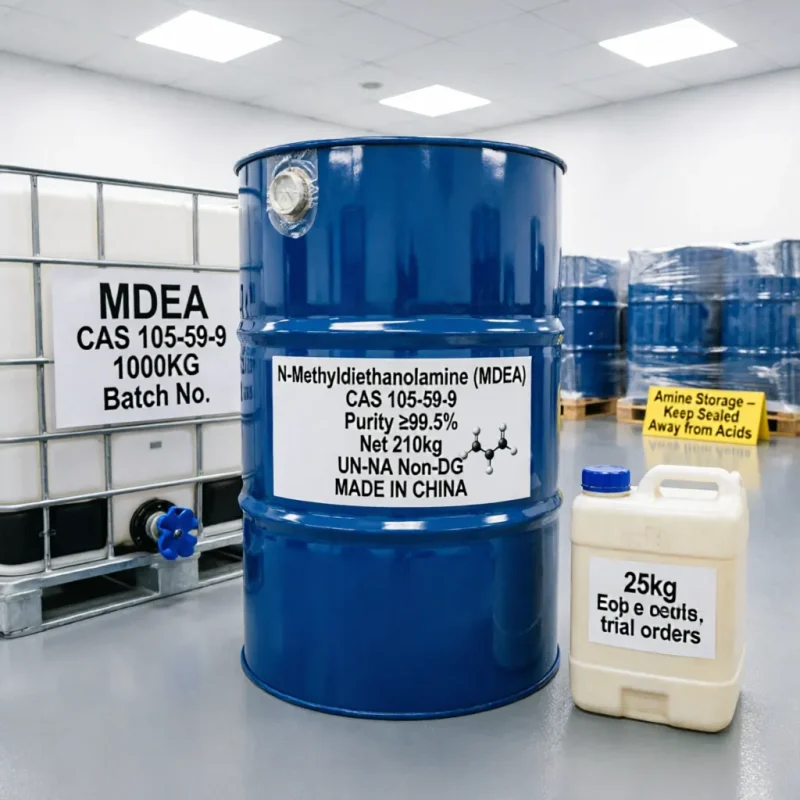
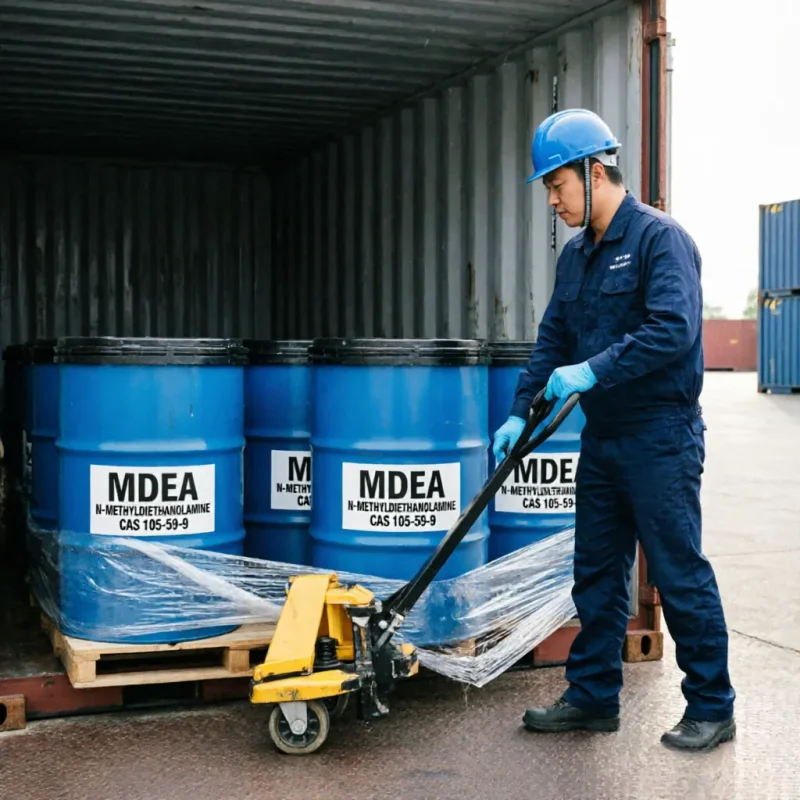
- Packaging: 200 kg (441 lb) drum, 1000 kg (2205 lb) IBC. Custom packaging available upon request.
- Main Applications: Selective H₂S removal, activated MDEA for CO₂ capture, polyurethane catalyst intermediate, quaternary ammonium and surfactant intermediate
Introduction to MDEA
MDEA is a colorless to pale yellow viscous tertiary alkanolamine containing one N-methyl and two hydroxyethyl substituents on a single nitrogen atom. It removes acid gases by protonating H₂S and hydrating CO₂ to bicarbonate, so natural gas treating, refinery gas scrubbing, and polyurethane catalyst intermediates are principal outlets.
MDEA has no N-H bond, so CO₂ is held mainly as bicarbonate. This supports lower regeneration steam demand and selective H₂S pickup from mixed H₂S/CO₂ streams, usually as 30–50 wt% aqueous solution. The practical handling issue is hygroscopicity: open drums absorb moisture and atmospheric CO₂, reducing active amine value and raising viscosity. Before charging, confirm amine value and water; a batch may darken slightly without failing titration. Release tests normally track amine value, water, and color.
Key Features of MDEA
- No N-H bond on tertiary nitrogen: CO₂ uptake proceeds through bicarbonate, which can reduce regeneration heat in acid-gas service.
- Two terminal hydroxyl groups: MDEA can react into polyurethane networks or be esterified and quaternized, helping bind amine fragments into the product matrix.
- High water solubility: clear aqueous solutions are practical at 30–50 wt%, so gas plants can run high amine strength without a co-solvent.
- Low vapor pressure and high flash point: evaporation losses stay low in hot absorbers and storage.
- QC checkpoints: density by ASTM D4052, viscosity by ASTM D445, flash point by ASTM D93, and water by ASTM E203 help detect dilution or CO₂ ingress before dispatch.
MDEA Chemical & Physical Properties
| Property | Value |
|---|---|
| Molecular Formula | C5H13NO2 |
| Molecular Weight | 119.16 g/mol (119.16 lb/lbmol) |
| Boiling Point | 247 °C (477 °F) at 101.3 kPa |
| Density | 1.038 g/cm³ (8.66 lb/gal) at 20 °C (68 °F) |
| Flash Point | 126 °C (259 °F) closed cup |
| Solubility | Miscible with water; soluble in methanol and ethanol; low solubility in aliphatic hydrocarbons |
| Viscosity | 80–110 mPa·s (80–110 cP) at 25 °C (77 °F) |
| Amine Value | 460–480 mg KOH/g |
| Hydroxyl Number | 930–950 mg KOH/g |
| Refractive Index | n20/D 1.466–1.468 |
Applications of MDEA
Selective H₂S removal: In gas treating, the tertiary nitrogen accepts a proton from H₂S, while CO₂ enters mainly through slower bicarbonate hydration. Plants normally circulate 30–50 wt% aqueous MDEA and control absorber contact time to hold CO₂ slip.
Activated MDEA for CO₂ capture: Adding piperazine or MEA creates carbamate-forming sites inside the solvent, so CO₂ loading increases while MDEA still buffers pH and lowers regeneration heat. Typical activated blends contain 40–60 wt% total amine.
Polyurethane catalyst and reactive amine: The tertiary nitrogen accelerates isocyanate reactions, and the two hydroxyethyl groups can react with NCO groups, binding amine fragments into the polymer. Formulators often start at 0.05–0.5 phr and adjust for cure, odor, and cell opening.
Quaternary ammonium and surfactant intermediate: MDEA can be alkylated, quaternized, or esterified with fatty acids; the two hydroxyl groups improve water dispersibility and give formulators a polar head group. Intermediate synthesis is typically run near stoichiometric amine charge, and final derivative use levels often fall between 0.5–5% in finished formulations.
Storage & Safety Precautions for MDEA
Storage and moisture control: Keep drums sealed at 5–35 °C (41–95 °F), ideally under a dry nitrogen blanket. MDEA is highly hygroscopic and absorbs atmospheric CO₂, forming carbonate salts that drop the titratable amine value and spike viscosity. Use HDPE or lined carbon steel, and keep away from strong acids and isocyanates.
Safety and spill response: Treat as a skin and eye irritant (GHS H315, H319, H302). Wear chemical goggles and nitrile gloves. Absorb spills with inert sand, then wash the residue with water since MDEA is fully water-miscible. Ship as Non-DG; verify SDS section 14 for heated loads.
Field note: Purge sampling valves and cap bottles instantly. A 30-minute open sample can absorb enough CO₂ to lower the amine value by several mg KOH/g and fail a release test.
MDEA FAQ
Q: Why does MDEA (CAS 105-59-9) remove H₂S more selectively than CO₂?
A: MDEA has no N-H bond. H₂S is absorbed by fast proton transfer; CO₂ enters mainly through slower bicarbonate hydration. Typical gas treating uses 30–50 wt% MDEA. For deep CO₂ removal, add piperazine or MEA and recheck foaming and corrosion.
Q: How should I store MDEA to avoid amine loss and viscosity increase?
A: Store MDEA sealed, preferably under dry nitrogen, at 5–35 °C (41–95 °F). It absorbs moisture and CO₂, forming salts that lower amine value and raise viscosity. Use closed vents, cap samples, and test water plus amine value before use. Keep away from acids, oxidizers, and isocyanates.
Q: Can MDEA replace DEA in an existing amine unit without changes?
A: Not directly. MDEA kinetics and CO₂ chemistry differ, so circulation, lean loading, reclaimer duty, and heat duty need review. 50 wt% MDEA is not the same molar amine inventory as 30 wt% DEA. Pilot with solution analysis and gas composition; monitor corrosion and foaming.
Related products
Manufacturer & Exporter Since 2006
Get Tailored Chemical Raw Material Solutions — Reply Within 1 Hour
Factory-direct pricing, stable high-purity supply and complete compliance documentation for your industrial formulations.
- 1000+Products
- 200+QC Protocols
- 7–15Days Delivery
- Factory-Direct Pricing
- COA / TDS / SDS Included
- Free Samples for Testing
- 40+ Export Countries
Request a Free Quote
Our engineers reply within 1 hour during GMT+8 business hours.
Please include in your inquiry:
- Product name or CAS number
- Required quantity
- Destination country or port
- Preferred packaging