
Cashmeran CAS 33704-61-9
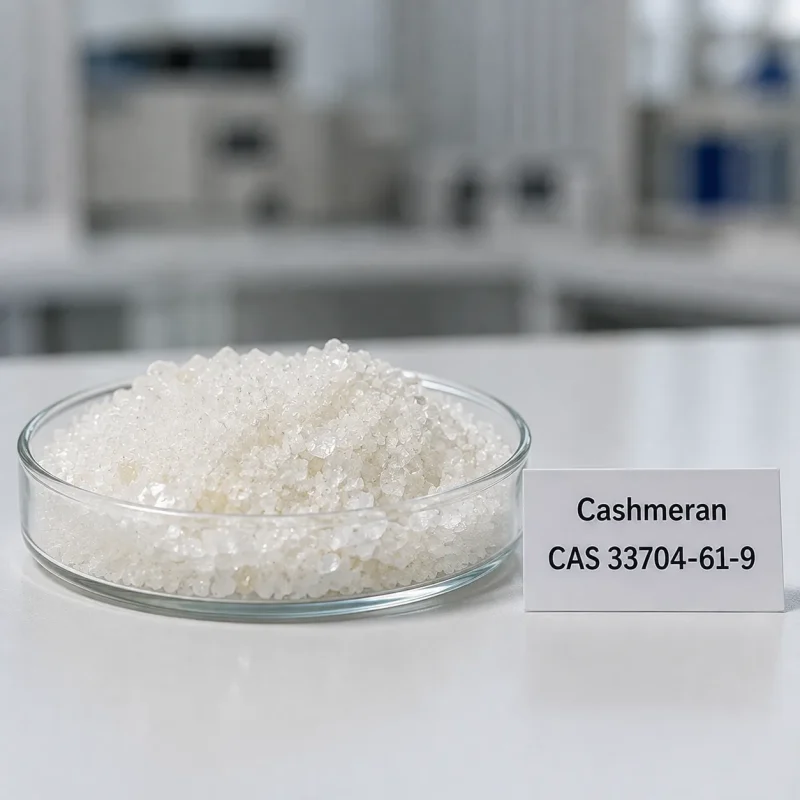
Cashmeran is a methyl-substituted indanone musk—1,1,2,3,3-pentamethyl-6,7-dihydro-4(5H)-indanone—supplied as white to off-white crystals (≥98.0% GC purity). It delivers a diffusive, velvety woody-amber musk in fine fragrances, fabric softeners, and soap perfumes. The indanone ketone carries no ester or acetal bond, so the odour survives alkaline soap bases and peroxide bleach systems intact. Each shipment includes COA, TDS, and SDS.
- CAS No.: 33704-61-9
- Synonyms: Cashmeran; DPMI; 6,7-Dihydro-1,1,2,3,3-pentamethyl-4(5H)-indanone
- EINECS: 251-649-3
- Molecular Formula: C₁₄H₂₂O
- Molecular Weight: 206.32 g/mol
- Appearance: White to off-white crystals (clear liquid above 29 °C)
- Purity (GC): ≥98.0%
- Melting Point: 27–29 °C
- Flash Point: ~94 °C (closed cup)
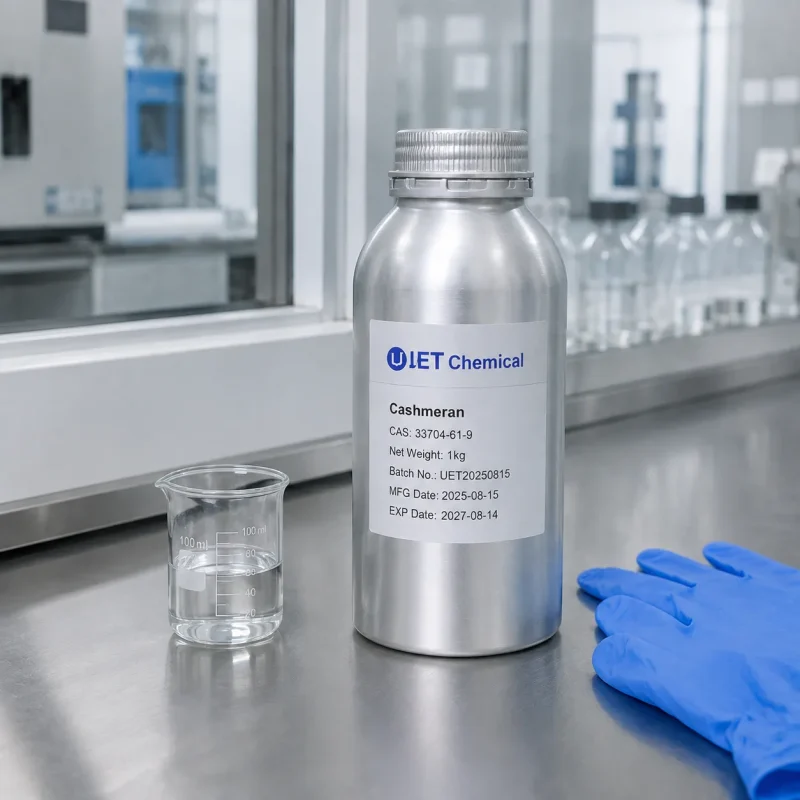
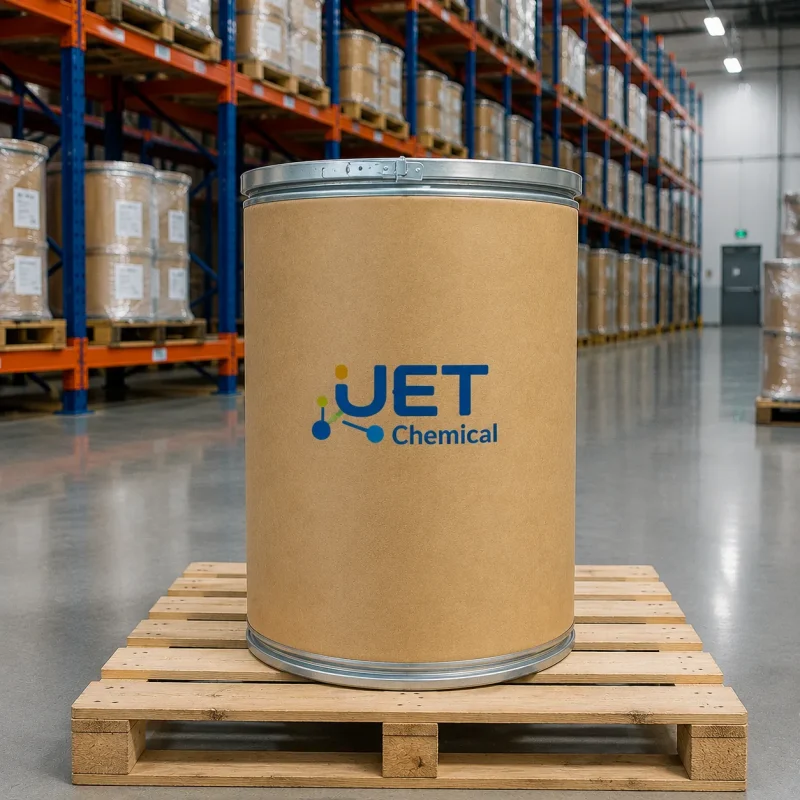
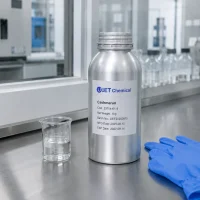
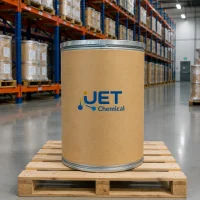
- Packaging: 25 kg fibre drum / 1 kg aluminium bottle. Custom packaging available upon request.
- Main Applications: Fine fragrances; fabric softeners; soap perfumes; candles & air care
Introduction to Cashmeran
Cashmeran is a white to off-white crystalline solid, a methyl-substituted indanone whose 1,1,2,3,3-pentamethyl cyclopentanone ring fused to an aromatic core creates the signature velvety, woody-amber “cashmere” musk odour. The molecule melts just above room temperature (27–29 °C), so drums ship as crystals in winter and as a clear liquid in summer. Perfumers dose it as a diffusive base-note builder in fine fragrances, fabric softeners, and alkaline soap perfumes.
The indanone ketone carries no ester or acetal linkage, so the odour profile survives pH 3–11 matrices, peroxide bleaches, and 80 °C soap-noodle extrusion without hydrolysis. One practical caution: the 27–29 °C melting point means summer containers arrive partially molten—this is a physical phase change, not degradation. Cool the drum to 15–20 °C, let it re-crystallise, and assay as normal. Dose conservatively: above 2% of the concentrate the woody-musk facet begins to dominate floral hearts.
Key Features of Cashmeran
- Pentamethyl indanone skeleton. Five methyl groups lock the cyclopentanone ring into a rigid, lipophilic shape that produces the “cashmere wool” musk facet—a profile ester and macrocyclic musks do not reproduce.
- Diffusion at low dose. With a vapour pressure of ~0.009 mmHg at 23 °C and a low odour threshold, 0.1–0.5% of the concentrate already lifts the top-to-heart transition and adds perceived volume.
- Chemical inertness of the ketone. No ester bond to saponify and no acetal to hydrolyse: the odour stays intact in pH 3–11 detergents, peroxide bleach systems, and soap noodles extruded at 80 °C.
- Low melting point processing. Melting at 27–29 °C allows molten dosing into candle wax, soap noodles, and warm fragrance blends at 40–50 °C, avoiding the high-heat exposure that degrades sensitive top notes.
- Fabric substantivity. Log P of 4.2–4.5 drives adsorption onto cotton and polyester during the rinse cycle, releasing a soft musky dry-down during tumble drying and wear.
Cashmeran Chemical & Physical Properties
| Property | Value |
|---|---|
| Molecular Formula | C₁₄H₂₂O |
| Molecular Weight | 206.32 g/mol |
| Appearance | White to off-white crystals; clear to pale-yellow liquid above 29 °C |
| Melting Point | 27–29 °C |
| Boiling Point | ~256 °C (760 mmHg, reported) |
| Flash Point | ~94 °C (closed cup) |
| Vapour Pressure (23 °C) | ~0.009 mmHg |
| Log P | ~4.2–4.5 |
| Solubility | Insoluble in water; miscible with ethanol, DPG, IPM, fragrance oils |
| Purity (GC) | ≥98.0% |
Applications of Cashmeran
Fine fragrances (EDP/EDT): Used at 0.5–5% of the concentrate. The velvety woody-amber musk bridges floral hearts to the base and adds a tactile “cashmere” texture; blotters evaluated at 0.5% show a 48-hour musk dry-down.
Fabric softeners and laundry detergents: Dosed at 0.1–1.0%. Log P ~4.2–4.5 drives deposition onto fibres during the rinse cycle, and the ketone survives alkaline builders and peroxide bleach, releasing a soft musk during tumble drying.
Soap and personal-care perfumes: Added at 0.2–2% of the perfume compound. The indanone skeleton shows no odour shift and minimal discoloration in soap noodles extruded at pH 9–10 and 80 °C.
Candles and air-care systems: Formulated at 0.5–3%. Dosed molten into wax at 40–50 °C, it disperses without high-heat exposure and holds a steady throw in paraffin and soy wax with low soot contribution.
Storage & Safety Precautions for Cashmeran
Storage conditions. Store sealed at 10–25 °C, away from direct sunlight and heat sources above 30 °C. Repeated melt–recrystallise cycles cake the crystals into a solid mass; the mass is chemically intact but slower to weigh and dissolve. Keep away from strong oxidising agents. Once opened, reseal the PE liner to prevent odour cross-contamination of neighbouring drums.
Safety and PPE. GHS: Skin Irrit. 2 (H315); Skin Sens. 1 (H317); Aquatic Chronic 2 (H411). Wear nitrile gloves, safety glasses, and an N95 mask when handling crystals to avoid skin contact and dust inhalation. Spills: sweep up dry crystals into a labelled container; wash residues with warm soapy water. Follow current IFRA Standards for leave-on and rinse-off category limits.
Transport classification. Non-DG. Flash point ~94 °C places it outside Class 3; not regulated under IMDG, IATA, or ADR. Ship as standard general cargo. In summer months, book reefer or ventilated slots if transit exceeds 30 days at ambient above 30 °C to avoid molten arrival.
Practitioner note: For incoming QC, assay by GC-FID with an internal standard (e.g., benzyl benzoate) and confirm identity by melting point (27–29 °C). If the drum arrives molten, cool it to 15–20 °C for 24 h and crush the re-crystallised mass before sampling—drawing a sample from a partially molten drum biases the result toward the liquid fraction.
Cashmeran FAQ
Q: My Cashmeran (CAS 33704-61-9) arrived as a liquid in July. Is it degraded?
A: No. The melting point is 27–29 °C, so any container above that temperature ships as a clear liquid. This is a physical phase change; the ketone does not hydrolyse or oxidise at transit temperatures. Cool the drum to 15–20 °C, allow 24 h to re-crystallise, then sample and run the GC assay—purity reads unchanged against the shipped COA.
Q: What dose range should I start with, and how do I avoid overdosing?
A: Start at 0.1–0.5% of the concentrate for diffusion lift, and 0.5–2% when the musk is part of the base accord. Above 2–5%, the woody-amber facet saturates the blend and flattens floral hearts. Evaluate on blotters at 0.5% and after 24 h; the odour strengthens on dry-down, so judge the final effect late, not at the dip.
Q: Is Cashmeran stable in alkaline soap and bleach detergents?
A: Yes. The molecule is a ketone with no ester or acetal bond, so saponification and acid hydrolysis pathways do not exist. It holds its odour from pH 3 to 11, survives peroxide bleach systems, and tolerates 80 °C soap-noodle extrusion with minimal discoloration—no stabilisers or antioxidants are required in these bases.
Related products
Manufacturer & Exporter Since 2006
Get Tailored Chemical Raw Material Solutions — Reply Within 1 Hour
Factory-direct pricing, stable high-purity supply and complete compliance documentation for your industrial formulations.
- 1000+Products
- 200+QC Protocols
- 7–15Days Delivery
- Factory-Direct Pricing
- COA / TDS / SDS Included
- Free Samples for Testing
- 40+ Export Countries
Request a Free Quote
Our engineers reply within 1 hour during GMT+8 business hours.
Please include in your inquiry:
- Product name or CAS number
- Required quantity
- Destination country or port
- Preferred packaging