
Lead(II) Bromide CAS 10031-22-8
Lead(II) Bromide is an inorganic lead halide in which one Pb²⁺ cation pairs with two bromide anions in an orthorhombic lattice. Supplied as a white crystalline powder (≥98% purity), it serves as the lead source for halide perovskite optoelectronics (CsPbBr₃, MAPbBr₃), scintillator crystals, and fine-chemical intermediates. Solubility rises from ~0.5 g/100 mL at 20 °C to ~2 g/100 mL in boiling water, allowing simple hot-water recrystallisation. Each shipment includes COA, TDS, and SDS.
- CAS No.: 10031-22-8
- Synonyms: Lead dibromide; Plumbous bromide; Lead(II) bromide
- EINECS: 233-084-4
- Molecular Formula: PbBr₂
- Molecular Weight: 367.01 g/mol
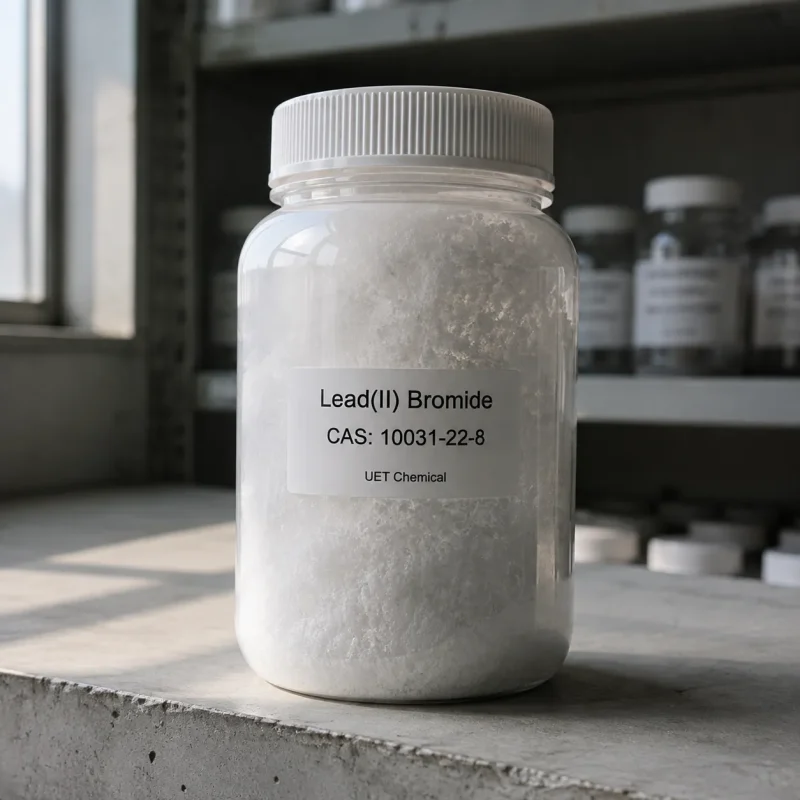
- Appearance: White crystalline powder
- Purity: ≥98% (99.99% optoelectronic grade on request)
- Density (25 °C): 6.66 g/cm³
- Melting Point: 371–373 °C
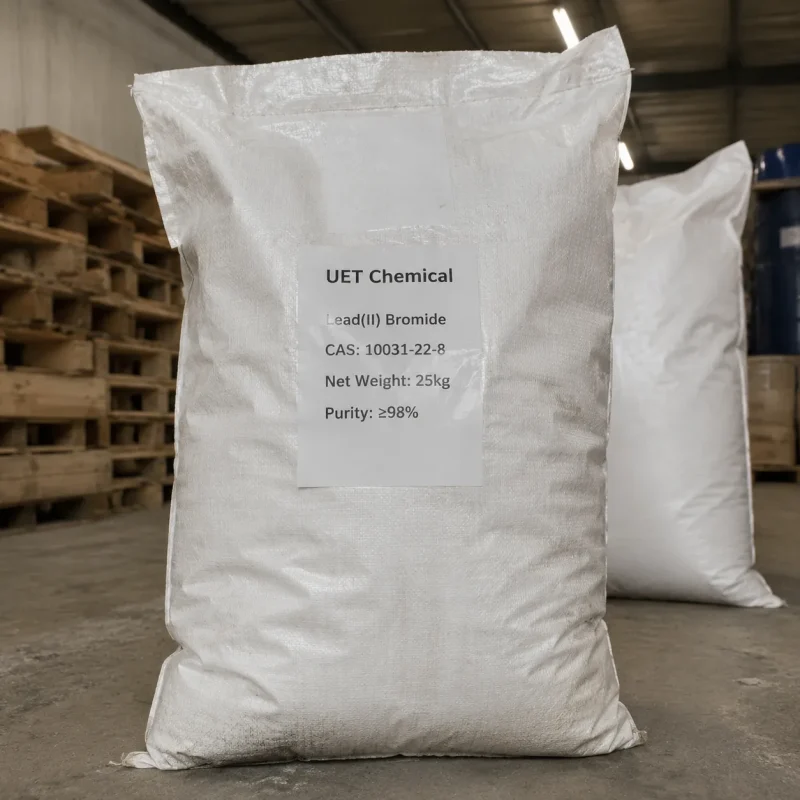
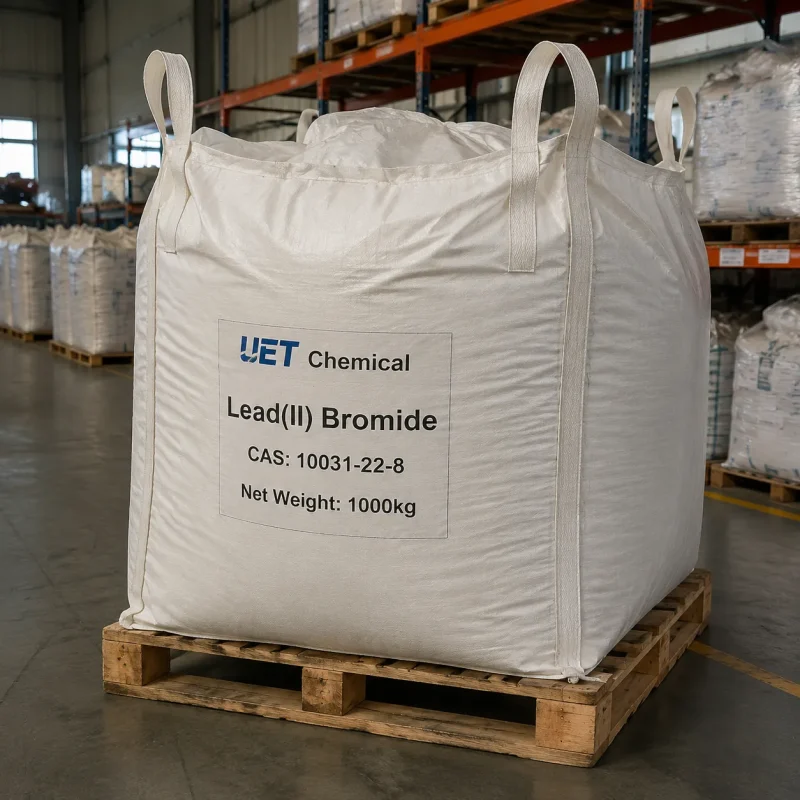
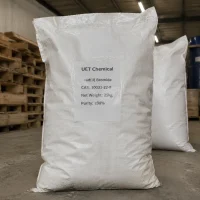
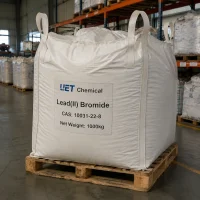
- Packaging: 25 kg woven bag with PE liner / 1000 kg FIBC bulk bag. Custom packaging available upon request.
- Main Applications: Perovskite precursors; scintillator crystals; lab reagents; synthesis intermediates
Introduction to Lead(II) Bromide
Lead(II) Bromide is a white crystalline powder, an inorganic lead halide with an orthorhombic PbBr₂ lattice and a density of 6.66 g/cm³. Water solubility is slight at 20 °C (~0.5 g/100 mL) but quadruples near boiling, so hot-water recrystallisation purifies the salt without organic solvents. It functions as the lead source for halide perovskite semiconductors and as a bromide building block in fine-chemical synthesis.
The optoelectronic grade holds total trace metals below 10 ppm by ICP-MS, keeping Fe, Cu, and Na low enough to preserve CsPbBr₃ photoluminescence quantum yield. One practical caution: PbBr₂ dissolves sharply in excess bromide, forming soluble [PbBr₄]²⁻ complexes. Washing a filtered cake with KBr or NH₄Br solution instead of cold deionised water silently dissolves 5–10% of the batch.
Key Features of Lead(II) Bromide
- Stoichiometric perovskite precursor. Reacts 1:1 molar with CsBr or CH₃NH₃Br in DMF/DMSO to give phase-pure CsPbBr₃ or MAPbBr₃; a Br:Pb ratio of 2.00 ± 0.02 prevents mixed-halide side phases.
- Recrystallisation-friendly solubility curve. ~0.5 g/100 mL at 20 °C versus ~2 g/100 mL at 100 °C—a single hot-water pass lifts assay from 98% to >99.9% with no organic solvent waste.
- High photon stopping power. Pb (Z = 82) at 6.66 g/cm³ delivers strong X-ray and γ-ray attenuation, suiting scintillator host crystals and radiation-shielding glass research.
- Polybromide complexation. Freely soluble in concentrated HBr, NH₄Br, and KBr solutions as [PbBr₄]²⁻, enabling solution crystal growth and controlled re-precipitation processes.
- Low hygroscopicity. Unlike hydrated lead salts that cake in humid warehouses, PbBr₂ powder stays free-flowing at 70% RH; only light-tight storage is needed to prevent slight grey tinting.
Lead(II) Bromide Chemical & Physical Properties
| Property | Value |
|---|---|
| Molecular Formula | PbBr₂ |
| Molecular Weight | 367.01 g/mol |
| Appearance | White crystalline powder |
| Density (25 °C) | 6.66 g/cm³ |
| Melting Point | 371–373 °C |
| Boiling Point | ~916 °C |
| Solubility in Water | ~0.5 g/100 mL (20 °C); ~2 g/100 mL (boiling) |
| Solubility (Other) | Soluble in conc. HBr, NH₄Br, KBr solutions; insoluble in ethanol |
| Crystal Structure | Orthorhombic (PbCl₂-type) |
| Loss on Drying | ≤0.5% (105 °C, 2 h) |
Applications of Lead(II) Bromide
Halide perovskite solar cells and LEDs: Co-dissolved with CsBr or MABr at 1:1 molar ratio (40–50 wt% in 4:1 DMF:DMSO), spin-coated and annealed at 80–100 °C. Optoelectronic grade (99.99%) yields CsPbBr₃ films with PLQY >80%; standard grade suits two-step sequential deposition.
CsPbBr₃ quantum dots for displays: Injected into hot (140–180 °C) oleic acid/oleylamine/1-octadecene together with cesium oleate. The PbBr₂ feed controls nanocrystal edge length at 8–12 nm and green emission at 510–520 nm.
Scintillator and X-ray detector crystals: Melt-grown by Bridgman–Stockbarger above the 373 °C melting point, or grown from aqueous anti-solvent systems. The high effective Z gives strong γ-ray stopping power for photon-counting detectors.
Fine-chemical and laboratory reagent: Bromide/lead source for lead-mediated organic transformations, precursor for other lead halides, and analytical reagent. Typical charge: 0.5–5% w/w of reaction mass.
Storage & Safety Precautions for Lead(II) Bromide
Storage conditions. Store in sealed, PE-lined bags on pallets at 5–30 °C, dry and away from light—prolonged light exposure may cause a slight grey tint without affecting assay. Keep in a dedicated toxic-materials area, separated from foodstuffs, strong acids (which can liberate HBr fumes), and strong oxidisers.
Safety and PPE. GHS: Repr. 1A (H360Df); Acute Tox. 4 (H302, H332); STOT RE 2 (H373); Aquatic Acute/Chronic 1 (H400, H410). Wear a P3 particulate respirator, nitrile gloves, and goggles; no eating or drinking in the handling area; wash hands after handling. Spills: wet-mop or HEPA-vacuum to avoid dust; dispose as hazardous lead waste—never flush to drain.
Transport classification. Class 6.1, Packing Group III, UN 3288 (Toxic solid, inorganic, n.o.s.); marine pollutant. DG declaration required for ocean and air freight.
Practitioner note: For incoming QC, assay lead by EDTA complexometric titration at pH 5–6 with xylenol orange indicator; check chloride by ion chromatography—tap-water wash residue shows Cl⁻ >200 ppm and degrades perovskite film morphology. For optoelectronic grade, run ICP-MS (Na, K, Fe, Cu) and reject if the total exceeds 10 ppm.
Lead(II) Bromide FAQ
Q: Is Lead(II) Bromide (CAS 10031-22-8) pure enough for perovskite solar cells, or only for industrial use?
A: Both grades ship from this line. The ≥98% industrial grade suits two-step sequential deposition and crystal-growth work; the 99.99% optoelectronic grade holds total trace metals <10 ppm (ICP-MS) and Cl⁻ <50 ppm for one-step antisolvent processes targeting PLQY >80%. State the target application on the PO so QC releases the correct spec.
Q: Why did I lose 8% of my batch when washing the filter cake with ammonium bromide solution?
A: PbBr₂ forms soluble polybromide complexes ([PbBr₄]²) in excess Br⁻. NH₄Br, KBr, or HBr wash liquors re-dissolve the cake. Wash only with cold (5–10 °C) deionised water in 2–3 small portions; the ~0.45 g/100 mL cold-water solubility keeps wash loss below 1%.
Q: Can PbBr₂ be recrystallised from hot water without hydrolysis?
A: Yes. Dissolve at 90–100 °C (~2 g/100 mL), add 1–2 drops of dilute HBr per litre to suppress basic-salt formation, filter hot, then cool to 5–10 °C. Colorless needle crystals form; one pass lifts assay from 98% to >99.9%. Dry at 105 °C for 2 h and store light-tight.
Related products
Manufacturer & Exporter Since 2006
Get Tailored Chemical Raw Material Solutions — Reply Within 1 Hour
Factory-direct pricing, stable high-purity supply and complete compliance documentation for your industrial formulations.
- 1000+Products
- 200+QC Protocols
- 7–15Days Delivery
- Factory-Direct Pricing
- COA / TDS / SDS Included
- Free Samples for Testing
- 40+ Export Countries
Request a Free Quote
Our engineers reply within 1 hour during GMT+8 business hours.
Please include in your inquiry:
- Product name or CAS number
- Required quantity
- Destination country or port
- Preferred packaging