
Tin (2+) Oxalate CAS 814-94-8
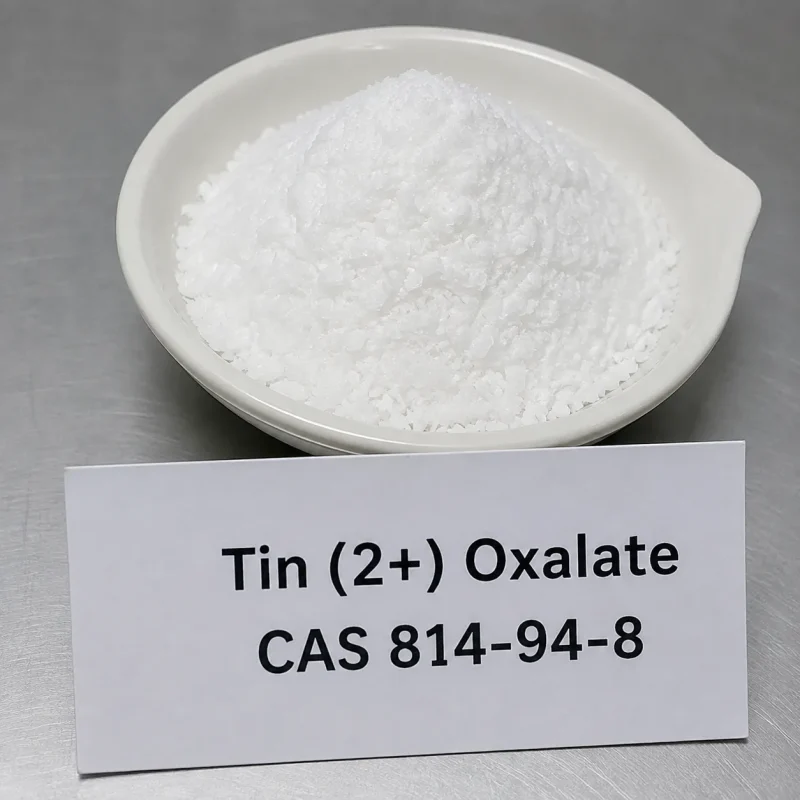
Tin(II) Oxalate is an inorganic stannous salt of oxalic acid. White crystalline powder, ≥98% Sn(II) purity. Serves as a chloride-free tin source for SnO₂ precursor ceramics, tin electroplating baths, and polyester polycondensation catalysts. On calcination the oxalate leaves only CO/CO₂—no chloride or sulfate residue to contaminate electronic-grade tin oxide. Each shipment includes COA, TDS, and SDS.
- CAS No.: 814-94-8
- Synonyms: Stannous oxalate; Tin(II) ethanedioate; Oxalic acid, tin(2+) salt
- EINECS: 212-410-9
- Molecular Formula: SnC₂O₄
- Molecular Weight: 206.72 g/mol
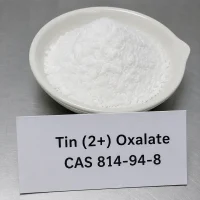
- Appearance: White crystalline powder
- Sn(II) Purity (iodometric): ≥98.0%
- Tin Content: ≥56.0% (theoretical 57.4%)
- Solubility: Insoluble in water; dissolves in dilute HCl
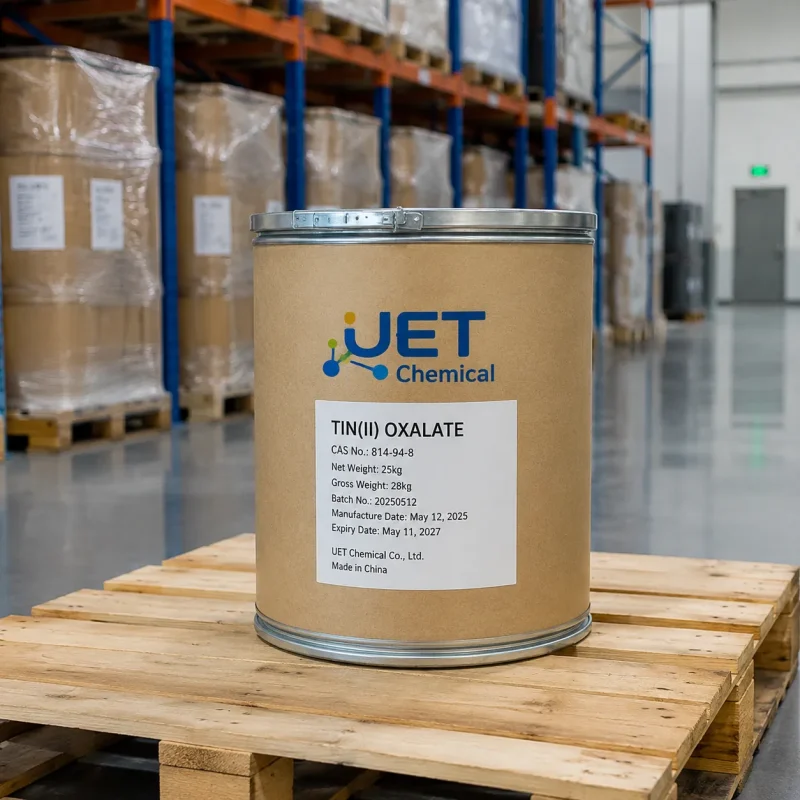
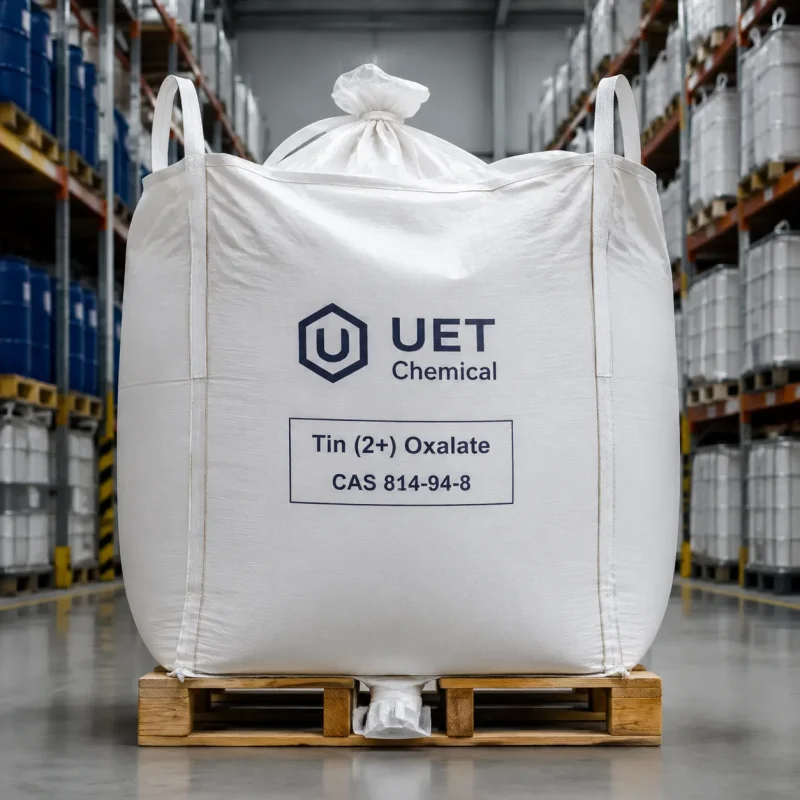
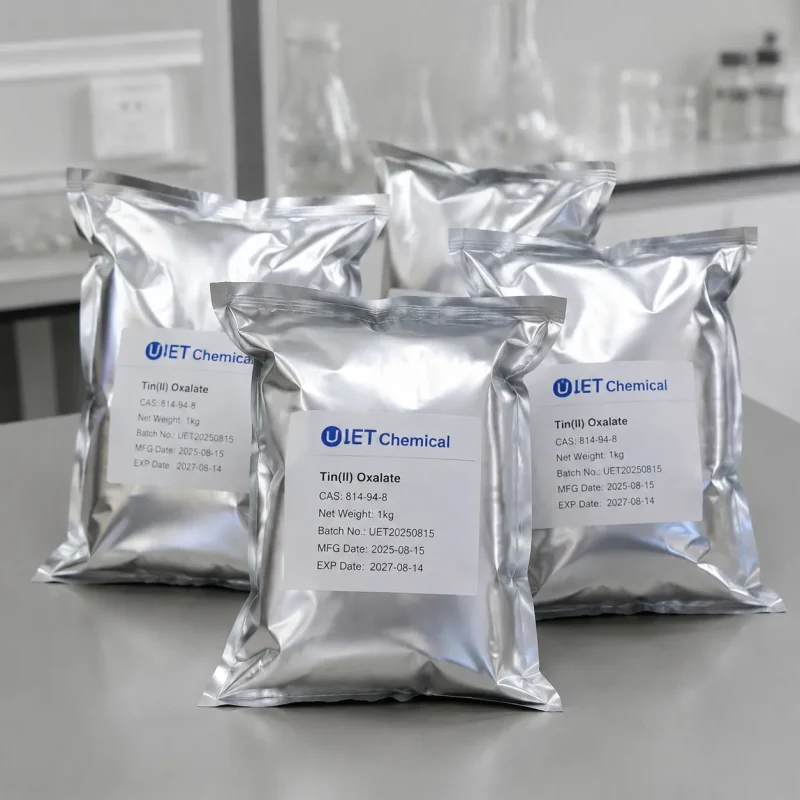
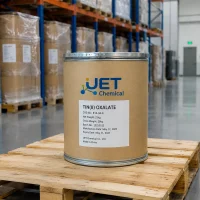
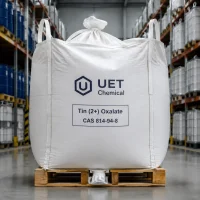
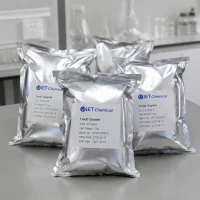
- Packaging: 1 kg aluminium foil bag / 25 kg fibre drum with PE liner. Custom packaging available upon request.
- Main Applications: SnO₂ precursors; tin electroplating; polyester catalysts; reducing agent
Introduction to Tin(II) Oxalate
Tin(II) Oxalate is a white crystalline powder, the stannous salt of oxalic acid with Sn²⁺ coordinated to the bidentate oxalate anion. Water solubility is negligible (<0.1 g/L at 20 °C), but the salt dissolves readily in dilute hydrochloric acid. Industry uses it as a chloride-free tin feedstock for SnO₂ ceramic powders, a tin source in oxalate-based electroplating baths, and a polycondensation catalyst for polyesters and alkyd resins.
Because the oxalate anion burns off as CO/CO₂ between 280 and 450 °C, calcined products carry no halide or sulfate contamination—a decisive advantage for gas-sensor and electronic-grade SnO₂. One practical caution: Sn²⁺ oxidises slowly in moist air. Drums left open in humid warehouses gain Sn⁴⁺ surface species and lose iodometric titre; reseal immediately after sampling and check the Sn(II)/total-tin ratio on arrival.
Key Features of Tin(II) Oxalate
- Chloride- and sulfate-free tin chemistry. The oxalate counter-ion volatilises as CO/CO₂ on calcination, holding Cl⁻ and SO₄²⁻ in the fired oxide below 50 ppm—levels chloride or sulfate tin routes cannot reach without repeated washing.
- High stannous payload. 57.4% theoretical tin content, ≥56.0% as shipped—the lowest transport cost per kilogram of tin among solid Sn(II) salts.
- Controlled solubility profile. Insoluble in water but dissolves cleanly in dilute HCl or warm dilute acids, giving slow, controllable tin release in plating and precipitation processes.
- Low-temperature oxide conversion. Decomposes at 280–450 °C to SnO under nitrogen or SnO₂ in air, preserving high surface area for sensor powders without sintering the oxide.
- Built-in reducing character. Sn²⁺ donates two electrons (Sn²⁺ → Sn⁴⁺), acting as a mild reducing agent in organic synthesis and scavenging dissolved oxygen in plating baths.
Tin(II) Oxalate Chemical & Physical Properties
| Property | Value |
|---|---|
| Molecular Formula | SnC₂O₄ |
| Molecular Weight | 206.72 g/mol |
| Appearance | White crystalline powder |
| Tin Content | ≥56.0% (theoretical 57.4%) |
| Sn(II) Purity (iodometric) | ≥98.0% |
| Solubility in Water | <0.1 g/L (20 °C) |
| Solubility (Other) | Dissolves in dilute HCl and warm dilute H₂SO₄; insoluble in ethanol |
| Thermal Decomposition | 280–450 °C to SnO (N₂) / SnO₂ (air) |
| Loss on Drying | ≤0.5% (105 °C) |
| Chloride / Sulfate | ≤0.05% each |
Applications of Tin(II) Oxalate
SnO₂ precursor for ceramics and gas sensors: Calcined at 350–500 °C in air with ~27% mass loss. The low decomposition temperature yields high-surface-area SnO₂ (20–40 m²/g) for sensor, varistor, and electrode powders, with no chloride to corrode downstream metallisation.
Tin electroplating (oxalate baths): Dissolved in oxalic/hydrochloric acid systems to hold 10–30 g/L Sn²⁺. The oxalate ligand complexes Sn²⁺ and stabilises the bath against hydrolysis, depositing uniform matte tin on copper lead frames and connector strips.
Polyester and alkyd polycondensation catalyst: Charged at 0.02–0.1% Sn on polymer weight. Sn²⁺ catalyses esterification and polycondensation at 200–250 °C, producing water-white polyols for optical and coating polyesters.
Reducing agent and tin-salt intermediate: Sn²⁺ reduces nitro, peroxide, and quinone species in fine-chemical synthesis, and serves as the starting salt for stannous oxide and other organotin-free tin compounds.
Glaze and glass opacifier precursor: Fired SnO₂ from oxalate decomposition opacifies ceramic glazes and enamel frits at 4–8% of the frit weight, replacing heavier oxide loadings.
Storage & Safety Precautions for Tin(II) Oxalate
Storage conditions. Store in sealed, foil-lined bags or PE-lined fibre drums at 5–30 °C, warehouse RH below 60%. Sn²⁺ oxidises to Sn⁴⁺ in moist air; a drum opened repeatedly in a humid warehouse loses 1–2% iodometric titre per month. Keep away from strong oxidisers (nitrates, peroxides, chlorates) and strong mineral acids in open contact.
Safety and PPE. GHS: Skin Irrit. 2 (H315); Eye Irrit. 2 (H319); Aquatic Chronic 2 (H411). Wear an N95/P2 dust mask, chemical-splash goggles, and nitrile gloves during bag emptying. Spills: sweep up dry, avoid dusting, collect into a labelled container; do not flush tin-bearing material to drain.
Transport classification. Non-DG. Not regulated under IMDG, IATA, or ADR. Ship as standard general cargo. Ensure container liners are intact to prevent moisture ingress during ocean freight.
Practitioner note: For incoming QC, run Sn(II) by iodometric titration: dissolve the sample in deaerated 10% HCl under a CO₂ or N₂ blanket and titrate immediately with 0.1 N iodine using starch—1 mL of 0.1 N I₂ equals 10.34 mg SnC₂O₄. Cross-check total tin by igniting a separate sample at 900 °C to constant SnO₂ (residue ≈73%). A Sn(II)/total-Sn ratio below 95% flags surface oxidation.
Tin(II) Oxalate FAQ
Q: How do I verify the Sn(II) content of Tin(II) Oxalate (CAS 814-94-8) on arrival?
A: Use iodometric titration: dissolve in deaerated 10% HCl under inert blanket, titrate with 0.1 N iodine to starch endpoint; 1 mL equals 10.34 mg SnC₂O₄. Ignite a second sample at 900 °C to constant SnO₂ (≈73% residue) for total tin. A Sn(II)/total-Sn ratio above 95% confirms fresh material; a grey or yellow tint signals surface oxidation.
Q: The powder turned pale grey after six months in the warehouse. Is it still usable?
A: Grey tint means partial surface oxidation of Sn²⁺ to Sn⁺. Run the iodometric titre first. At ≥95% Sn(II) use it normally; at 90–95% reserve it for plating or catalyst duties where total tin matters more than oxidation state; below 90% reject for electronic-grade SnO₂. Store future drums sealed with desiccant and use within 24 months.
Q: What calcination schedule converts it to SnO₂ without hard agglomerates?
A: Ramp at 2–5 °C/min to 400–450 °C, hold 2 h in air. Mass loss is ~27% (SnC₂O₄ → SnO₂ + 2CO). A slow ramp and shallow trays prevent CO-driven spattering and keep the powder free-flowing with 20–40 m²/g surface area. Faster ramps sinter the oxide into hard lumps that need milling.
Related products
Manufacturer & Exporter Since 2006
Get Tailored Chemical Raw Material Solutions — Reply Within 1 Hour
Factory-direct pricing, stable high-purity supply and complete compliance documentation for your industrial formulations.
- 1000+Products
- 200+QC Protocols
- 7–15Days Delivery
- Factory-Direct Pricing
- COA / TDS / SDS Included
- Free Samples for Testing
- 40+ Export Countries
Request a Free Quote
Our engineers reply within 1 hour during GMT+8 business hours.
Please include in your inquiry:
- Product name or CAS number
- Required quantity
- Destination country or port
- Preferred packaging