
Stannous Chloride Dihydrate (Tin(II) Chloride Dihydrate) CAS 10025-69-1
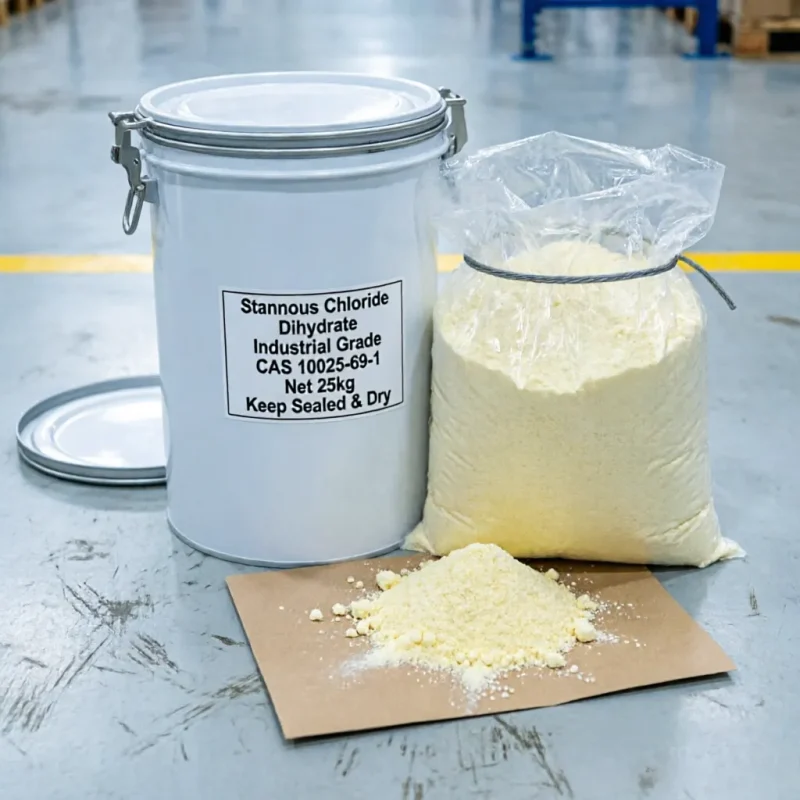
Stannous Chloride Dihydrate is a versatile reducing agent and tin plating chemical supplied as white to pale yellow crystalline powder. As the dihydrate form of Tin(II) Chloride, it delivers controlled Sn²⁺ release for electroplating bath formulation, industrial reduction reactions, and water treatment applications. Core uses include tin electroplating, dye reduction, PET polymerization catalysis, and food-grade antioxidant (E512) production. Each shipment includes COA, TDS, and SDS.
- CAS No: 10025-69-1
- Synonyms: Tin(II) Chloride Dihydrate, Stannous Chloride Dihydrate, Tin Dichloride Dihydrate, Tin Protochloride Dihydrate, SnCl₂·2H₂O
- EC Number: 231-596-2
- Molecular Formula: SnCl₂·2H₂O
- Molecular Weight: 225.63 g/mol
- Appearance: White to pale yellow crystalline powder or granules
- Purity (Titration): ≥ 98.0% (SnCl₂·2H₂O basis)
- Packaging: 1 kg (2.2 lb) aluminum foil bag with PE liner; 5 kg (11 lb) aluminum foil bag with PE liner; 25 kg (55 lb) PP woven bag with PE liner. Custom packaging available upon request.
- Main Applications: Tin electroplating baths, reducing agent in dye and chemical synthesis, PET polymerization catalyst, water treatment coagulant, food additive E512, silver mirror reaction
Introduction to Stannous Chloride Dihydrate
Stannous Chloride Dihydrate (SnCl₂·2H₂O) is the commercially dominant hydrated form of tin(II) chloride, produced by dissolving metallic tin in hydrochloric acid followed by controlled crystallization. In aqueous solution, it dissociates to release Sn²⁺ ions that act as both a reducing agent and a Lewis acid catalyst. The dihydrate form is preferred over anhydrous SnCl₂ for industrial handling because it is less hygroscopic and easier to dose accurately in plating baths and chemical formulations.
Sn²⁺ is readily oxidized to Sn⁴⁺ by dissolved oxygen, which gradually converts active material into insoluble stannic hydroxide or stannic chloride complexes. This oxidation pathway is the primary quality risk during storage and use. Maintain acidic conditions (pH below 2 with HCl addition) in solution to suppress hydrolysis and slow oxidation. Store the solid in sealed, light-protected bags below 25 °C (77 °F). Once a bag is opened, use the entire contents within 30 days or re-seal with nitrogen blanket if available.
Key Features of Stannous Chloride Dihydrate
- Controlled Sn²⁺ release for plating uniformity. Dissolves rapidly in dilute HCl (1–5% v/v) to produce clear, colorless plating bath solutions. Provides consistent tin ion concentration for bright, ductile tin deposits on copper, brass, and steel substrates.
- Strong reducing power without heavy metal contamination. Standard reduction potential E°(Sn⁴⁺/Sn²⁺) = +0.15 V allows selective reduction of aromatic nitro groups, azo dyes, and metal ions (Ag⁺, Hg²⁺, Au³⁺) without introducing toxic chromium or cyanide species.
- Dihydrate stability for industrial dosing. Unlike anhydrous SnCl₂ (melting point 246 °C / 475 °F, highly hygroscopic), the dihydrate form (melting point 37.7 °C / 99.9 °F) is free-flowing at ambient temperature and can be metered by volumetric or gravimetric feeders without caking.
- Acid-soluble with minimal insoluble residue. Dissolves completely in 1% HCl at 20 °C (68 °F) within 5 minutes. Insoluble matter typically below 0.05%, preventing nozzle blockage in continuous plating lines.
- Food-grade and technical grades available. Food-grade material meets FCC (Food Chemicals Codex) specifications for use as antioxidant E512 in canned vegetables and fruit products. Technical grade serves electroplating, dye, and catalysis markets.
Stannous Chloride Dihydrate Chemical & Physical Properties
| Property | Value |
|---|---|
| Molecular Formula | SnCl₂·2H₂O |
| Molecular Weight | 225.63 g/mol |
| Melting Point | 37.7 °C (99.9 °F); loses water of crystallization above 100 °C (212 °F) |
| Density | 2.71 g/cm³ (169.2 lb/ft³) crystal density; bulk powder density 1.00–1.30 g/cm³ (62.4–81.2 lb/ft³) |
| Solubility in Water | 84 g/100 mL at 20 °C (68 °F); soluble in ethanol, dilute HCl, and NaOH solution |
| pH (5% aqueous solution) | 2.0 – 3.5 |
| Insoluble Matter | ≤ 0.05% |
| Iron (Fe) | ≤ 0.005% |
| Lead (Pb) | ≤ 5 ppm (food grade); ≤ 20 ppm (technical grade) |
| Free Hydrochloric Acid | ≤ 0.5% (as HCl) |
Applications of Stannous Chloride Dihydrate
Tin electroplating baths: Dissolve 60–120 g/L Stannous Chloride Dihydrate in deionized water acidified with 50–100 mL/L concentrated HCl. Operate bath at 15–25 °C (59–77 °F) with current density 1–3 A/dm² for matte tin deposits, or add brightener systems for reflective finishes on electronic connectors and food-can steel. Maintain Sn²⁺ concentration by periodic iodometric titration; replenish when Sn²⁺ drops below 90% of target.
Reducing agent in dye and chemical synthesis: Reduce azo dyes to hydrazo intermediates or convert aromatic nitro compounds to amines. Typical usage: 1.5–2.0 molar equivalents SnCl₂·2H₂O relative to substrate, in aqueous HCl at 60–80 °C (140–176 °F). Filter off precipitated tin(IV) oxide by-product; recover tin values from filter cake if volumes justify.
PET and polyester polymerization catalyst: Added at 50–200 ppm (as Sn) during polycondensation stage of polyethylene terephthalate (PET) production. Accelerates esterification and polycondensation rates while maintaining low color formation. Preferred over antimony catalysts in food-contact PET where antimony migration limits are restrictive.
Water treatment and heavy metal removal: Dosed at 10–50 mg/L as coagulant aid in electroplating wastewater treatment. Sn²⁺ reduces hexavalent chromium (Cr⁶⁺) to trivalent chromium (Cr³⁺), which then precipitates as Cr(OH)₃ at pH 8–9. Also effective for mercury and silver recovery from photographic fixer solutions.
Food additive E512 (antioxidant): Food-grade Stannous Chloride Dihydrate is approved in EU (E512) and Codex Alimentarius for use in canned asparagus, artichokes, and mushrooms at maximum 25 mg/kg (as Sn). Prevents oxidative discoloration and preserves natural vegetable color during thermal processing.
Storage & Safety Precautions for Stannous Chloride Dihydrate
- Storage: Keep sealed in original foil bags or woven bags with PE liner at 5–25 °C (41–77 °F), away from direct sunlight and oxidizing agents. Above 30 °C (86 °F), the dihydrate begins to lose crystal water and may cake. Oxidation by atmospheric oxygen is the primary degradation pathway; opened bags should be used within 30 days or purged with dry nitrogen before re-sealing. Shelf life 24 months unopened.
- Safety: Harmful if swallowed; causes skin and eye irritation. Corrosive in concentrated solution due to free HCl. Wear nitrile gloves, safety goggles, and dust mask during weighing. In case of eye contact, flush with water for 15 minutes. Do not mix with strong oxidizers (chlorates, nitrates, permanganates) as exothermic reactions may occur.
- Transport: Stannous Chloride Dihydrate is classified as UN 1759, Class 8, Packing Group II (Corrosive Solid) under IATA/IMDG/ADR when free HCl exceeds 0.5%. Many commercial grades with ≤ 0.5% free acid are shipped as Non-DG—confirm SDS Section 14 for specific lot classification. Use corrosion-resistant liners in containers; avoid co-loading with oxidizers.
- QC note: On receipt, verify Sn²⁺ content by iodometric titration (target ≥ 98.0% SnCl₂·2H₂O). Check insoluble matter in 10% HCl solution (≤ 0.05%). A yellowish-brown tint or cloudy dissolution indicates partial oxidation to Sn⁴⁺—request replacement if titration falls below 96.0%.
Stannous Chloride Dihydrate FAQ
Q: How do I prevent oxidation of Sn²⁺ in my electroplating bath?
A: Maintain bath pH below 1.0 with 50–100 mL/L free HCl; this suppresses hydrolysis and slows aerial oxidation. Avoid air sparging; use nitrogen blanket on bath surface for long idle periods. Add metallic tin granules to the bath as a sacrificial reductant to regenerate Sn²⁺ from any Sn⁴⁺ formed. Titrate weekly by iodometric method.
Q: My Stannous Chloride powder has turned yellow. Is it still usable?
A: Yellowing indicates partial oxidation of Sn²⁺ to Sn⁴⁺. Dissolve a sample in 10% HCl and titrate; if Sn²⁺ content remains above 96.0%, the material is acceptable for most technical applications but not for food-grade or high-precision plating. Prevent recurrence by storing sealed below 25 °C (77 °F) away from air exposure.
Q: What is the difference between Stannous Chloride Dihydrate and Anhydrous for plating use?
A: The dihydrate (CAS 10025-69-1) contains 15.9% crystal water, is free-flowing, and dissolves easily in dilute acid at room temperature. Anhydrous SnCl₂ (CAS 7772-99-8) is hygroscopic, fumes in moist air, and requires careful handling in dry rooms. For plating bath preparation, the dihydrate is preferred for ease of dosing and lower handling risk.
Related products
Manufacturer & Exporter Since 2006
Get Tailored Chemical Raw Material Solutions — Reply Within 1 Hour
Factory-direct pricing, stable high-purity supply and complete compliance documentation for your industrial formulations.
- 1000+Products
- 200+QC Protocols
- 7–15Days Delivery
- Factory-Direct Pricing
- COA / TDS / SDS Included
- Free Samples for Testing
- 40+ Export Countries
Request a Free Quote
Our engineers reply within 1 hour during GMT+8 business hours.
Please include in your inquiry:
- Product name or CAS number
- Required quantity
- Destination country or port
- Preferred packaging