
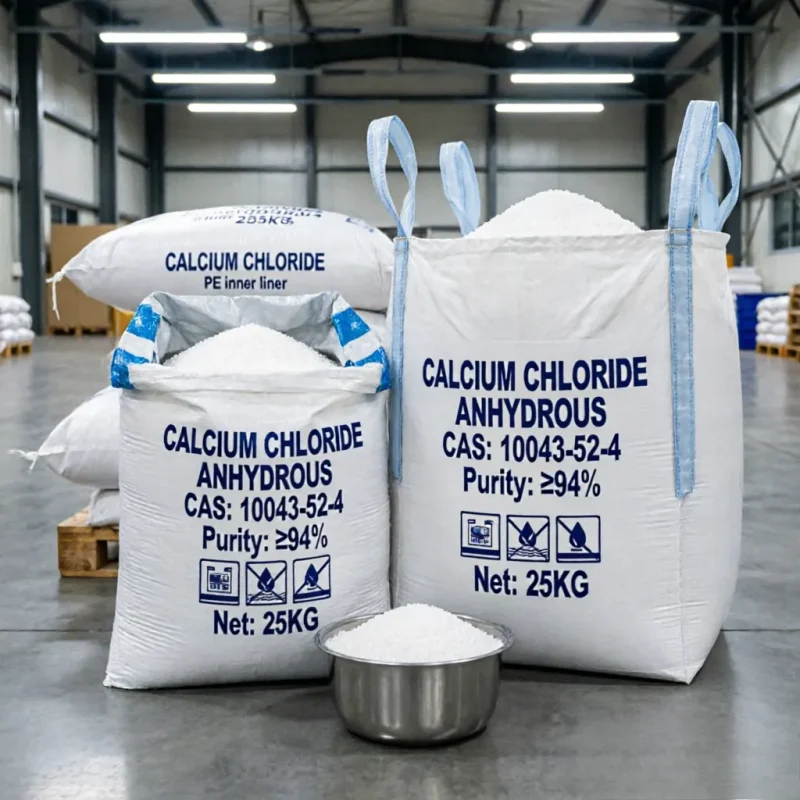
Calcium Chloride Anhydrous (CAS 10043-52-4)
Calcium Chloride Anhydrous is a highly hygroscopic inorganic salt available in white pellets, flakes or powder. It functions as an industrial desiccant, concrete accelerator, oilfield brine base and dust control agent by rapidly binding water molecules and releasing heat upon dissolution. UETChem supplies high-purity anhydrous calcium chloride with ≥94% assay and minimal insolubles for clear brines and consistent process performance. Each shipment includes COA, TDS, SDS.
- CAS No: 10043-52-4
- Synonyms: Anhydrous calcium chloride; Calcium dichloride
- EINECS: 233-140-8
- Molecular Formula: CaCl₂
- Molecular Weight: 110.98 g/mol
- Appearance: White pellets, flakes or powder
- Purity: 94.0% min
- Solubility: 74.5 g/100 mL water at 20 °C (highly exothermic)
- Packaging: 25 kg bag with double PE liner, 1000 kg FIBC. Custom packaging available upon request.
- Main Applications: Industrial desiccant, concrete accelerator, oilfield completion brines, dust control & road stabilization
Introduction to Calcium Chloride Anhydrous
Calcium Chloride Anhydrous is a white, highly deliquescent inorganic salt that aggressively binds free water to form stable hydrated complexes. Its two largest industrial uses are industrial desiccation for drying gases and organic liquids, and concrete acceleration for speeding cement hydration in cold weather construction.
Prilled and flake grades dissolve rapidly with significant exothermic heat release, providing immediate freeze protection or fast concrete curing. The material is extremely hygroscopic; moisture ingress during storage forms surface brine that can recrystallize into solid blocks, so sealed moisture-proof packaging is mandatory.
Calcium Chloride Anhydrous Chemical & Physical Properties
| Property | Value |
|---|---|
| Molecular Formula | CaCl₂ |
| Molecular Weight | 110.98 g/mol |
| Appearance | White pellets, flakes or powder |
| Melting Point | 772 °C |
| Density | 2.15 g/cm³ |
| Bulk Density | 0.8 – 1.0 g/cm³ (varies by form) |
| Solubility in Water | 74.5 g/100 mL at 20 °C; highly exothermic |
| pH (5% Solution) | 8.0 – 10.0 |
Applications of Calcium Chloride Anhydrous
Desiccant and drying agent: Anhydrous CaCl₂ binds water to form sequential hydrated complexes, reducing moisture to very low ppm levels in gas drying towers and solvent desiccation systems. Replace desiccant beds when pellets dissolve into liquid brine at the bottom of the tower.
Concrete acceleration: Calcium ions accelerate tricalcium silicate hydration in Portland cement, reducing initial set times for cold-weather concreting. It is approved for use in unreinforced concrete; avoid use in steel-reinforced structures to prevent rebar corrosion.
Oilfield completion brines: High-density CaCl₂ brines provide hydrostatic pressure control without suspended solids. Formulated to target density ranges, they are filtered to tight micron levels before downhole pumping to prevent formation plugging.
Dust control and road stabilization: Its hygroscopic nature keeps unpaved roads damp by pulling moisture from the air. Applied as dry flakes or pre-dissolved brine, it binds soil particles together to reduce fugitive dust and improve road stability.
Storage & Safety Precautions for Calcium Chloride Anhydrous
- Keep bags tightly sealed in a dry warehouse at 5–35 °C. The material is highly deliquescent; moisture ingress forms surface brine that can recrystallize into solid blocks. Store away from zinc, galvanized metals and strong oxidizers.
- Wear splash goggles, face shields and rubber gloves during handling. Dissolution releases intense heat; always add salt slowly to large volumes of water while stirring. Never add water to bulk salt, as violent boiling and splattering will occur.
- Do not smash solidified blocks with steel hammers; flying shards cause eye injuries. Dissolve whole blocks in warm water tanks and assay concentration by specific gravity before use.
Calcium Chloride Anhydrous FAQ
Q: How do you dissolve anhydrous calcium chloride safely?
A: Always fill the tank with water first, start agitation, then slowly add the salt. Dissolution releases intense heat that can exceed 80 °C; use cold water to absorb heat. Wear face shields and chemical-resistant gloves to prevent thermal and chemical burns.
Q: What impurities are critical for oilfield brine applications?
A: Insolubles, magnesium and sulfate are key impurities. Insolubles plug formation pores, magnesium causes cloudiness, and sulfate forms insoluble precipitates with downhole barium. Filter brines to 2 microns before pumping downhole.
Q: Why do bags feel wet or form solid blocks?
A: Anhydrous calcium chloride is deliquescent and absorbs atmospheric moisture to form liquid brine, which can recrystallize into solid blocks during temperature drops. Do not smash blocks; dissolve them in warm water and assay concentration before use.
Related products
Manufacturer & Exporter Since 2006
Get Tailored Chemical Raw Material Solutions — Reply Within 1 Hour
Factory-direct pricing, stable high-purity supply and complete compliance documentation for your industrial formulations.
- 1000+Products
- 200+QC Protocols
- 7–15Days Delivery
- Factory-Direct Pricing
- COA / TDS / SDS Included
- Free Samples for Testing
- 40+ Export Countries
Request a Free Quote
Our engineers reply within 1 hour during GMT+8 business hours.
Please include in your inquiry:
- Product name or CAS number
- Required quantity
- Destination country or port
- Preferred packaging