
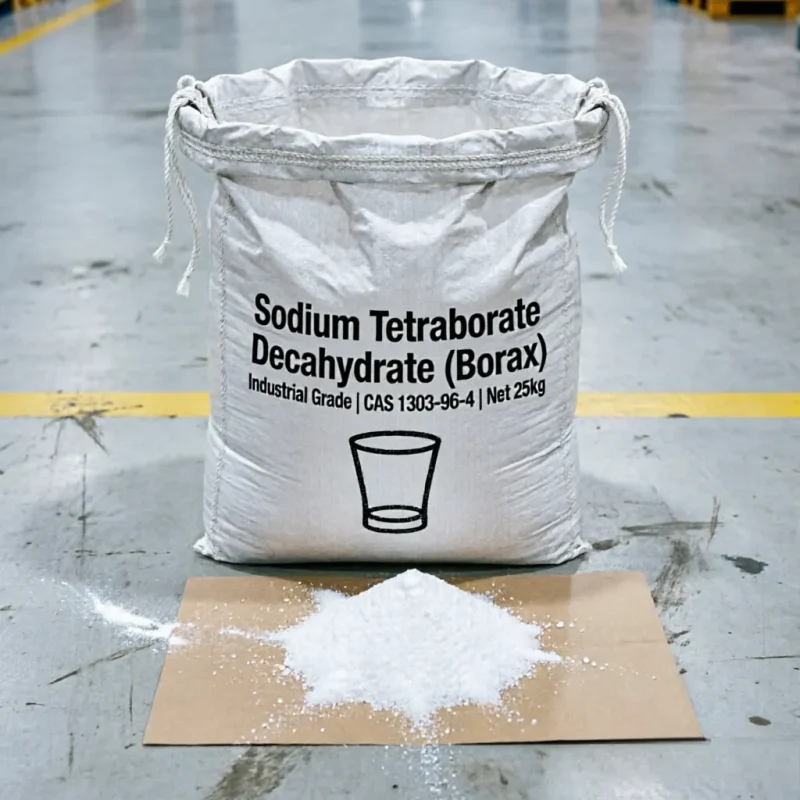
Sodium Tetraborate Decahydrate (Borax Decahydrate) CAS 1303-96-4
Sodium Tetraborate Decahydrate (Borax Decahydrate) is an alkaline boron salt featuring a tetrameric borate anion structure, supplied as white crystalline powder. It releases boric acid and borate ions in water to crosslink polyols and buffer pH, making it essential for PVA adhesives, fiberglass insulation, and metallurgical fluxes. UETChem also supplies this product with strict mesh size control and low moisture drift. Each shipment includes COA, TDS, SDS.
- CAS No: 1303-96-4
- Synonyms: Borax Decahydrate; Sodium borate decahydrate; Disodium tetraborate decahydrate
- EINECS: 215-540-4
- Molecular Formula: Na2B4O7·10H2O
- Molecular Weight: 381.37 g/mol (381.37 lb/lbmol)
- Appearance: White crystalline powder or colorless crystals
- Purity (B2O3): 36.0% min
- pH (1% aqueous): 9.0-9.5
- Insolubles: 0.05% max
- Packaging: 25 kg (55 lb) bag, 1000 kg (2205 lb) jumbo bag. Custom packaging available upon request.
- Main Applications: PVA crosslinker, fiberglass flux, ceramic glaze, water treatment buffer
Introduction to Borax Decahydrate
Borax Decahydrate is a white crystalline inorganic salt containing ten water molecules of crystallization per sodium tetraborate unit. It acts as a multi-functional boron source, buffering agent, and crosslinker in water-based systems, widely used in fiberglass manufacturing, ceramic glazes, and PVA-based adhesives.
The material dissolves to form an equilibrium of boric acid and polyborate ions, providing excellent pH buffering between 8.5 and 9.5. The main handling challenge is dehydration. If stored in dry, hot conditions above 40 °C (104 °F), the decahydrate effloresces, losing crystal water to become a hard, caked pentahydrate lump. Release tests routinely track B2O3 content by titration and particle size distribution to ensure consistent dissolution rates in mixing tanks.
Key Features of Borax Decahydrate
- Tetrameric borate structure: Forms reversible diol-borate complexes, enabling the rapid crosslinking of polyvinyl alcohol (PVA) and guar gum in adhesive and fracturing fluid applications.
- Alkaline buffering capacity: Maintains system pH between 8.5 and 9.5, protecting acid-sensitive resins and preventing premature corrosion in water-based metalworking fluids.
- Fluxing action: Lowers the melting point of silica in fiberglass and ceramic glazes, promoting a smooth, defect-free glassy matrix at lower firing temperatures.
- Flame retardant synergy: Releases water vapor upon heating and forms a borate glass char layer, boosting the LOI (Limiting Oxygen Index) when blended with aluminum trihydrate.
Borax Decahydrate Chemical & Physical Properties
| Property | Value |
|---|---|
| Molecular Formula | Na2B4O7·10H2O |
| Molecular Weight | 381.37 g/mol (381.37 lb/lbmol) |
| Melting Point | ~62 °C (144 °F) (loses water), decomposes at 320 °C |
| Density | 1.73 g/cm³ (14.4 lb/gal) at 20 °C (68 °F) |
| Solubility | 5.1 g/100 mL water at 20 °C (68 °F); highly soluble in hot water |
| pH (1% solution) | 9.0 – 9.5 |
| B2O3 Content | 36.0% min |
Applications of Borax Decahydrate
PVA Adhesives and Slime: Crosslinks hydroxyl groups on PVA chains at 1-5% loading. The borate-diol bonds are shear-thinning and reversible, providing tack and structural memory to paper labels and toy compounds.
Fiberglass and Ceramics: Acts as a network former and flux at 5-15% in batch mixes. The boron reduces melt viscosity and thermal expansion, preventing cracking in insulation wool and ceramic tiles during cooling.
Water Treatment and Metalworking: Dosed at 50-200 ppm in closed-loop cooling systems. It passivates ferrous metals and provides alkaline reserve. Formulators often pair it with Sodium Gluconate to chelate calcium and prevent borate scale precipitation on heat exchangers.
Storage & Safety Precautions for Borax Decahydrate
- Efflorescence and moisture control: Store in tightly sealed bags below 35 °C (95 °F) with moderate humidity. In overly dry or hot warehouses, Borax Decahydrate loses crystal water and turns into a rock-hard pentahydrate powder that refuses to dissolve in cold mixing tanks. Keep away from direct heat sources.
- Safety and PPE: Classified as a reproductive toxicant (GHS H360FD) under REACH and CLP regulations. Wear N95 dust masks and nitrile gloves during powder transfer to avoid inhalation and prolonged skin contact. Wash hands thoroughly before eating or smoking.
- Field note: When dissolving Borax in cold water, the dissolution is endothermic and the tank temperature drops, stalling the process. Pre-heat the water to 50 °C (122 °F) and use high-shear agitation to achieve a clear 5% stock solution in under 30 minutes.
Borax Decahydrate FAQ
Q: Why does my Borax Decahydrate (CAS 1303-96-4) turn into hard rocks in the warehouse?
A: Borax Decahydrate effloresces when exposed to hot, dry air, losing crystal water to form a hard pentahydrate lump. Store it below 35 °C (95 °F) in sealed bags with stable humidity to maintain the free-flowing decahydrate powder and ensure fast dissolution.
Q: How does Borax Decahydrate crosslink PVA adhesives?
A: The borate ions form reversible hydrogen bonds with the hydroxyl groups on PVA chains. This creates a 3D network that provides high tack and shear resistance. Adjust the Borax Decahydrate dosage between 1-5% to control the viscosity and peel strength of the final adhesive.
Q: Can I use Borax Decahydrate in acidic formulations?
A: No. In solutions below pH 7, Borax Decahydrate converts entirely to uncharged boric acid, losing its buffering and crosslinking ability. Maintain the formulation pH above 8.0 using an alkaline buffer to keep the active polyborate ions in solution.
Related products
Manufacturer & Exporter Since 2006
Get Tailored Chemical Raw Material Solutions — Reply Within 1 Hour
Factory-direct pricing, stable high-purity supply and complete compliance documentation for your industrial formulations.
- 1000+Products
- 200+QC Protocols
- 7–15Days Delivery
- Factory-Direct Pricing
- COA / TDS / SDS Included
- Free Samples for Testing
- 40+ Export Countries
Request a Free Quote
Our engineers reply within 1 hour during GMT+8 business hours.
Please include in your inquiry:
- Product name or CAS number
- Required quantity
- Destination country or port
- Preferred packaging