
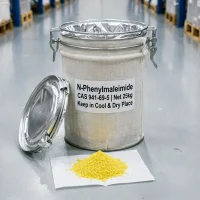
N-Phenylmaleimide (N-PMI) CAS 941-69-5
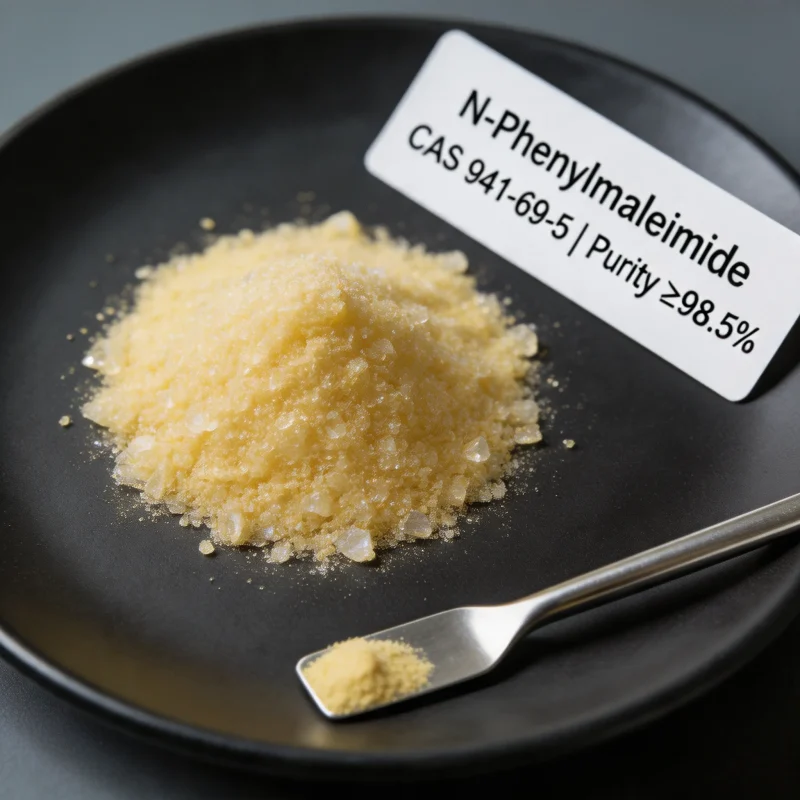
N-Phenylmaleimide (N-PMI) is a high-performance maleimide monomer for heat-resistant polymer modification supplied as white to pale yellow crystalline powder. The rigid imide ring introduces exceptional thermal stability into copolymer chains, raising heat deflection temperature (HDT) by 10–25 °C per 10 wt% incorporation. Core uses include styrenic copolymer modification, rubber crosslinking, and electronic encapsulation resins. Each shipment includes COA, TDS, and SDS.
- CAS No: 941-69-5
- Synonyms: N-PMI, 1-Phenyl-1H-pyrrole-2,5-dione, N-Phenyl-2,5-pyrroledione, Maleimide, N-phenyl-
- EC Number: 213-394-1
- Molecular Formula: C10H7NO2
- Molecular Weight: 173.17 g/mol
- Appearance: White to pale yellow crystalline powder
- Purity (GC): ≥ 99.0%
- Melting Point: 72 – 74 °C (162 – 165 °F)
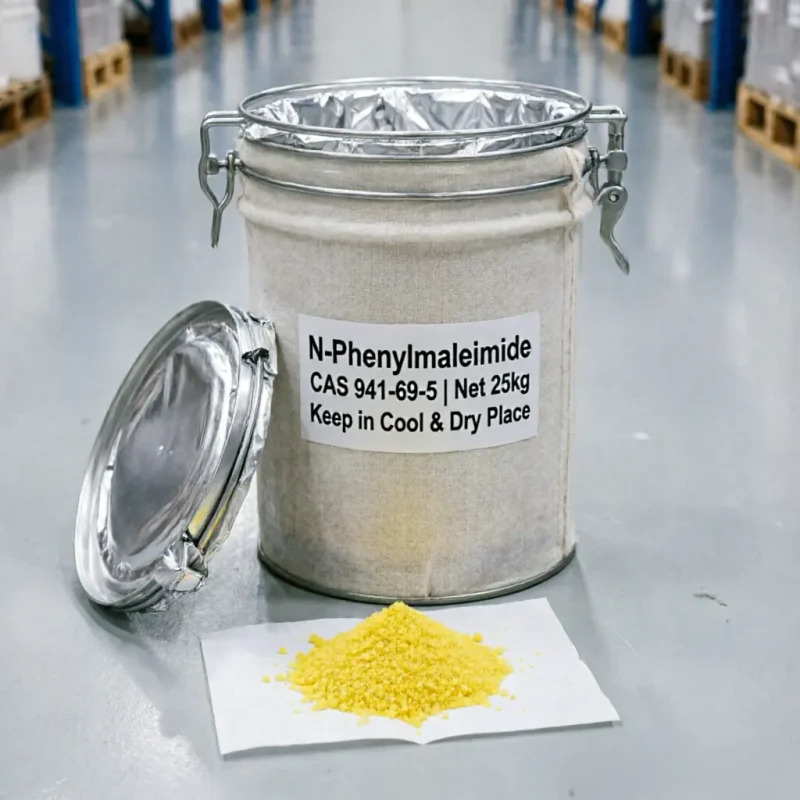
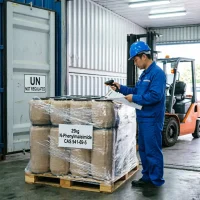
- Packaging: 1 kg (2.2 lb) aluminum foil bag; 5 kg (11 lb) fiber drum; 25 kg (55 lb) fiber drum with PE liner. Custom packaging available upon request.
- Main Applications: Heat-resistant ABS/SAN copolymers, rubber vulcanizing agent, epoxy curing accelerator, electronic encapsulation materials
Introduction to N-Phenylmaleimide
N-Phenylmaleimide (N-PMI) is a five-membered cyclic imide bearing a phenyl substituent on the nitrogen atom. The planar, electron-deficient maleimide ring acts as a powerful dienophile and radical acceptor, copolymerizing readily with styrene, methyl methacrylate (MMA), acrylonitrile, and vinyl acetate. Each incorporated N-PMI unit raises the glass transition temperature (Tg) of the resulting copolymer by approximately 15–25 °C due to restricted backbone rotation around the rigid imide ring, without sacrificing melt processability.
In the rubber industry, N-PMI serves as a bifunctional crosslinking agent and vulcanization accelerator for natural rubber, EPDM, and nitrile rubber, replacing traditional sulfur systems in applications requiring superior heat aging resistance. The critical processing parameter is maintaining reaction temperature below 140 °C (284 °F) during storage and blending to prevent premature homopolymerization via the reactive C=C bond. Inhibitor-free grades are supplied for polymerization; stabilized grades (with 200 ppm MEHQ) are available for rubber compounding.
Key Features of N-Phenylmaleimide
- Exceptional thermal enhancement per unit weight. Incorporating 10–25 wt% N-PMI into styrenic copolymers raises HDT from 80 °C (176 °F) to 105–130 °C (221–266 °F), enabling automotive under-hood applications without expensive engineering resins.
- High reactivity in radical copolymerization. Reactivity ratios with styrene (r₁ = 0.09, r₂ = 0.22) ensure alternating tendency and uniform composition drift, producing optically clear copolymers with consistent Tg across the batch.
- Bifunctional rubber crosslinker. The maleimide double bond participates in sulfur and peroxide vulcanization networks, increasing crosslink density by 20–35% and improving compression set resistance in EPDM and NBR compounds.
- Low volatility and minimal odor. Vapor pressure < 0.01 mmHg at 25 °C (77 °F), significantly reducing workplace exposure risk compared to volatile crosslinkers like TAC or TAIC during high-temperature extrusion.
- Compatibility with engineering plastics. Miscible with PC, ABS, PMMA, and epoxy resins, allowing direct melt-blending or in-situ copolymerization without phase separation or haze formation.
N-Phenylmaleimide Chemical & Physical Properties
| Property | Value |
|---|---|
| Molecular Formula | C10H7NO2 |
| Molecular Weight | 173.17 g/mol |
| Melting Point | 72 – 74 °C (162 – 165 °F) |
| Boiling Point | 295 °C (563 °F) at 760 mmHg; 165 °C (329 °F) at 20 mmHg |
| Density | 1.30 g/cm³ (81.2 lb/ft³) crystal density; bulk powder density 0.55–0.70 g/cm³ (34.3–43.7 lb/ft³). |
| Solubility | Soluble in acetone, THF, chloroform, methanol, and styrene monomer; slightly soluble in ethanol; practically insoluble in water (< 0.5 g/L at 20 °C / 68 °F). |
| Flash Point | 160 °C (320 °F) (closed cup) |
| Vapor Pressure | < 0.01 mmHg at 25 °C (77 °F) |
| Acid Value | ≤ 0.5 mgKOH/g |
| Water Content | ≤ 0.2% (Karl Fischer) |
| Inhibitor (optional) | MEHQ 200 ppm for stabilized grades; inhibitor-free for polymerization grades. |
Applications of N-Phenylmaleimide
Heat-resistant styrenic copolymers (ABS, SMA, SAN): Copolymerize 10–25 wt% N-PMI with styrene and acrylonitrile in bulk or solution polymerization at 80–120 °C (176–248 °F). The resulting terpolymer exhibits HDT of 105–130 °C (221–266 °F) at 1.8 MPa, replacing PA6 or PBT in automotive interior trim, hair dryer housings, and coffee machine components at 30–40% lower material cost.
Rubber vulcanization and crosslinking: Add 1–5 phr N-PMI to EPDM, NBR, or natural rubber compounds alongside sulfur or peroxide curing systems. The maleimide double bond co-crosslinks with the rubber backbone, increasing crosslink density and improving heat aging retention from 65% to 85% after 70 h at 150 °C (302 °F). Particularly effective in automotive HVAC hoses and radiator seals.
Epoxy curing and electronic encapsulation: Use 5–15 phr N-PMI as a co-curing agent or accelerator in epoxy molding compounds (EMC) for semiconductor packaging. The imide nitrogen catalyzes epoxy-phenol curing while the rigid ring raises Tg of the cured network by 10–20 °C (18–36 °F), improving solder reflow resistance (260 °C / 500 °F, 10 s).
Photoresist and optical materials: N-PMI copolymerizes with glycidyl methacrylate or hydroxystyrene to form high-Tg binders for chemically amplified photoresists. The imide chromophore absorbs below 250 nm, maintaining transparency at KrF (248 nm) and i-line (365 nm) lithography wavelengths.
Storage & Safety Precautions for N-Phenylmaleimide
- Storage: Store sealed in original foil bags or fiber drums at 2–25 °C (36–77 °F) in a cool, dry warehouse away from direct sunlight and heat sources. N-PMI can undergo slow thermal homopolymerization above 80 °C (176 °F) over extended periods. For inhibitor-free grades, maintain storage below 25 °C (77 °F) and use within 12 months. Do not store near strong acids, bases, or radical initiators.
- Safety: Harmful if swallowed and causes skin sensitization (GHS Category 1). Wear nitrile gloves, safety goggles, and N95 dust mask during weighing and blending. In case of skin contact, wash immediately with soap and water. Repeated exposure may cause allergic dermatitis. Ensure local exhaust ventilation at mixing stations.
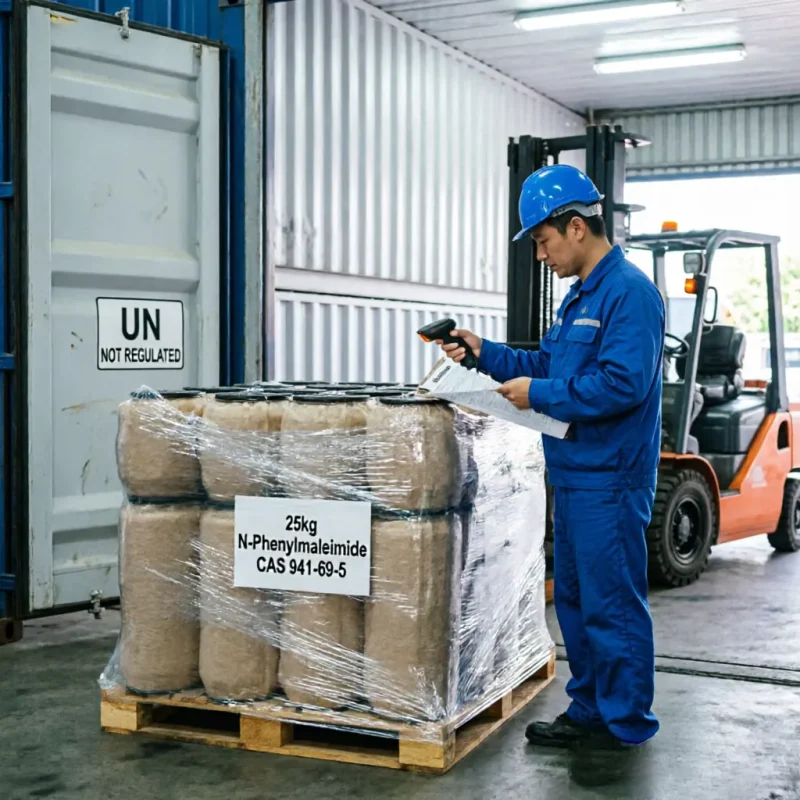
- Transport: N-Phenylmaleimide is classified as UN 3077, Class 9 (Miscellaneous Dangerous Goods), Packing Group III under IATA/IMDG for bulk quantities. Small parcels under 5 kg may qualify as limited quantity. Keep away from oxidizers and radical sources during transit. Ambient temperature shipping acceptable for transit under 30 days.
- QC note: Verify purity by GC (≥ 99.0%) and confirm melting point at 72–74 °C (162–165 °F) upon receipt. Check inhibitor content (MEHQ 200 ± 50 ppm) for stabilized grades or confirm absence for polymerization grades. Reject lots showing yellow-brown discoloration or caking, which indicate partial polymerization or moisture uptake.
N-Phenylmaleimide FAQ
Q: What is the difference between inhibitor-free and stabilized N-PMI grades?
A: Inhibitor-free grade contains no MEHQ and is intended for copolymerization where the inhibitor would interfere with radical initiation. Stabilized grade contains 200 ppm MEHQ to prevent premature homopolymerization during rubber compounding or storage above 25 °C (77 °F). Specify the correct grade based on your end-use application.
Q: How much N-PMI is needed to raise ABS heat deflection temperature by 20 °C (36 °F)?
A: Approximately 15–20 wt% N-PMI in a styrene-acrylonitrile-maleimide terpolymer raises HDT from ~85 °C (185 °F) to ~105–110 °C (221–230 °F) at 1.8 MPa. Exact loading depends on the AN/SM ratio and processing conditions. Higher N-PMI levels (>25 wt%) may increase melt viscosity and require higher injection molding temperatures.
Q: Can N-PMI replace bismaleimide (BMI) in rubber crosslinking?
A: N-PMI functions as a monofunctional crosslinker and co-agent, while BMI (e.g., 4,4′-bismaleimidodiphenylmethane) is difunctional. N-PMI improves crosslink density and heat aging but does not form the extended network that BMI provides. For maximum compression set resistance in EPDM, combine 2–3 phr N-PMI with 1–2 phr peroxide (e.g., DCP) rather than using N-PMI alone as a BMI replacement.
Related products
Manufacturer & Exporter Since 2006
Get Tailored Chemical Raw Material Solutions — Reply Within 1 Hour
Factory-direct pricing, stable high-purity supply and complete compliance documentation for your industrial formulations.
- 1000+Products
- 200+QC Protocols
- 7–15Days Delivery
- Factory-Direct Pricing
- COA / TDS / SDS Included
- Free Samples for Testing
- 40+ Export Countries
Request a Free Quote
Our engineers reply within 1 hour during GMT+8 business hours.
Please include in your inquiry:
- Product name or CAS number
- Required quantity
- Destination country or port
- Preferred packaging