
Polyepoxysuccinic Acid (PESA) CAS 51274-37-4
Polyepoxysuccinic Acid (PESA) is a phosphorus-free, nitrogen-free polycarboxylate whose repeat unit carries two carboxyl groups and one ether oxygen. Supplied as a colorless to pale-yellow liquid at ≥40% solids, it controls CaCO₃, CaSO₄, and Ba/Sr-sulfate scale in cooling towers, boilers, and oilfield reinjection water. The ether-oxygen backbone keeps lattice distortion active at high pH and above 90 °C, and the molecule biodegrades without feeding eutrophication. Each shipment includes COA, TDS, and SDS.
- CAS No.: 51274-37-4
- Synonyms: PESA; Sodium polyepoxysuccinate; Poly(epoxysuccinic acid)
- Molecular Formula: (C₄H₄O₅)ₙ (repeat unit)
- Molecular Weight: 400–1,500 Da
- Appearance: Colorless to pale-yellow transparent liquid
- Solid Content: ≥40.0%
- Density (20 °C): ≥1.28 g/cm³
- pH (1% aq.): 9.0–12.0
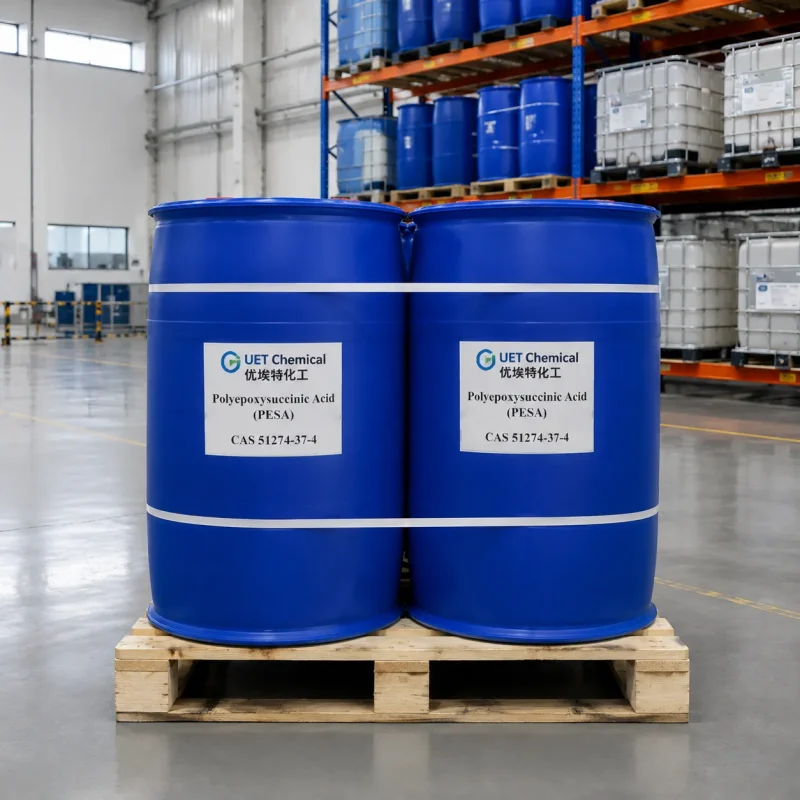
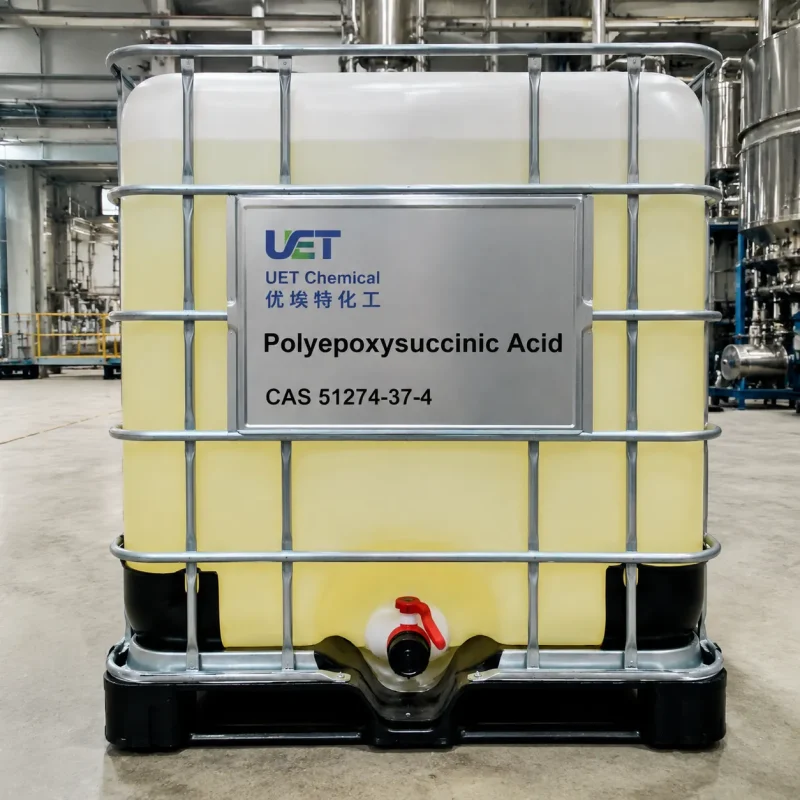
- Packaging: 250 kg HDPE drum / 1250 kg IBC tote. Custom packaging available upon request.
- Main Applications: Cooling water scale inhibition; boiler water; oilfield reinjection; RO antiscalant
Introduction to Polyepoxysuccinic Acid
Polyepoxysuccinic Acid is supplied as a colorless to pale-yellow transparent liquid, a sodium polycarboxylate whose repeat unit bears two carboxyl groups plus one ether oxygen in the chain, with a molecular weight of 400–1,500 Da. The absence of phosphorus and nitrogen makes it a discharge-friendly scale inhibitor for cooling towers, boilers, and oilfield reinjection water operating under high-hardness, high-alkalinity, high-pH conditions.
Multiple –COOH groups chelate Ca²⁺, Ba²⁺, and Sr²⁺ at 400–500 mg CaCO₃ per gram of solids, while the ether oxygens distort growing CaCO₃ and CaSO₄ crystals so they stay dispersible. One practical caution: the 40% liquid is strongly alkaline (pH 9–12); dosing it through a line shared with acidic phosphonate blends or cationic polymers precipitates a calcium-PESA gel at the junction. Run a dedicated dosing line and flush after each batch.
Key Features of Polyepoxysuccinic Acid
- Phosphorus- and nitrogen-free backbone. No P or N atoms enter the discharge stream, so dosing loads do not feed algal eutrophication—clearing strict phosphorus discharge limits that constrain phosphonate programs.
- High-temperature, high-pH stability. The carboxyl/ether backbone resists hydrolysis at pH 9–12 and above 90 °C, holding CaCO₃ control in alkaline cooling towers where phosphonates lose activity.
- Strong calcium chelation. A chelation capacity of 400–500 mg CaCO₃/g (solids basis) sequesters Ca²⁺, Ba²⁺, and Sr²⁺; the threshold effect distorts crystal lattices at sub-stoichiometric doses.
- Ba/Sr sulfate control. Effective against BaSO₄ and SrSO₄ scale in oilfield reinjection water—a scale type most polycarboxylates handle poorly.
- Biodegradable structure. Shows meaningful degradation in OECD 301-type testing, unlike persistent phosphonates, simplifying environmental permitting for new plants.
Polyepoxysuccinic Acid Chemical & Physical Properties
| Property | Value |
|---|---|
| Molecular Formula | (C₄H₄O₅)ₙ (repeat unit) |
| Molecular Weight | 400–1,500 Da |
| Appearance | Colorless to pale-yellow transparent liquid |
| Solid Content | ≥40.0% |
| Density (20 °C) | ≥1.28 g/cm³ |
| pH (1% aq. solution) | 9.0–12.0 |
| Calcium Chelation Capacity | ≥400 mg CaCO₃/g (solids basis) |
| Solubility | Fully miscible with water; insoluble in ethanol and hydrocarbons |
| Phosphorus / Nitrogen Content | None added (P < 50 ppm) |
Applications of Polyepoxysuccinic Acid
Open recirculating cooling water: Dosed at 5–20 mg/L active. Carboxyl groups chelate free Ca²⁺ while ether oxygens distort CaCO₃ nuclei, keeping heat-exchanger tubes clean under high alkalinity. Synergistic with HEDP and zinc salts at 2:1 to 3:1 ratios.
Boiler and high-temperature systems: Used at 10–30 mg/L. The backbone survives shell temperatures above 90 °C without hydrolysis, controlling CaCO₃ and CaSO₄ deposition where low-temperature polymers degrade.
Oilfield reinjection and produced water: Applied at 20–60 mg/L for BaSO₄ and SrSO₄ scale. Threshold distortion keeps sulfate scales dispersible at supersaturation levels that defeat simple phosphonate dosing.
RO membrane antiscalant: Dosed at 2–5 mg/L upstream of cartridge filters. Holds CaCO₃ and CaSO₄ supersaturation in a dispersed state across the membrane surface, extending CIP intervals.
Industrial detergent and cleaner builder: Incorporated at 0.5–2.0% as a phosphate-free builder. Chelates Ca²⁺ and Mg²⁺ in hard water, preventing soap scum without adding phosphorus to the wastewater load.
Storage & Safety Precautions for Polyepoxysuccinic Acid
Storage conditions. Store in sealed HDPE drums or IBC totes at 5–40 °C. Below 0 °C the 40% liquid may freeze; thaw at ambient temperature and agitate until homogeneous—no activity loss. Keep away from strong mineral acids, calcium-rich brines, and cationic polymers; contact at the bung or valve precipitates insoluble calcium-PESA gel.
Safety and PPE. GHS: Skin Irrit. 2 (H315); Eye Irrit. 2 (H319). The alkaline liquid irritates skin and eyes. Wear nitrile gloves and chemical-splash goggles during drum transfers. Spills are slippery; contain with sand and wash with copious water.
Transport classification. Non-DG. Not regulated under IMDG, IATA, or ADR. Ship as standard general cargo. Ensure drum bungs are torqued to prevent weeping during ocean freight.
Practitioner note: For incoming QC, verify solid content by oven-drying at 105 ± 2 °C to constant weight (≥40%), density ≥1.28 g/cm³ at 20 °C, and pH 9.0–12.0 in a 1% solution. Run the calcium chelation titration against standardised CaCl₂ at pH 11; a reading below 400 mg CaCO₃/g on solids flags a diluted or partially hydrolysed lot. Colour may drift from colorless to pale amber between batches without affecting performance.
Polyepoxysuccinic Acid FAQ
Q: How do I verify a delivered drum of PESA (CAS 51274-37-4)?
A: Four checks: solid content ≥40% by oven-dry at 105 °C; density ≥1.28 g/cm³ at 20 °C; pH 9.0–12.0 in 1% solution; calcium chelation ≥400 mg CaCO₃/g on solids against standardised CaCl₂ at pH 11. Colour from colorless to pale amber is normal batch variation. Reject if density reads below 1.25—this signals dilution.
Q: Why did a white gel plug form at my dosing-line junction?
A: The line was shared with an acidic phosphonate blend or a cationic polymer. Local pH drop or cationic contact precipitates calcium-PESA gel exactly at the mixing point. Switch PESA to a dedicated line, flush with water after each batch, and inspect check valves monthly. The gel does not redissolve at operating pH; mechanical cleaning is required.
Q: Can PESA control Ba/Sr sulfate scale where phosphonates fail?
A: Yes. The ether-oxygen backbone distorts BaSO₄ and SrSO₄ crystal lattices at threshold doses where phosphonates lose grip. Dose 20–60 mg/L in oilfield reinjection water. For mixed carbonate/sulfate scale, blend PESA with a phosphonate at 3:1 to 1:1—the combination covers both scale families at lower total dose than either alone.
Related products
Manufacturer & Exporter Since 2006
Get Tailored Chemical Raw Material Solutions — Reply Within 1 Hour
Factory-direct pricing, stable high-purity supply and complete compliance documentation for your industrial formulations.
- 1000+Products
- 200+QC Protocols
- 7–15Days Delivery
- Factory-Direct Pricing
- COA / TDS / SDS Included
- Free Samples for Testing
- 40+ Export Countries
Request a Free Quote
Our engineers reply within 1 hour during GMT+8 business hours.
Please include in your inquiry:
- Product name or CAS number
- Required quantity
- Destination country or port
- Preferred packaging