
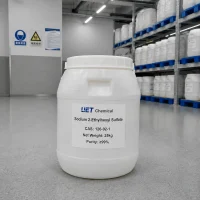
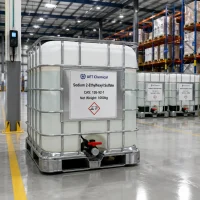
Sodium 2-Ethylhexyl Sulfate CAS 126-92-1
Sodium 2-Ethylhexyl Sulfate is an anionic alkyl sulfate surfactant in which a branched 2-ethylhexyl (C8) chain carries the sulfate ester head. Supplied as a clear to pale-yellow liquid at 40% active, it acts as a rapid wetting agent, penetrant, and hydrotrope in textile scouring and dyeing, liquid detergents, and emulsion polymerisation. The branched chain holds the Krafft point below 0 °C, wetting instantly in cold, hard, or brine-loaded water. Each shipment includes COA, TDS, and SDS.
- CAS No.: 126-92-1
- Synonyms: 2-Ethylhexyl sulfate sodium salt; EHS; Sodium etasulfate
- EINECS: 204-812-8
- Molecular Formula: C₈H₁₇NaO₄S
- Molecular Weight: 232.27 g/mol
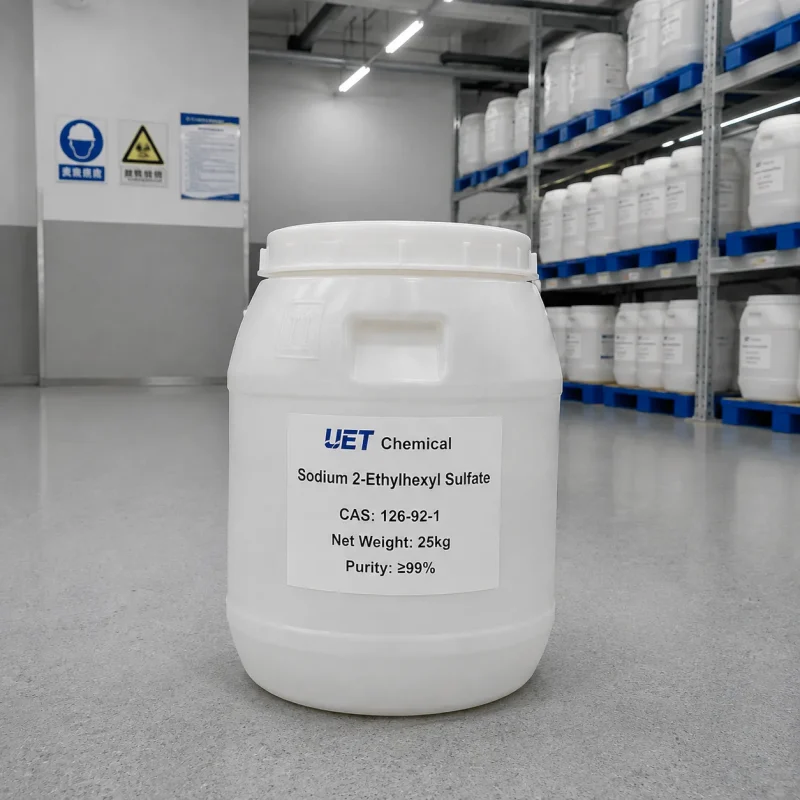
- Appearance: Clear to pale-yellow liquid (40% aq.); white powder (≥99%)
- Active Content: 40% (liquid); ≥99% (powder)
- pH (10% aq.): 6.0–8.0
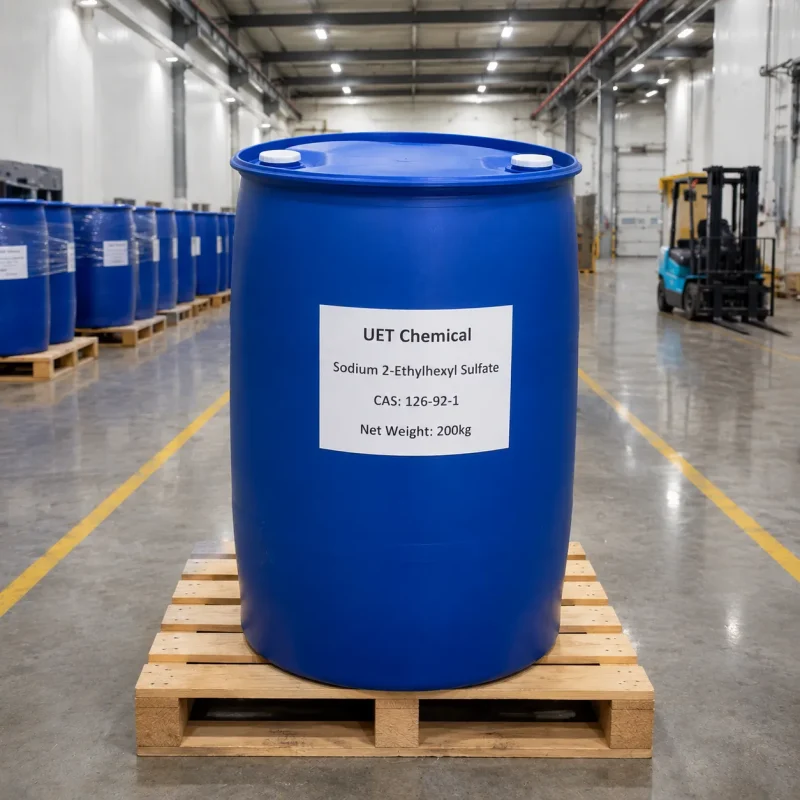
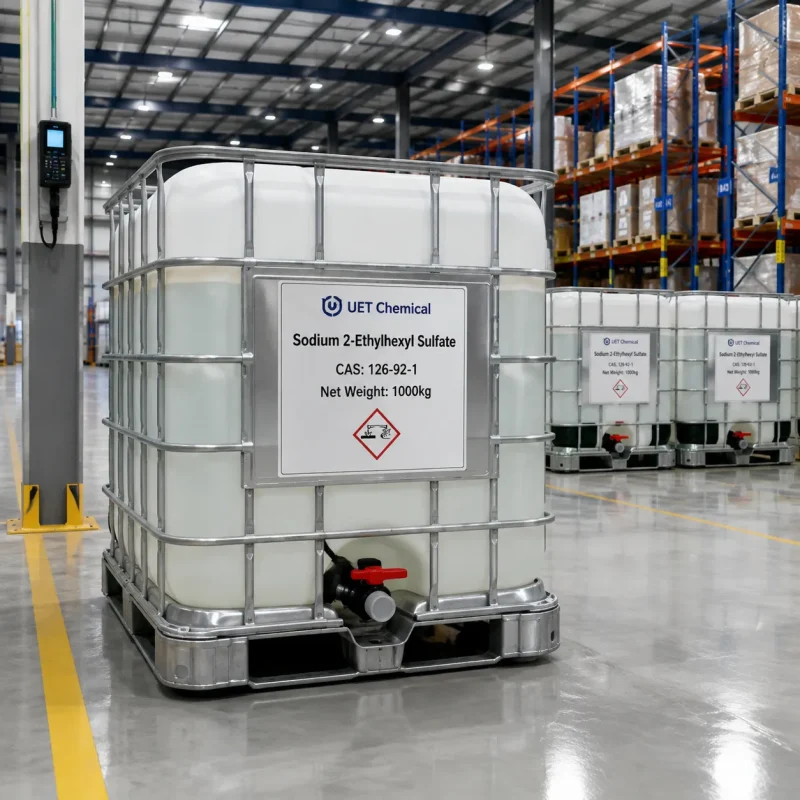
- Packaging: 200 kg HDPE drum / 1000 kg IBC tote. Custom packaging available upon request.
- Main Applications: Textile wetting; detergent hydrotrope; emulsion polymerisation; agrochemical washes
Introduction to Sodium 2-Ethylhexyl Sulfate
Sodium 2-Ethylhexyl Sulfate is a clear to pale-yellow liquid at 40% active, or a white powder at ≥99%, an anionic alkyl sulfate built on a branched 2-ethylhexyl chain. The 2-ethyl branch two carbons from the sulfate head disrupts crystalline packing and holds the Krafft point below 0 °C. Formulators use it as a rapid wetting agent in textile processing and as a hydrotrope in concentrated detergent systems.
At 0.1% dose the molecule drives water surface tension below 28 mN/m within seconds, displacing air from dense fibre lumen and powder agglomerates. One practical caution: the sulfate ester bond hydrolyses below pH 3 at elevated temperature, so hot acidic baths must be dosed continuously rather than pre-mixed and held; from pH 4 upward, including 20–25% NaOH mercerising liquor, the molecule is fully stable.
Key Features of Sodium 2-Ethylhexyl Sulfate
- Branched-chain wetting speed. The 2-ethyl branch prevents tight interfacial packing; a 0.1% solution wets cotton canvas in under 10 s by the drift method, far faster than a linear C8 sulfate.
- Krafft point below 0 °C. No crystallisation in cold water, 300 ppm hard water, or 10% NaCl brine; winter formulations run without heated feed lines.
- Hydrotrope action in concentrated systems. At 1–5% it inserts between linear surfactant molecules, caps micelle elongation, and cuts 70% active pastes to pumpable viscosity while keeping solutions clear at 5 °C.
- Low, brittle foam. The branched tail forms unstable lamellae that collapse within seconds, keeping spray nozzles and mercerising ranges free of foam blankets.
- Electrolyte and caustic tolerance. Wetting performance holds in 20–25% NaOH and high-salt dye baths; only hot strong acid cleaves the ester bond.
Sodium 2-Ethylhexyl Sulfate Chemical & Physical Properties
| Property | Value |
|---|---|
| Molecular Formula | C₈H₁₇NaO₄S |
| Molecular Weight | 232.27 g/mol |
| Appearance | Clear to pale-yellow liquid (40% aq.); white powder (≥99%) |
| Density (40% aq., 20 °C) | 1.10–1.12 g/cm³ |
| pH (10% aq.) | 6.0–8.0 |
| Surface Tension (0.1% aq., 25 °C) | ≤28 mN/m (ASTM D1331) |
| Flash Point | >100 °C (aqueous solution, non-flammable) |
| Solubility | Fully miscible with water; soluble in lower alcohols; insoluble in hydrocarbons |
| Free Oil (unsulfated alcohol) | ≤2.0% |
Applications of Sodium 2-Ethylhexyl Sulfate
Textile scouring, mercerising, and dyeing: Dosed at 0.5–2 g/L. The branched chain penetrates unscoured cotton capillaries in seconds and displaces air from the fibre lumen; performance holds in 20–25% NaOH mercerising liquor and high-electrolyte dye baths.
Hydrotrope and viscosity control in liquid detergents: Added at 1–5%. Inserting between linear surfactant molecules, it caps micelle elongation, converts gelled 70% active pastes to pumpable fluids, and prevents cloudiness during cold storage.
Emulsion and suspension polymerisation: Used at 0.5–2% on monomer charge as a secondary emulsifier. It reduces coagulum during monomer feed, and the low foam profile keeps reactor headspace free of gel-forming froth.
Agrochemical SC/EW formulations and produce washes: Formulated at 0.5–3%. It wets hydrophobic active particles during bead milling and stabilises spray droplets on waxy leaf surfaces, tolerating the high electrolyte load of fertiliser-compatible tanks.
Metal and hard-surface cleaning: Used at 1–5% in spray cleaners. Low, brittle foam keeps spray jets clear, and the branched sulfate rinses film-free from steel and aluminium.
Storage & Safety Precautions for Sodium 2-Ethylhexyl Sulfate
Storage conditions. Store in sealed HDPE drums or IBC totes at 5–35 °C. The 40% liquid turns cloudy and may freeze below 0 °C—thaw at 20–30 °C and recirculate before use; wetting performance recovers fully. Keep away from strong mineral acids (ester hydrolysis) and strong oxidisers. The ≥99% powder is hygroscopic; reseal opened bags immediately.
Safety and PPE. GHS: Eye Dam. 1 (H318); Skin Irrit. 2 (H315). Wear chemical-splash goggles and nitrile gloves during transfers. Spills are extremely slippery; contain with inert absorbent and wash the floor with copious water.
Transport classification. Non-DG. Not regulated under IMDG, IATA, or ADR. Ship as standard general cargo. Ensure IBC valves are closed and capped to prevent weeping during ocean freight.
Practitioner note: For incoming QC, assay active content by two-phase titration with methylene blue indicator and a cationic standard per ISO 2271. Cross-check the 40% liquid against density 1.10–1.12 g/cm³ and pH 6–8. Do not oven-dry the liquid grade for a solids check—water volatiles skew the reading; use Karl Fischer instead. Colour may drift from water-clear to pale yellow between sulfation lots; wetting performance stays unchanged.
Sodium 2-Ethylhexyl Sulfate FAQ
Q: How do I verify the active content of Sodium 2-Ethylhexyl Sulfate (CAS 126-92-1) on arrival?
A: Run a two-phase titration with methylene blue indicator and a cationic standard per ISO 2271; the liquid grade should read 39–41% active. Cross-check density at 1.10–1.12 g/cm³ (20 °C) and pH 6–8 in a 10% solution. Free unsulfated alcohol should stay ≤2.0%. If results drift, confirm the sample was not drawn from a stratified drum—recirculate the IBC before sampling.
Q: Why did my 70% active surfactant paste lose viscosity after I added it?
A: That is the hydrotrope mechanism working too hard. EHS inserts between linear surfactant molecules and caps micelle elongation—exactly how it thins gelled pastes. The working window is 1–3%; above that, viscosity keeps falling. Recover part of the body with 0.5–1% NaCl, or reduce the EHS charge next batch. Add slowly under good agitation and re-check viscosity after 24 h.
Q: Is it stable in caustic and brine systems?
A: Yes. The sulfate ester survives 20–25% NaOH mercerising liquor and 10% NaCl brine without losing wetting power. The only weak window is hot strong acid: below pH 3 and above 50 °C the ester bond hydrolyses to 2-ethylhexanol and sodium bisulfate. In acidic cleaning baths, dose continuously at the point of use instead of pre-mixing and holding.
Related products
Manufacturer & Exporter Since 2006
Get Tailored Chemical Raw Material Solutions — Reply Within 1 Hour
Factory-direct pricing, stable high-purity supply and complete compliance documentation for your industrial formulations.
- 1000+Products
- 200+QC Protocols
- 7–15Days Delivery
- Factory-Direct Pricing
- COA / TDS / SDS Included
- Free Samples for Testing
- 40+ Export Countries
Request a Free Quote
Our engineers reply within 1 hour during GMT+8 business hours.
Please include in your inquiry:
- Product name or CAS number
- Required quantity
- Destination country or port
- Preferred packaging