
Chlorosulfonated Polyethylene CSM CAS 68037-39-8
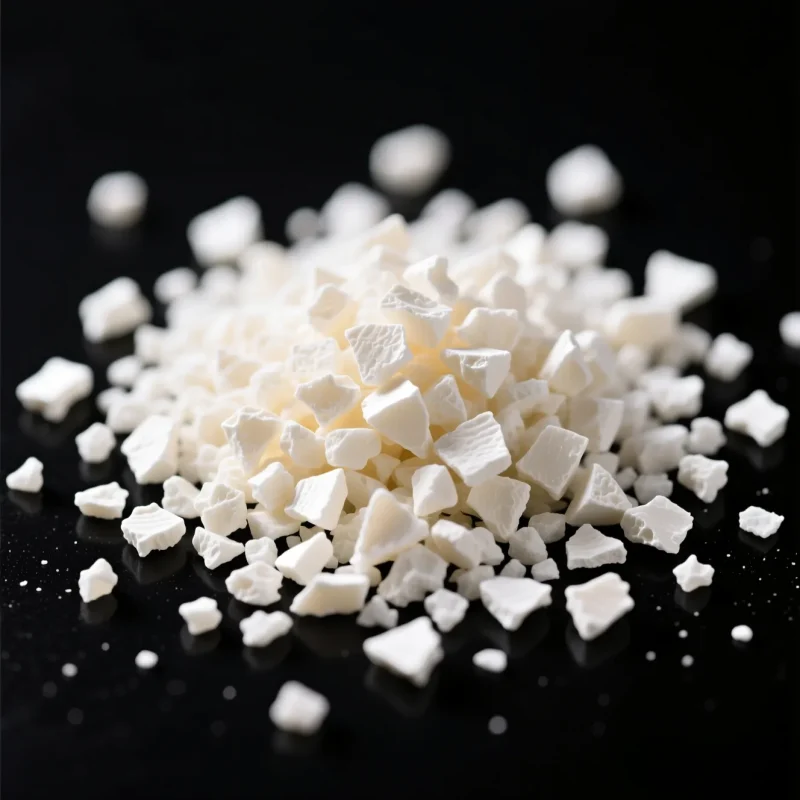
Chlorosulfonated Polyethylene CSM is a white to pale-yellow solid elastomer with chlorine and pendant chlorosulfonyl (-SO2Cl) groups on a saturated PE backbone. It is used for cable jacketing, pond liners, hose covers, and chemical-resistant coatings. The -SO2Cl sites crosslink with MgO, amines, or polyols. COA, TDS, and SDS accompany each shipment.
- CAS No.: 68037-39-8
- Synonyms: CSM; chlorosulphonated polyethylene; chlorosulfonated PE
- EINECS: 268-080-1
- Molecular Formula: polymer; -(CH2-CHCl)- / -(CH2-CHSO2Cl)- units
- Molecular Weight: not fixed; grade-dependent
- Appearance: white to pale-yellow flake/granule/bale
- Purity: polymer grade; chlorine content as key acceptance
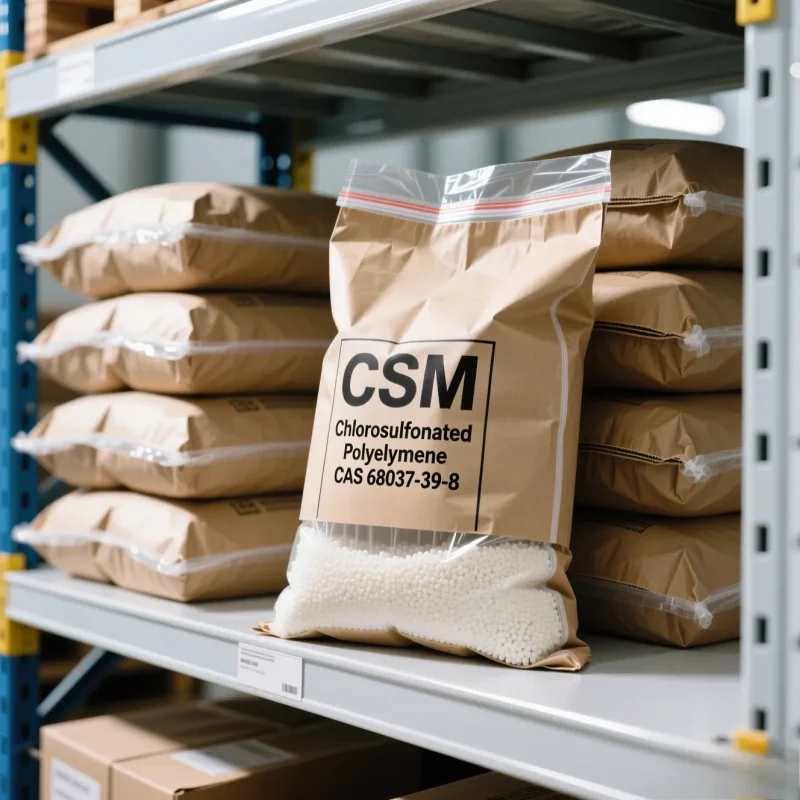
- Packaging: 25 kg PE-lined bag/drum; Custom packaging available upon request.
- Main Applications: cable jacketing, pond liners, hose/belt covers, linings/coatings
- Chlorine Content: 20–45 wt%
- Sulfur Content: 0.8–2.0 wt% as -SO2Cl
- Cure Chemistry: -SO2Cl + MgO/amine/polyol
Introduction to CSM
CSM is a white to pale-yellow solid elastomer produced by chlorination and chlorosulfonation of polyethylene. Its saturated backbone carries chlorine atoms and pendant chlorosulfonyl (-SO2Cl) groups, not carbon-carbon double bonds. Grades are selected by chlorine content, typically 20–45 wt%, and Mooney viscosity. It serves cable jacketing, pond liners, hose covers, and chemical-resistant coatings.
Compared with CR, CSM keeps elongation and surface condition better after hot-air aging at 120–135 °C, and its saturated structure resists ozone attack. For processing, the -SO2Cl groups react with MgO, amines, or polyol systems to build crosslinks. Store the polymer dry and sealed; moisture hydrolyzes -SO2Cl, creates acidic odor, and lowers cure response. Incoming QC should check chlorine, sulfur, and Mooney against COA before compounding each lot.
Key Features of CSM
- Pendant -SO2Cl cure sites: These groups react with MgO, amines, or polyols to form sulfonate or sulfonamide crosslinks, so cure does not depend on carbon-carbon unsaturation.
- Saturated chlorinated backbone: The backbone has no double bonds, which limits ozone and UV chain attack and helps outdoor covers resist surface cracking.
- Adjustable chlorine level: Typical 20–45 wt% chlorine lets formulators balance oil, fuel, and chemical splash resistance against solubility and low-temperature flexibility.
- Solution film formation: CSM dissolves in chlorinated and aromatic solvents, forming low-permeability films for tank linings and protective coatings after solvent release and crosslinking.
- Heat-aging stability: Properly cured CSM compounds are commonly specified for continuous service around 120 °C, where natural rubber and SBR lose tensile strength quickly.
- Recognized designation: The polymer is identified as CSM under ISO 1629 and ASTM D1418, helping QA match specification sheets.
CSM Chemical & Physical Properties
| Property | Value |
|---|---|
| Molecular Formula | Polymeric; no fixed formula; backbone contains -(CH2-CHCl)- and -(CH2-CHSO2Cl)- units |
| Molecular Weight | Not fixed; grade-dependent; incoming QC typically uses Mooney viscosity per ISO 289-1 |
| Boiling Point | Not applicable; decomposes before boiling |
| Density | 1.10–1.25 g/cm³ (typical, grade-dependent) |
| Flash Point | Not applicable for solid polymer; thermal decomposition can release HCl and SOx above about 200 °C |
| Solubility | Soluble in chlorinated and aromatic hydrocarbons; limited swelling in some ketones/esters; insoluble in water and aliphatic hydrocarbons |
| Chlorine Content | 20–45 wt% typical; grade-dependent |
| Sulfur Content | 0.8–2.0 wt% typical, present as chlorosulfonyl groups |
| Cure Chemistry | -SO2Cl reacts with MgO, amines, or polyols to form crosslinks |
| Designation | CSM per ISO 1629 / ASTM D1418 |
| Continuous Service Temperature | Around 120 °C for properly cured compounds, formulation-dependent |
Applications of CSM
Cable jacketing and mining cable: CSM 40–45 grades form the outer jacket. The -SO2Cl sites crosslink with MgO/polyol cure systems into sulfonate networks, while backbone chlorine resists ozone, oil mist, and flame exposure. Typical jacket compounds use 50–100 phr CSM with 2–6 phr MgO, plus fillers and plasticizer selected for cable flexibility.
Pond liners and geomembranes: CSM acts as the waterproof elastomer in exposed membranes. After metal-oxide curing, the saturated chlorinated network resists UV, rain, and mildly acidic or alkaline water. Membrane formulations commonly contain 60–100 phr CSM, sometimes blended with EPDM to improve low-temperature flexibility, and 2–8 phr cure agents.
Industrial hose and belt covers: CSM is used as the cover stock rather than just a pigment or filler. The chlorinated backbone takes weathering and oil splash, while -SO2Cl cure builds heat resistance at flex points. Cover stocks often run 40–100 phr CSM, with lower-chlorine grades for cold flexibility and higher-chlorine grades for oil resistance.
Tank linings and protective coatings: CSM is dissolved at 15–35 wt% solids in aromatic or chlorinated solvents, where regulations allow. The -SO2Cl groups can react with polyamine hardeners to form sulfonamide links, producing a dense film resistant to acid/alkali splash. Coating formulators adjust solvent blend and hardener equivalent to control pot life and dry time.
Storage & Safety Precautions for CSM
Storage: Keep CSM in unopened PE-lined bags below 30 °C, away from liquid water, steam, rain, humid docks, amines, strong alkalis, and oxidizers. The -SO2Cl group hydrolyzes in moist air, forming acidic species and HCl-type odor. Once opened, re-seal the inner bag and use within the current production cycle. Opened bags can absorb moisture and shift Mooney/cure response.
Handling and PPE: Wear nitrile gloves, safety glasses, and a dust mask/FFP2 when weighing or cutting bales. Use local exhaust at mixing stations. GHS: check the supplier SDS; commercial solid CSM is commonly not classified as hazardous, but dust may irritate and thermal decomposition gives corrosive HCl/SOx. Spills should be swept or shoveled dry into a labeled container; do not wash flakes into drains.
Transport: Solid CSM is normally shipped as Non-DG. Verify classification against the current SDS for the exact grade and packaging. In practice, exporters heat-seal the inner PE bag, add desiccant, and avoid loading containers next to steam-heated tanks or wet cargo.
CSM FAQ
Q: Is CAS 68037-39-8 CSM a finished rubber part or a curable raw polymer?
A: Curable raw polymer, not a finished part. Its -SO2Cl sites must react with MgO, amine, or polyol cure systems to form crosslinks. Check chlorine and Mooney before use.
Q: How do I choose a CSM grade by chlorine content?
A: Choose by exposure. 20–30% Cl aids dissolution and flexibility; 40–45% Cl improves oil/chemical resistance. Recheck Mooney and COA before trials.
Q: Why can CSM develop acidic odor or reduced cure after storage?
A: Moisture hydrolyzes -SO2Cl, creating acidic odor and consuming cure sites. Keep bags sealed, dry, below 30 °C, and test-cure suspect lots.
Related products
Manufacturer & Exporter Since 2006
Get Tailored Chemical Raw Material Solutions — Reply Within 1 Hour
Factory-direct pricing, stable high-purity supply and complete compliance documentation for your industrial formulations.
- 1000+Products
- 200+QC Protocols
- 7–15Days Delivery
- Factory-Direct Pricing
- COA / TDS / SDS Included
- Free Samples for Testing
- 40+ Export Countries
Request a Free Quote
Our engineers reply within 1 hour during GMT+8 business hours.
Please include in your inquiry:
- Product name or CAS number
- Required quantity
- Destination country or port
- Preferred packaging