
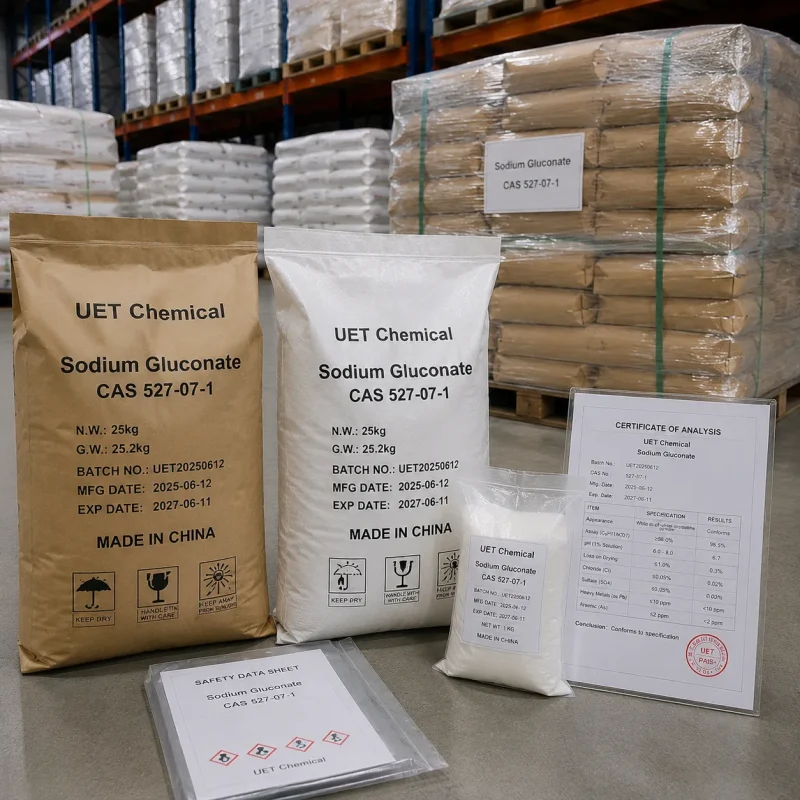
Sodium Gluconate CAS 527-07-1
Sodium Gluconate is a high-purity polyhydroxy carboxylate salt supplied as a white crystalline powder or free-flowing granules. Renowned for its exceptional chelating power in highly alkaline environments and synergistic effects with superplasticizers, it is the industry standard for concrete admixtures, industrial water treatment, and heavy metal sequestration. Each shipment includes COA, TDS, and SDS.
- CAS No: 527-07-1
- Synonyms: D-Gluconic acid sodium salt, Sodium D-gluconate, Pentahydroxycaproic acid sodium salt
- EC Number: 208-407-7
- Molecular Formula: C6H11NaO7
- Molecular Weight: 218.14 g/mol
- Appearance: White crystalline powder or free-flowing granules
- Purity: ≥ 98.0% (Industrial Grade) / ≥ 99.0% (Food Grade)
- Packaging: 25 kg (55 lb) woven PP bag with PE liner; 25 kg (55 lb) kraft paper bag with PE liner; 1000 kg (2200 lb) FIBC jumbo bag. Custom packaging available upon request.
- Main Applications: Concrete set retarder, industrial chelating agent, boiler water treatment, textile printing auxiliary
Introduction to Sodium Gluconate
Sodium Gluconate is a versatile organic sodium salt derived from the oxidation of glucose. Construction chemical formulators and industrial cleaning manufacturers rely heavily on it because its multiple hydroxyl groups and carboxylate structure grant it unmatched metal-ion chelating capabilities, especially in highly alkaline environments (pH > 12) where traditional chelators like EDTA fail.
The primary processing advantage is its excellent synergy with Polycarboxylate Ether (PCE) superplasticizers, drastically reducing slump loss in concrete without compromising ultimate compressive strength. The critical handling risk is its hygroscopic nature. If the PE liner is left open in a humid warehouse, the powder will rapidly absorb moisture and form rock-hard lumps, complicating automated dosing systems. Store pallets in a dry, climate-controlled environment and ensure bags are tightly heat-sealed or tied after every use.
Key Features of Sodium Gluconate
- Superior alkaline chelation. Effectively sequesters calcium, iron, and magnesium ions even at pH levels above 12, making it indispensable for cementitious systems and alkaline industrial cleaners.
- Concrete slump retention. Acts as a highly efficient set retarder and slump-keeping agent, extending the working time of ready-mix concrete during summer pours or long-distance transit.
- Excellent biodegradability. Unlike phosphonates or synthetic polycarboxylates, it degrades rapidly in wastewater treatment plants, meeting strict environmental discharge regulations.
- High aqueous solubility. Dissolves rapidly and completely in cold water without leaving residue, ensuring smooth operation in liquid admixture blending tanks and automated dosing rigs.
Sodium Gluconate Chemical & Physical Properties
| Property | Value |
|---|---|
| Molecular Formula | C6H11NaO7 |
| Molecular Weight | 218.14 g/mol |
| Thermal Behaviour | Decomposes above 200 °C (392 °F) without a sharp melting point. |
| Density | Bulk density approx. 0.80–0.95 g/cm³ (50–59 lb/ft³) for powder; higher for granules. |
| Solubility in Water | Very soluble, approx. 59 g / 100 mL at 20 °C (68 °F); insoluble in organic solvents. |
| pH (10% aqueous solution) | 6.5 – 8.5 |
| Chloride (Cl⁻) Content | ≤ 0.05% (Crucial for reinforced concrete) |
| Loss on Drying | ≤ 2.0% |
| Heavy Metals (as Pb) | ≤ 10 ppm |
Applications of Sodium Gluconate
Concrete admixtures and construction: Dosed at 0.05–0.20% by weight of cement. It retards the hydration of C3A and C3S phases, extending initial set times by several hours and significantly reducing slump loss in ready-mix concrete. It is universally blended with PCE superplasticizers for high-performance and self-compacting concrete (SCC).
Industrial water treatment and boiler cleaning: Used as a scale inhibitor and sequestering agent in cooling towers and boiler feedwater. Its ability to hold calcium and magnesium in solution prevents hard scale deposition on heat-exchange surfaces without introducing environmentally restricted phosphorus.
Metal surface treatment and electroplating: Acts as a complexing agent in alkaline zinc and tin plating baths, ensuring smooth, dense, and bright metal deposits. Also used in alkaline derusting and metal cleaning formulations to dissolve iron oxides without attacking the base metal.
Textile printing and dyeing: Serves as a water softener and heavy-metal masking agent in dye baths, preventing calcium/magnesium ions from reacting with dyes and causing uneven coloration or fabric spotting.
Storage & Safety Precautions for Sodium Gluconate
- Storage: Store in a cool, dry, and well-ventilated warehouse below 30 °C (86 °F). The material is moderately hygroscopic; moisture ingress will cause severe caking. Keep PP bags and FIBC liners tightly sealed. Stack pallets on racks or dunnage, never directly on damp concrete floors.
- Safety: Non-hazardous and non-toxic. Avoid inhalation of dust during bag slitting, which may cause mild respiratory irritation. Wear standard dust masks (N95) and safety goggles. Wash hands with soap and water after handling.
- Transport: Sodium Gluconate is Non-DG under IATA/IMDG/ADR. Not a marine pollutant. Ships efficiently in 20ft standard dry containers. Ensure container doors and vents are sealed to prevent ocean moisture ingress during long transits.
- QC note: Verify Loss on Drying (≤ 2.0%) and Chloride content (≤ 0.05%) upon receipt. High moisture content indicates poor storage, while elevated chloride levels can induce severe rebar corrosion in reinforced concrete applications—strictly reject lots failing the chloride specification.
Sodium Gluconate FAQ
Q: How does Sodium Gluconate (CAS 527-07-1) improve concrete performance compared to standard sugar retarders?
A: While sugar is a cheap retarder, it causes unpredictable flash sets and severe strength reduction if overdosed. Sodium Gluconate provides highly predictable, linear retardation, superior slump retention over 4+ hours, and does not compromise the 28-day compressive strength of the concrete matrix.
Q: My powder arrived in rock-hard lumps. Is it still chemically effective?
A: Chemically, the chelating power remains intact, but mechanically, lumps will clog automated dosing hoppers and dissolve too slowly in liquid blending tanks. If the lumps can be easily crushed between your fingers, it can still be used; if they are rock-hard, the lot should be rejected due to severe moisture ingress.
Q: Why is the Chloride (Cl⁻) specification so critical for construction buyers?
A: Chloride ions penetrate concrete and destroy the passive oxide layer on steel reinforcement bars, leading to catastrophic rust expansion and structural spalling. High-quality Sodium Gluconate must have Cl⁻ ≤ 0.05% to meet strict international building codes for reinforced and pre-stressed concrete.
Related products
Manufacturer & Exporter Since 2006
Get Tailored Chemical Raw Material Solutions — Reply Within 1 Hour
Factory-direct pricing, stable high-purity supply and complete compliance documentation for your industrial formulations.
- 1000+Products
- 200+QC Protocols
- 7–15Days Delivery
- Factory-Direct Pricing
- COA / TDS / SDS Included
- Free Samples for Testing
- 40+ Export Countries
Request a Free Quote
Our engineers reply within 1 hour during GMT+8 business hours.
Please include in your inquiry:
- Product name or CAS number
- Required quantity
- Destination country or port
- Preferred packaging