
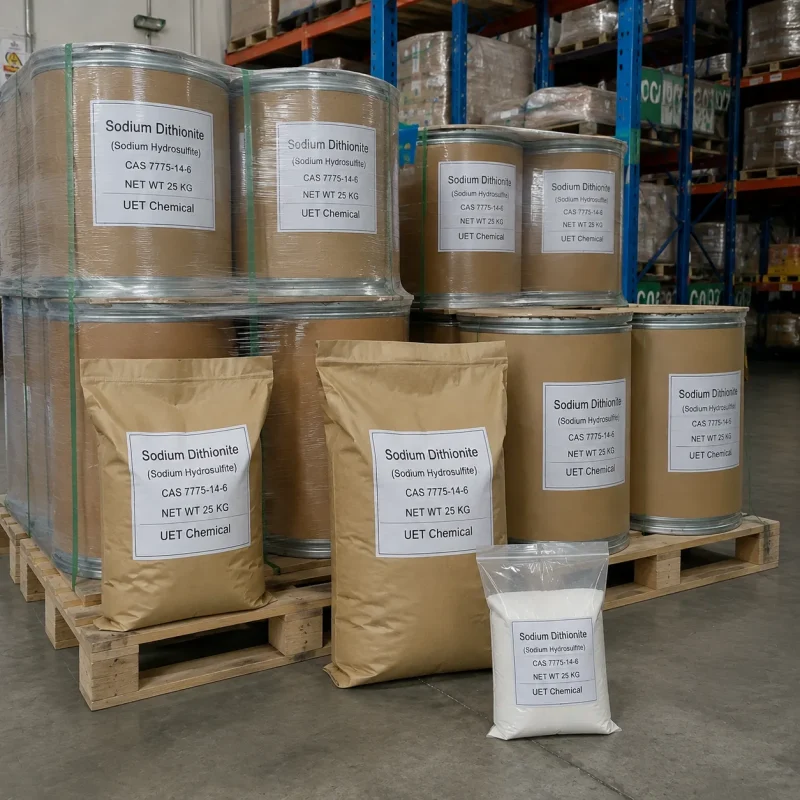
Sodium Dithionite (Sodium Hydrosulfite) CAS 7775-14-6
Sodium Dithionite is a powerful reducing agent supplied as white to light grey crystalline powder. With a standard reduction potential of -1.12 V, it rapidly reduces vat dyes to soluble leuco forms, removes chromophores from pulp, and decolorizes kaolin clay. Core uses include textile vat dyeing, paper pulp bleaching, and clay brightness improvement. Each shipment includes COA, TDS, and SDS.
- CAS No: 7775-14-6
- Synonyms: Sodium hydrosulfite, Na2S2O4, Hydrosulphite
- EC Number: 231-890-0
- Molecular Formula: Na2S2O4
- Molecular Weight: 174.11 g/mol
- Appearance: White to light grey crystalline powder
- Purity: ≥ 85.0% / 88.0% / 90.0% (Industrial Grade)
- Packaging: 50 kg (110 lb) sealed iron drum; 25 kg (55 lb) woven PP bag with PE liner; 1000 kg (2200 lb) IBC tote. Custom packaging available upon request.
- Main Applications: Textile vat dyeing, pulp bleaching, kaolin clay decolorization, water treatment
Introduction to Sodium Dithionite
Sodium Dithionite is a strong inorganic reducing agent featuring the dithionite anion (S2O4²⁻), where two sulfur atoms are directly bonded. In aqueous solution, it decomposes to generate active hydrogen and bisulfite ions, which reduce chromophoric groups, metal ions, and insoluble vat pigments. The reduction potential of approximately -1.12 V makes it significantly stronger than sodium metabisulfite or sulfite salts.
The primary processing advantage is its rapid reduction kinetics in continuous textile dyeing and pulp bleaching lines, where short residence times demand high reactivity. The critical storage risk is extreme sensitivity to moisture and heat. When wet, sodium dithionite undergoes exothermic decomposition, generating heat and potentially igniting spontaneously. Store drums in a dry, well-ventilated warehouse below 25 °C (77 °F), strictly isolated from water, acids, and oxidizing agents.
Key Features of Sodium Dithionite
- High reduction potential. At -1.12 V, it rapidly reduces indigo and anthraquinone vat dyes to water-soluble leuco forms, enabling fast fiber penetration and high color yield in textile dyeing.
- Significant brightness gain in pulp bleaching. Reduces chromophoric groups in mechanical pulp (TMP, CMP), increasing brightness by 5–15 ISO points without degrading cellulose fibers.
- Effective clay de-colorization. Converts insoluble ferric iron (Fe³⁺) stains in kaolin clay to soluble ferrous iron (Fe²⁺), which can be washed away, improving whiteness by 3–8 ISO units.
- Fast dissolution rate. High-quality powder grades dissolve quickly in cold water, making them ideal for continuous padding and injection systems where undissolved particles cause defects.
Sodium Dithionite Chemical & Physical Properties
| Property | Value |
|---|---|
| Molecular Formula | Na2S2O4 |
| Molecular Weight | 174.11 g/mol |
| Appearance | White to light grey crystalline powder |
| Purity (Assay) | ≥ 85.0% / 88.0% / 90.0% (typical industrial grades) |
| Bulk Density | Approx. 0.9 – 1.2 g/cm³ (56 – 75 lb/ft³) |
| Solubility in Water | Approx. 250 g/L at 20 °C (68 °F); insoluble in ethanol and ether. |
| pH (1% aqueous solution) | 4.5 – 6.5 (mildly acidic due to slow hydrolysis) |
| Thermal Behaviour | Decomposes above 50 °C (122 °F). Self-heating in moist air. Strongly exothermic decomposition. |
| Heavy Metals (as Pb) | ≤ 20 ppm (typical) |
Applications of Sodium Dithionite
Textile vat dyeing: Dosed at 2–10 g/L in reduction baths to convert indigo, anthraquinone, and thioindigoid vat dyes into water-soluble leuco forms. The leuco dye penetrates cotton or polyester fibers, then oxidizes back to the insoluble pigment inside the fiber, ensuring excellent wash fastness and vibrant color yield.
Paper pulp bleaching: Applied at 0.5–2.0% on dry pulp in mechanical pulp (TMP, CMP) bleaching. Reduces chromophoric groups and metal complexes, increasing brightness by 5–15 ISO points while preserving fiber strength. Typically combined with chelating agents (DTPA) to stabilize hydrogen peroxide in multi-stage bleaching sequences.
Kaolin clay brightness improvement: Dosed at 5–20 kg per ton of clay in aqueous slurry. Reduces insoluble ferric oxide stains to soluble ferrous iron, which is removed by filtration and washing, improving brightness and whiteness for high-quality paper coating and ceramics.
Water treatment and effluent polishing: Used at 10–50 ppm to remove residual chlorine and reduce toxic hexavalent chromium (Cr⁶⁺) to less mobile trivalent chromium (Cr³⁺) in electroplating and textile effluents, facilitating subsequent precipitation and discharge compliance.
Storage & Safety Precautions for Sodium Dithionite
- Storage: Keep absolutely dry and tightly sealed in original iron drums or woven bags in a cool, well-ventilated warehouse below 25 °C (77 °F). The product is highly hygroscopic; even minor moisture ingress causes exothermic decomposition, caking, and potential spontaneous combustion. Store away from water, acids, oxidizers, and heat sources.
- Safety: Classified as harmful if swallowed and irritating to eyes and respiratory system. In contact with acids, it decomposes violently, releasing toxic sulfur dioxide (SO2) gas and heat. Operators must wear chemical splash goggles, face shields, nitrile gloves, and N95 dust masks during handling.
- Transport: Sodium Dithionite is classified as Class 4.2 Spontaneously Combustible Substance under IATA/IMDG/ADR, UN 1384, Packing Group II or III. Requires special documentation, segregation from oxidizers and acids, and protection from moisture during transit.
- QC note: Verify assay by iodine titration upon receipt. Inspect drums for caking, discoloration, or unusual warmth. A warm drum indicates active moisture-driven decomposition; isolate immediately in a safe, dry area and do not open near water or acids. Reject compromised lots.
Sodium Dithionite FAQ
Q: How does Sodium Dithionite differ from Sodium Metabisulfite in textile processing?
A: Sodium dithionite (Na2S2O4) is a much stronger reducing agent (E° ≈ -1.12 V) required for vat dye reduction and pulp bleaching. Sodium metabisulfite (Na2S2O5) is milder, used primarily as a preservative, chlorine scavenger, or antioxidant. Dithionite should never be substituted with metabisulfite for vat dyeing.
Q: The iron drum feels warm to the touch. Is it safe to use?
A: No. Warmth indicates moisture ingress and exothermic decomposition. Move the drum immediately to a safe, dry, ventilated area away from combustibles. Do not open near water, acids, or heat sources. If the temperature exceeds 50 °C (122 °F) or smoking occurs, contact emergency services.
Q: Can Sodium Dithionite be used in acidic conditions?
A: No. In acidic media, it decomposes violently, generating toxic sulfur dioxide (SO2) gas and significant heat. Maintain pH above 5 in aqueous applications to ensure stability and safe operation.
Related products
Manufacturer & Exporter Since 2006
Get Tailored Chemical Raw Material Solutions — Reply Within 1 Hour
Factory-direct pricing, stable high-purity supply and complete compliance documentation for your industrial formulations.
- 1000+Products
- 200+QC Protocols
- 7–15Days Delivery
- Factory-Direct Pricing
- COA / TDS / SDS Included
- Free Samples for Testing
- 40+ Export Countries
Request a Free Quote
Our engineers reply within 1 hour during GMT+8 business hours.
Please include in your inquiry:
- Product name or CAS number
- Required quantity
- Destination country or port
- Preferred packaging