
N-Butyl Cyanoacrylate CAS 6606-65-1
N-Butyl Cyanoacrylate (NBCA) is a medical-grade monomeric ester that solves tissue trauma, scarring, and infection risks associated with traditional suturing. Medical device and industrial manufacturers rely on it for topical skin adhesives, surgical wound closure, and precision electronic bonding. UETChem supplies this active monomer with strict control over free acid, moisture, and inhibitor levels, ensuring extended shelf life, low exothermic heat, and excellent biocompatibility. Each shipment includes COA, TDS, SDS.
- CAS No: 6606-65-1
- Synonyms: NBCA; Butyl 2-cyanoacrylate; Enbucrilate
- EINECS: 229-556-4
- Molecular Formula: C8H11NO2
- Molecular Weight: 153.18 g/mol
- Appearance: Colorless to pale yellow transparent liquid
- Purity: 99.0% min (GC)
- Viscosity: 2.0 – 5.0 mPa·s at 25 °C
- Moisture: 50 ppm max
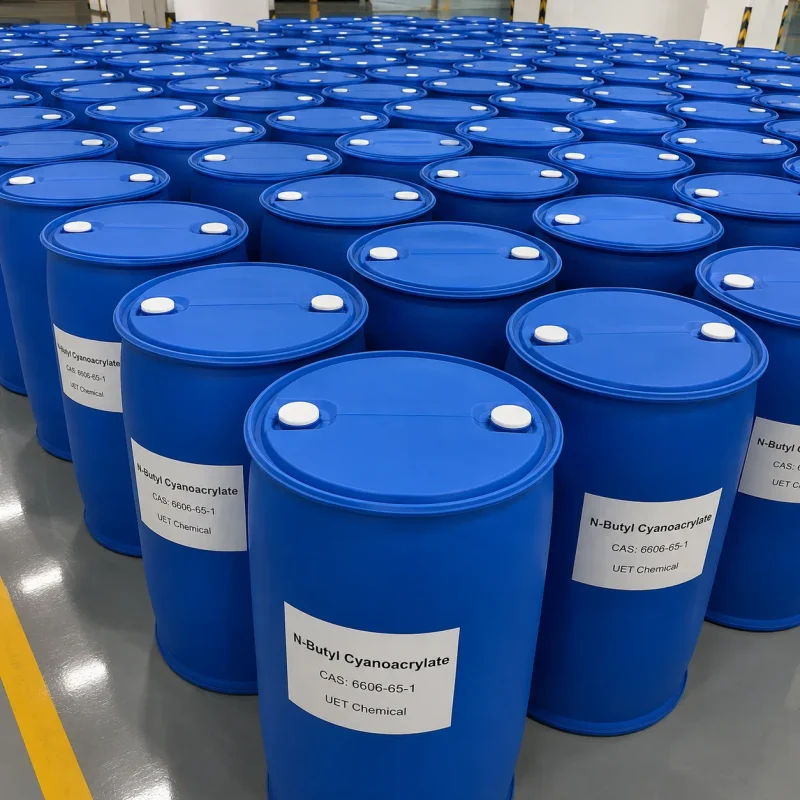
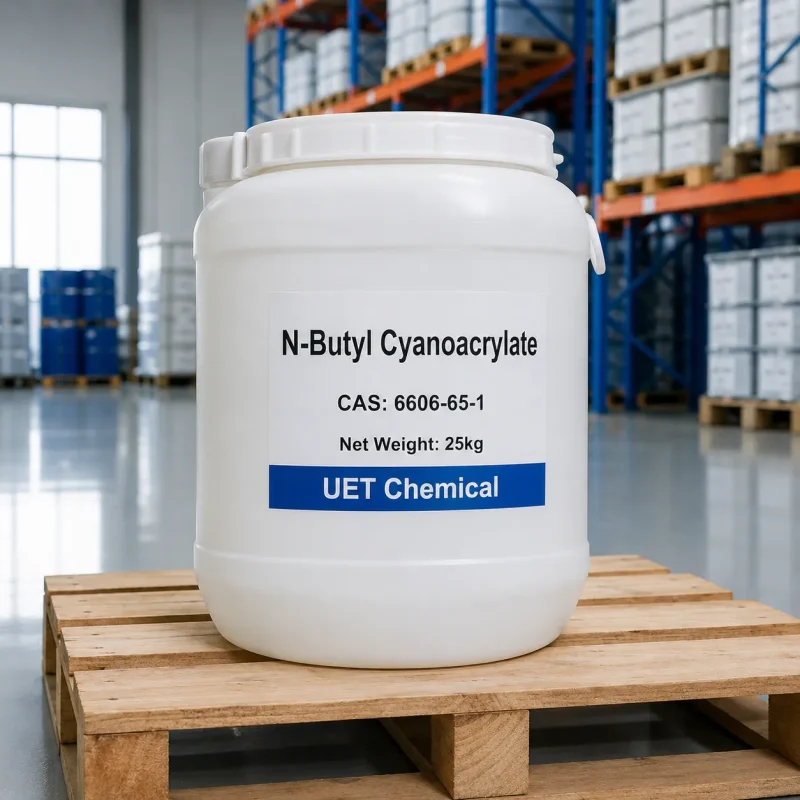
- Packaging: 1 kg (2.2 lb) aluminum bottle, 20 kg (44 lb) HDPE drum. Custom packaging available upon request.
- Main Applications: Medical tissue adhesives, veterinary wound sealants, industrial quick-bonding, electronic assembly
Introduction to N-Butyl Cyanoacrylate
N-Butyl Cyanoacrylate is a monomeric ester featuring a cyano group and an acrylate double bond attached to a four-carbon butyl chain. The molecular structure renders the double bond highly electrophilic. Upon contact with weak bases, such as hydroxyl ions present in ambient moisture or biological fluids, the monomer undergoes rapid anionic polymerization. The reaction propagates quickly, linking individual monomer units into long, high-molecular-weight poly(butyl cyanoacrylate) chains. The resulting polymer matrix forms a rigid yet flexible solid network. The liquid state allows for precise application and deep penetration into microscopic substrate irregularities before the phase transition occurs.
Key Features of NBCA
- Electrophilic double bond: Reacts instantly with trace moisture to form strong covalent polymer networks.
- Butyl side chain: Imparts structural flexibility to the cured polymer, reducing brittleness compared to shorter-chain variants.
- Exothermic reaction: Releases moderate heat during the rapid chain propagation phase, requiring controlled application thickness.
NBCA Chemical & Physical Properties
| Property | Value |
|---|---|
| Molecular Formula | C8H11NO2 |
| Molecular Weight | 153.18 g/mol |
| Appearance | Colorless to pale yellow transparent liquid |
| Density | 1.05 g/cm³ (8.76 lb/gal) at 20 °C |
| Viscosity | 2.0 – 5.0 mPa·s at 25 °C |
| Flash Point | > 80 °C (176 °F) |
| Purity | 99.0% min |
| Moisture Content | 50 ppm max |
Applications of N-Butyl Cyanoacrylate
Medical tissue adhesives: Used to close surgical incisions and lacerations. Formulators often pair the adhesive with antiseptic agents like Chlorhexidine Gluconate in surrounding skin prep protocols to maintain a sterile field during the bonding process.
Industrial assembly: Bonds plastics, rubber, and metals in electronics and automotive manufacturing. The low viscosity enables capillary action, drawing the liquid deep into tight mating surfaces before curing.
Veterinary care: Seals animal wounds and fixes hooves in field conditions where traditional suturing is impractical.
Storage & Safety Precautions for NBCA
- Temperature and moisture control: Store in original, unopened containers in a refrigerator between 2 °C and 8 °C (36 °F – 46 °F). Moisture is the primary enemy. Facilities run Calcium Chloride Anhydrous in storage rooms to maintain extremely low ambient humidity and prevent bulk degradation.
- Handling and PPE: Wear nitrile gloves and safety glasses. The liquid bonds skin instantly and can cause thermal burns due to the exothermic curing reaction on cotton or wool fabrics.
- Field note: When dispensing, never wipe the nozzle with a cotton swab or paper towel. Cellulose fibers contain abundant hydroxyl groups that trigger massive, instantaneous polymerization, permanently clogging the bottle.
NBCA FAQ
Q: How does N-Butyl Cyanoacrylate (NBCA) cure on skin?
A: NBCA cures via anionic polymerization initiated by trace moisture on the skin surface. The hydroxyl ions attack the cyanoacrylate double bond, triggering rapid chain growth. This forms a strong, flexible polymeric film that securely bonds tissue edges without requiring external heat or UV light.
Q: Is N-Butyl Cyanoacrylate safe for medical tissue adhesion?
A: Yes, NBCA exhibits lower toxicity and less exothermic heat than shorter-chain variants. Manufacturers use it to formulate topical skin adhesives. The butyl chain provides necessary flexibility, allowing the cured film to stretch with natural tissue movement.
Q: How should I store N-Butyl Cyanoacrylate to prevent premature curing?
A: Store NBCA in tightly sealed, opaque containers at 2 °C to 8 °C. Moisture and alkaline contaminants trigger rapid polymerization. Keep the warehouse dry using desiccants, and always purge opened bottles with dry nitrogen before resealing to extend the shelf life.
Related products
Manufacturer & Exporter Since 2006
Get Tailored Chemical Raw Material Solutions — Reply Within 1 Hour
Factory-direct pricing, stable high-purity supply and complete compliance documentation for your industrial formulations.
- 1000+Products
- 200+QC Protocols
- 7–15Days Delivery
- Factory-Direct Pricing
- COA / TDS / SDS Included
- Free Samples for Testing
- 40+ Export Countries
Request a Free Quote
Our engineers reply within 1 hour during GMT+8 business hours.
Please include in your inquiry:
- Product name or CAS number
- Required quantity
- Destination country or port
- Preferred packaging