
Musk Ambrette CAS 83-66-9
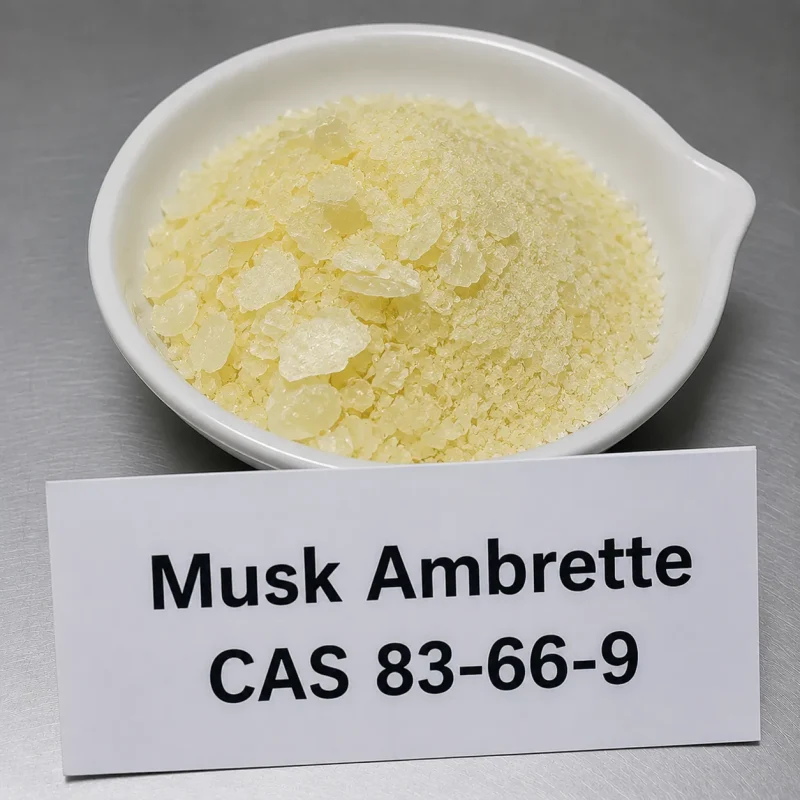
Musk Ambrette is a nitro-aromatic musk—4-tert-butyl-3-methoxy-2,6-dinitrotoluene—supplied as pale-yellow crystalline flakes (≥98.0% GC purity). It delivers a warm, sweet, animalic musk odour at a ppb-level threshold, functioning as a low-cost fixative in soap, detergent, and air-care fragrances. The two ring nitro groups give the classic nitro-musk tenacity on fabric, paper, and incense char. Each shipment includes COA, TDS, and SDS.
- CAS No.: 83-66-9
- Synonyms: Musk ambrette; 4-tert-Butyl-3-methoxy-2,6-dinitrotoluene; 2,6-Dinitro-3-methoxy-4-tert-butyltoluene
- EINECS: 201-495-8
- Molecular Formula: C₁₂H₁₆N₂O₅
- Molecular Weight: 268.27 g/mol
- Appearance: Pale yellow to yellow crystalline flakes
- Purity (GC): ≥98.0%
- Melting Point: 84–86 °C
- Odour: Strong sweet musk, animalic nuance
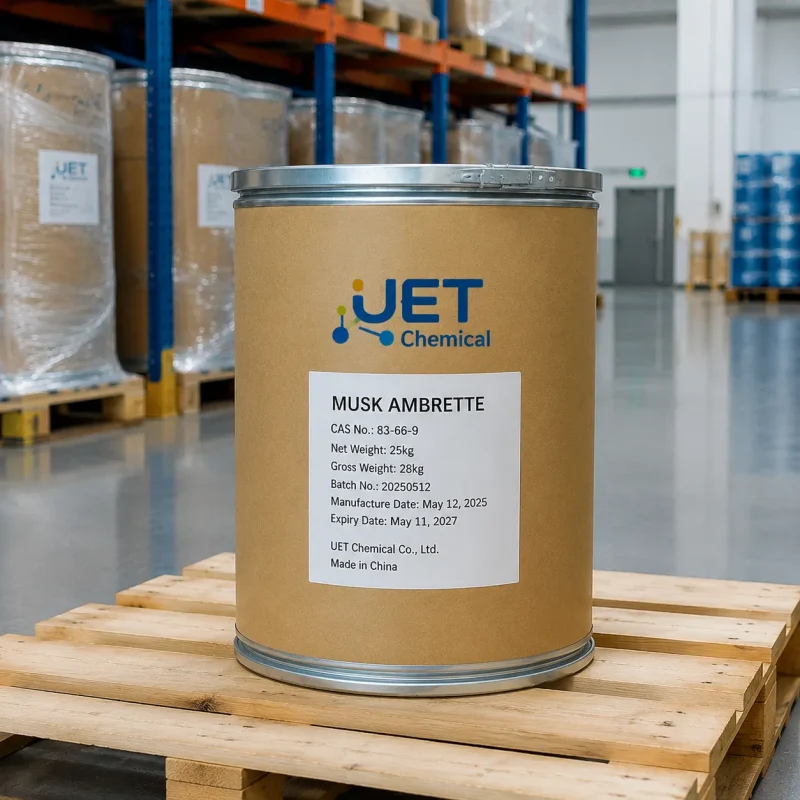
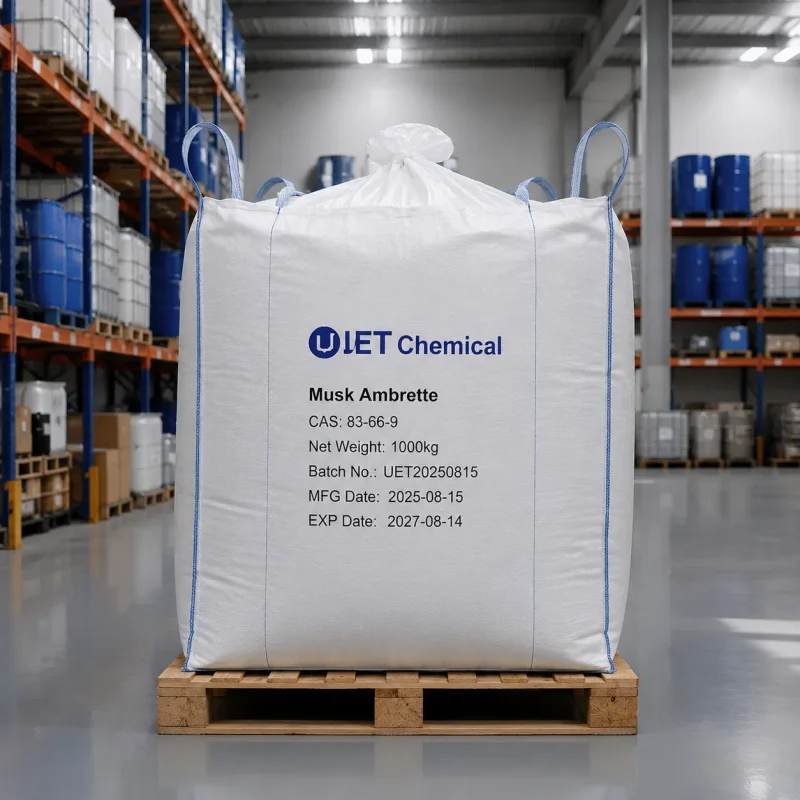
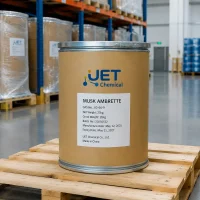
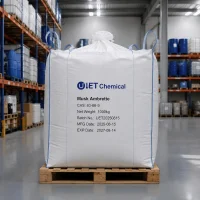
- Packaging: 25 kg fibre drum with PE liner / 1000 kg FIBC bulk bag. Custom packaging available upon request.
- Main Applications: Soap fragrances; detergent powders; air fresheners; incense & potpourri
Introduction to Musk Ambrette
Musk Ambrette is a pale-yellow crystalline flake, a nitro-aromatic musk built on a toluene core carrying a tert-butyl group, a methoxy group, and two nitro groups. The rigid nitro-aromatic chromophore produces a warm, sweet, animalic musk odour detectable at sub-ppm levels. Industrial perfumers use it as a low-cost fixative and base note in soap, detergent, air-care, and incense fragrances.
Within the nitro-musk family the ambrette structure delivers the highest odour intensity per kilogram, holding the effective dose at 0.1–0.5% of the fragrance concentrate. One practical caution: the nitro-aromatic ring photo-reacts under UV, yellowing light-exposed white soap and darkening crystal surfaces during storage—keep drums dark and specify opaque packaging for finished goods. Regulatory note: musk ambrette is prohibited in EU cosmetics (Annex II, (EC) 1223/2009) and under the IFRA Code; ship only to industrial-fragrance markets where local rules permit.
Key Features of Musk Ambrette
- Classic nitro-musk odour. Warm, sweet, slightly animalic musk with a powdery ambrette nuance; a ppb-range odour threshold gives full impact at 0.1–0.5% dose in the concentrate.
- Exceptional substantivity. Extremely low volatility anchors volatile top notes; the musk dry-down persists on fabric, paper, and incense char for days to weeks.
- Alkali tolerance in soap. The nitro-aromatic backbone survives pH 9–11 soap slurries and detergent alkalinity without odour breakdown during processing and cure.
- High cost-performance. The strongest odour load per kilogram among nitro musks; one 25 kg drum flavours several tonnes of finished soap.
- Crystal handling by pre-dilution. Practically insoluble in water but readily soluble in ethanol, DPG, and IPM—dosed as a 10–25% solution for even distribution in the base.
Musk Ambrette Chemical & Physical Properties
| Property | Value |
|---|---|
| Molecular Formula | C₁₂H₁₆N₂O₅ |
| Molecular Weight | 268.27 g/mol |
| Appearance | Pale yellow to yellow crystalline flakes |
| Melting Point | 84–86 °C |
| Flash Point | >100 °C (closed cup) |
| Solubility | Insoluble in water; soluble in 95% ethanol, DPG, IPM |
| Purity (GC) | ≥98.0% |
| Loss on Drying | ≤0.5% |
Applications of Musk Ambrette
Bar soap and soap noodles: Used at 0.1–0.5% of the fragrance concentrate. The nitro-aromatic backbone holds the musk note through saponification contact and 4–6 week cure at pH 9–11, while the low threshold keeps the concentrate dose—and cost—low.
Detergent powders and household cleaners: Dosed at 0.05–0.3%. Survives alkaline builders and carbonate load; deposits a residual musk on washed fabric that remains detectable after line-drying.
Air fresheners, incense, and potpourri: Formulated at 0.5–2%. Near-zero vapour pressure releases the musk slowly, giving weeks of longevity in room sprays and a clean musky dry-down when burned in incense sticks.
Low-cost industrial perfume compounds: Serves as the fixative backbone in export-market compounds for regions where regulation permits, blending with floral and woody notes at 1–5% of the concentrate.
Storage & Safety Precautions for Musk Ambrette
Storage conditions. Store sealed, dark, at 5–30 °C, away from heat sources, open flame, strong reducing agents, strong alkalis, and amines. The flakes are a combustible nitro-aromatic; avoid dust clouds during bag emptying and keep drums out of direct sunlight—UV darkens the crystal surface within weeks.
Safety and PPE. GHS: Skin Sens. 1 (H317); Aquatic Chronic 2 (H411). Wear nitrile gloves, safety goggles, and an N95/P2 dust mask during transfer; avoid skin contact—nitro musks absorb dermally. Spills: sweep up dry into a labelled container; do not flush to drain.
Transport classification. Non-DG. Not regulated under IMDG, IATA, or ADR. Ship as standard general cargo with drums kept away from window-side container slots to limit light exposure.
Practitioner note: For incoming QC, run melting point (84–86 °C) plus GC purity (≥98%), and sample from the drum core. Surface flakes one shade darker than the core signal UV exposure during prior handling; core colour and odour are the acceptance criteria. Crystal shade may vary pale-yellow to yellow between batches without changing the odour profile.
Musk Ambrette FAQ
Q: Is Musk Ambrette (CAS 83-66-9) still permitted in fragrance formulations?
A: Not in EU cosmetics—Annex II of (EC) 1223/2009 prohibits it, and the IFRA Code bans its use in fragrance ingredients. It remains in legal use for industrial fragrances (soap, detergent, air care, incense) in several non-EU markets. Confirm destination-country regulation before ordering; we ship with full COA/TDS/SDS documentation for industrial use only.
Q: Why do my white soap bars develop yellow patches after adding Musk Ambrette?
A: The nitro-aromatic chromophore photo-reacts under UV and strong visible light. Cap the dose at ≤0.3% of the soap weight, add a UV filter or wrap bars in opaque film, and store cartons away from daylight. The same mechanism darkens exposed crystals, so keep drums sealed and dark as well.
Q: What is the best way to dose the crystals into production?
A: Pre-dissolve at 10–25% in DPG, IPM, or warm ethanol (≤40 °C), or melt the flakes into the oil phase below 90 °C (melting point 84–86 °C). Never add dry crystals to a cold base—uneven distribution leaves musk spots in soap and hot spots in incense mixes. Stir 20–30 minutes for full homogeneity.
Related products
Manufacturer & Exporter Since 2006
Get Tailored Chemical Raw Material Solutions — Reply Within 1 Hour
Factory-direct pricing, stable high-purity supply and complete compliance documentation for your industrial formulations.
- 1000+Products
- 200+QC Protocols
- 7–15Days Delivery
- Factory-Direct Pricing
- COA / TDS / SDS Included
- Free Samples for Testing
- 40+ Export Countries
Request a Free Quote
Our engineers reply within 1 hour during GMT+8 business hours.
Please include in your inquiry:
- Product name or CAS number
- Required quantity
- Destination country or port
- Preferred packaging