
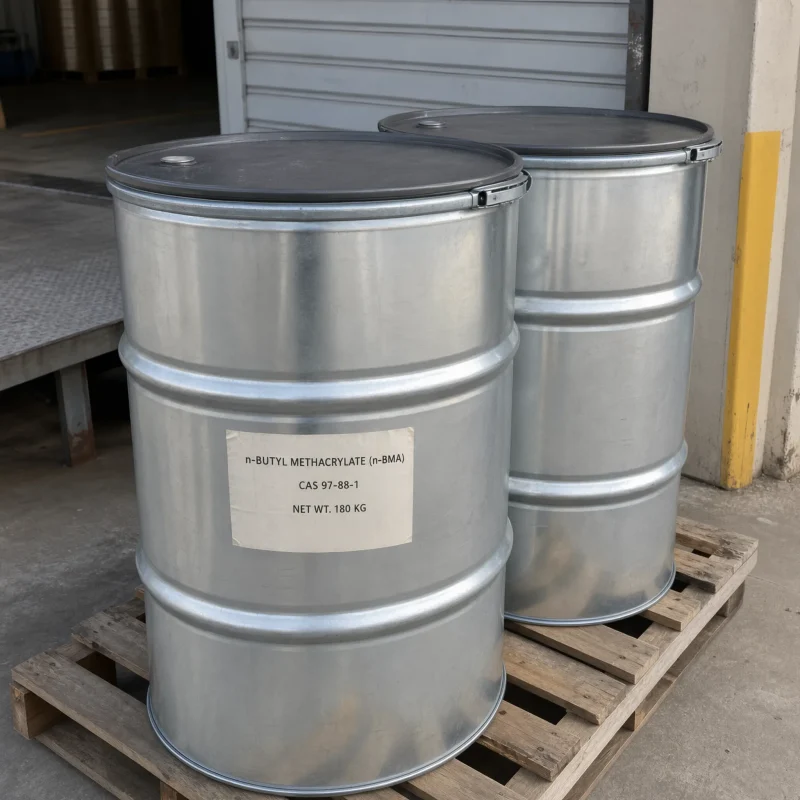
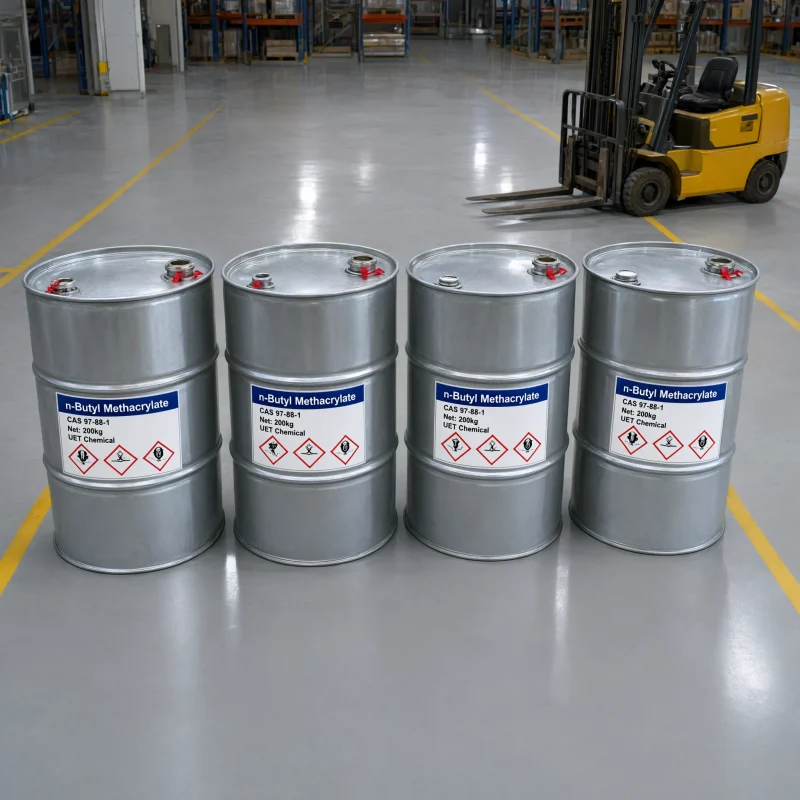
n-Butyl Methacrylate (n-BMA) CAS 97-88-1
n-Butyl Methacrylate (n-BMA) is a linear-chain methacrylate ester monomer supplied as colorless transparent liquid with characteristic methacrylate odor. As the n-butyl ester of methacrylic acid, it delivers moderate glass-transition temperature (Tg ≈ +20 °C) and superior weatherability to homopolymers and copolymers. Core uses include automotive OEM coatings, industrial acrylic latex paints, plastic impact modification, and UV-curable acrylate oligomer synthesis. Each shipment includes COA, TDS, and SDS.
- CAS No: 97-88-1
- Synonyms: Butyl 2-methylpropenoate, Methacrylic acid n-butyl ester, n-BMA, 2-Methyl-2-propenoic acid butyl ester
- EC Number: 202-614-6
- Molecular Formula: C8H14O2
- Molecular Weight: 142.20 g/mol
- Appearance: Colorless transparent liquid
- Purity (GC): ≥ 99.0%
- Packaging: 200 kg (440 lb) galvanized steel drum; 1000 kg (2200 lb) IBC tote; ISO tank bulk. Custom packaging available upon request.
- Main Applications: Automotive OEM and refinish coatings, industrial acrylic latex paints, plastic impact modifier for PMMA/PVC, pressure-sensitive adhesives, UV-curable oligomers, textile finishing binders
Introduction to n-Butyl Methacrylate (n-BMA)
n-Butyl Methacrylate (n-BMA) is a linear-chain methacrylate ester monomer produced by direct esterification of methacrylic acid with n-butanol over acid ion-exchange catalyst. The α-methyl group on the vinyl backbone distinguishes methacrylates from acrylates: it introduces steric hindrance that moderates propagation rate while providing a tertiary carbon center that resists UV-induced chain scission. The n-butyl ester side chain contributes controlled flexibility, yielding homopolymers with Tg of approximately +20 °C (68 °F)—positioned between the hardness of methyl methacrylate (+105 °C) and the softness of butyl acrylate (–54 °C).
In formulation design, n-BMA serves as the “intermediate segment” monomer. It bridges the gap between hard MMA-type monomers and soft BA-type monomers, providing balanced film hardness, flexibility, and outdoor durability in a single comonomer. The absence of labile tertiary hydrogen (present in acrylate backbones) grants n-BMA copolymers superior resistance to photo-oxidative yellowing and hydrolytic degradation. This makes n-BMA the preferred comonomer for automotive OEM clear coats, exterior coil coatings, and long-life architectural paints where 10+ year gloss retention is specified. n-BMA is also a key feedstock for impact-modifying PMMA and PVC via graft copolymerization.
Key Features of n-Butyl Methacrylate (n-BMA)
- Balanced Tg for single-monomer film formation. n-BMA homopolymer Tg of +20 °C (68 °F) allows ambient-temperature film formation without coalescing aids in many latex systems, reducing VOC content in architectural coatings.
- Superior UV and weather stability. The α-methyl group eliminates the labile tertiary C–H bond present in polyacrylate backbones, providing 3–5× longer gloss retention in QUV accelerated weathering versus equivalent BA copolymers.
- Excellent hydrolytic and chemical resistance. The methyl-substituted backbone and n-butyl ester resist alkaline hydrolysis, making n-BMA copolymers ideal for concrete coatings and industrial floor finishes exposed to pH 9–12 cleaning agents.
- Controlled polymerization kinetics. α-Methyl steric hindrance moderates propagation rate by 20–30% versus butyl acrylate, reducing exotherm intensity and gel formation risk in high-solids batch reactors operating at 80–95 °C (176–203 °F).
- Broad compatibility in copolymer design. Miscible and copolymerizable with MMA, BA, 2-EHA, styrene, hydroxyethyl methacrylate (HEMA), and glycidyl methacrylate (GMA), enabling Tg tuning from +20 °C to +110 °C (68 °F to 230 °F) for any coating performance target.
n-Butyl Methacrylate Chemical & Physical Properties
| Property | Value |
|---|---|
| Molecular Formula | C8H14O2 |
| Molecular Weight | 142.20 g/mol |
| Boiling Point | 163 °C (325 °F) at 101.3 kPa |
| Melting Point | –75 °C (–103 °F) |
| Density | 0.894 g/cm³ (55.8 lb/ft³) at 20 °C (68 °F) |
| Flash Point | 43 °C (109 °F) closed cup |
| Autoignition Temperature | 295 °C (563 °F) |
| Solubility in Water | 0.5 g/L at 20 °C (68 °F); miscible with most organic solvents |
| Viscosity | 1.2 mPa·s at 25 °C (77 °F) |
| Refractive Index | n²⁰_D = 1.4240 – 1.4270 |
| Inhibitor (MEHQ) | 15 – 20 ppm (standard); inhibitor-free grade available on request |
| Water Content | ≤ 0.10% (Karl Fischer) |
| Acidity (as methacrylic acid) | ≤ 0.02% |
Applications of n-Butyl Methacrylate (n-BMA)
Automotive OEM and refinish coatings: Copolymerized with MMA, HEMA, and styrene at 20–40% n-BMA loading in solvent-based or high-solids acrylic resins for automotive base coats and clear coats. Provides balanced hardness-to-flexibility ratio, excellent DOI (distinctness of image), and 10-year gloss retention in Florida exposure testing. Cured with melamine or isocyanate crosslinkers at 120–140 °C (248–284 °F).
Industrial acrylic latex paints: Emulsion polymerization at 80–90 °C (176–194 °F) with n-BMA as sole or primary monomer at 60–100% loading. Produces self-crosslinking latex films without coalescing aids, achieving MFFT below 5 °C (41 °F) and scrub resistance > 10,000 cycles. Ideal for low-VOC architectural coatings meeting Green Seal GS-11 and EU Ecolabel criteria.
Plastic impact modification (PMMA/PVC): n-BMA grafted onto PMMA or PVC backbone via emulsion or bulk polymerization at 10–30 phr loading. The rubbery n-BMA phase absorbs impact energy while maintaining optical clarity, producing high-impact acrylic sheets for glazing, signage, and automotive tail lamp lenses.
Pressure-sensitive adhesives and sealants: n-BMA copolymerized with 2-EHA and acrylic acid for acrylic PSA systems requiring higher shear resistance and temperature stability than BA-based adhesives. Suitable for automotive trim bonding and construction sealant applications operating at –30 °C to +80 °C (–22 °F to 176 °F).
UV-curable acrylate oligomers and inks: n-BMA esterified onto polyester or epoxy backbones to produce flexible UV-curable oligomers for overprint varnishes, wood coatings, and flexographic inks requiring balanced hardness and adhesion.
Storage & Safety Precautions for n-Butyl Methacrylate (n-BMA)
- Storage: Store in tightly sealed, grounded steel drums or IBC totes in a cool, well-ventilated warehouse below 25 °C (77 °F), away from heat, sparks, open flame, and direct sunlight. Do NOT store above 35 °C (95 °F). n-BMA is stabilized with 15–20 ppm MEHQ inhibitor which requires dissolved oxygen to remain effective—maintain 5–10% air headspace in bulk tanks. Keep away from oxidizers, strong acids, strong bases, peroxides, and free-radical initiators. Shelf life 12 months unopened; 30 days after opening with proper headspace.
- Safety: n-BMA is a flammable liquid (Flash point 43 °C / 109 °F) and harmful by inhalation. Causes skin and eye irritation; may cause respiratory irritation at elevated vapor concentrations. Wear butyl rubber gloves, chemical splash goggles, and organic vapor respirator during handling. Use explosion-proof electrical equipment and bonding/grounding for all transfer operations. Ensure ventilation to keep airborne concentration below 20 ppm (TWA). In case of spill, contain with inert absorbent—do NOT use sawdust or combustible materials.
- Transport: n-Butyl Methacrylate is classified as UN 2227, Class 3 (Flammable Liquid), Packing Group III under IATA/IMDG/ADR. DG documentation, placarding, and trained handler certification required. Do not co-load with oxidizers, peroxides, strong acids, or amines. Ensure drums are upright, secured, and protected from temperature extremes above 35 °C (95 °F). Summer shipments in tropical regions may require insulated containers. If bulk temperature exceeds 40 °C (104 °F) during transit, verify inhibitor level upon arrival.
- QC note: On receipt, verify GC purity (≥ 99.0%), water content (≤ 0.10%), and MEHQ inhibitor level (15–20 ppm). Check for premature polymerization: presence of gel particles, cloudiness, or viscosity increase above 1.5 mPa·s indicates inhibitor depletion or thermal exposure—reject the lot. Do NOT open drums that are warm to touch—cool to below 25 °C (77 °F) first. Confirm drum integrity and pressure relief vent functionality before opening.
n-Butyl Methacrylate (n-BMA) FAQ
Q: How does n-BMA compare to n-Butyl Acrylate (BA) in exterior architectural paint formulations?
A: n-BMA homopolymer Tg is +20 °C (68 °F) versus –54 °C (–65 °F) for BA. n-BMA provides harder films, superior UV stability (no tertiary C–H for photo-oxidation), and better alkaline resistance for masonry coatings. BA provides low-temperature flexibility and lower MFFT. For exterior paints requiring 10-year chalk and gloss retention, n-BMA is the preferred soft-to-intermediate monomer; for interior paints prioritizing flexibility, BA remains dominant.
Q: Why does my n-BMA drum show slight viscosity increase after summer transit?
A: This indicates partial thermal polymerization caused by inhibitor depletion at sustained temperatures above 35 °C (95 °F). MEHQ requires dissolved oxygen; in sealed drums at high temperature with insufficient headspace, inhibitor consumption accelerates. If gel content is below 0.1% and viscosity remains under 1.5 mPa·s, the material is usable after filtration through 200-mesh screen. Specify drums with 5–10% air headspace for summer shipments.
Q: Can n-BMA replace MMA in automotive clear coat formulations to reduce cost?
A: Partially. n-BMA lowers Tg and improves flexibility versus MMA, but reduces hardness and scratch resistance. Typical automotive clear coats use 10–30% n-BMA blended with 50–70% MMA and 5–15% HEMA to balance hardness, flexibility, and crosslink density. Full MMA replacement with n-BMA would compromise pencil hardness below the 2H–3H specification required by OEM standards.
Related products
Manufacturer & Exporter Since 2006
Get Tailored Chemical Raw Material Solutions — Reply Within 1 Hour
Factory-direct pricing, stable high-purity supply and complete compliance documentation for your industrial formulations.
- 1000+Products
- 200+QC Protocols
- 7–15Days Delivery
- Factory-Direct Pricing
- COA / TDS / SDS Included
- Free Samples for Testing
- 40+ Export Countries
Request a Free Quote
Our engineers reply within 1 hour during GMT+8 business hours.
Please include in your inquiry:
- Product name or CAS number
- Required quantity
- Destination country or port
- Preferred packaging