
Sodium Lauroyl Isethionate CAS 7381-01-3
Sodium Lauroyl Isethionate (SLI) is an anionic surfactant of the acyl isethionate family—the sodium salt of the lauric acid ester of isethionic acid. Supplied as white to off-white powder or noodles with ≥85% active matter, it produces a rich, creamy lather and leaves a soft, conditioned after-feel on skin. It is the core surfactant of syndet (soap-free) bars, facial cleansers, baby washes, and shower gels. We supply powder and noodle grades with full batch traceability; each shipment includes COA, TDS, and SDS.
- CAS No.: 7381-01-3
- Synonyms: Sodium lauroyl isethionate; SLI; Sodium ethyl 2-sulfolaurate; Dodecanoic acid, 2-sulfoethyl ester, sodium salt
- EINECS: 230-949-8
- Molecular Formula: C₁₄H₂₇NaO₅S
- Molecular Weight: 330.42 g/mol
- Appearance: White to off-white powder or noodles
- Active Content: ≥85%
- pH (10% aq.): 5.5–7.5
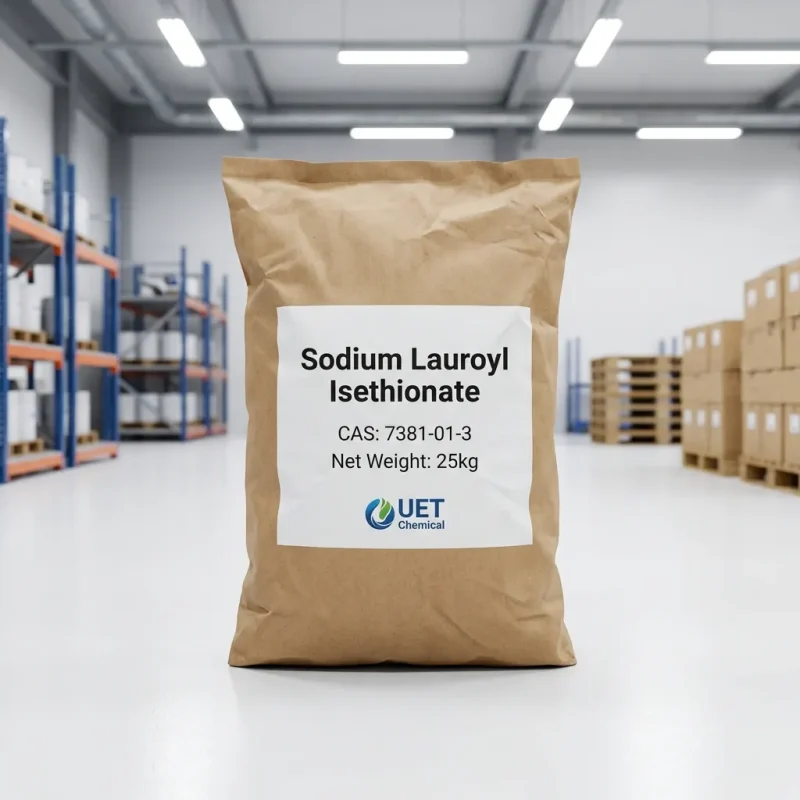
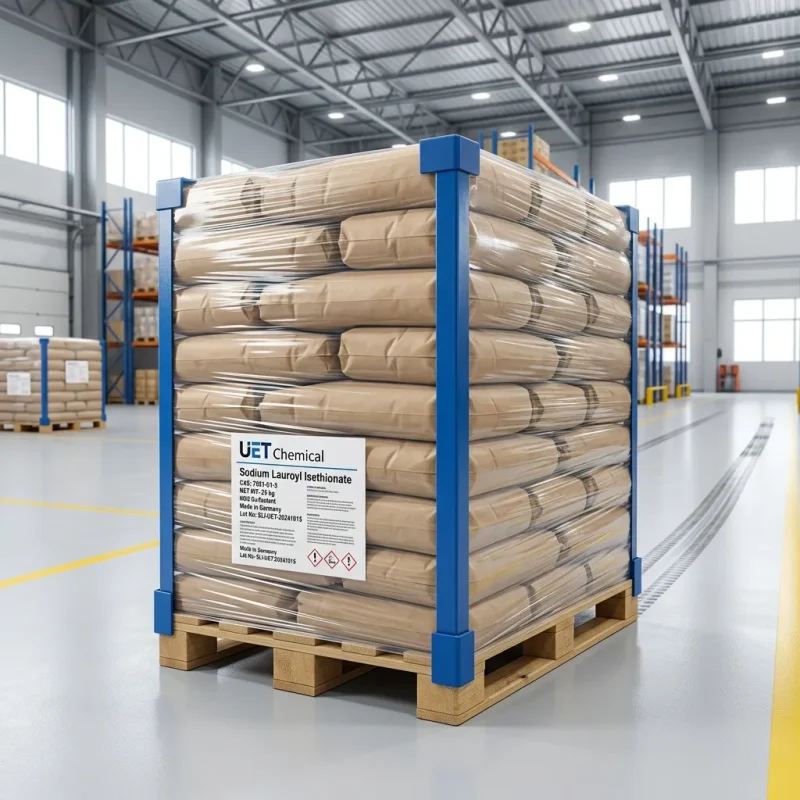
- Packaging: 25 kg kraft bag with PE liner / 25 kg fibre drum. Custom packaging available upon request.
- Main Applications: Syndet bars; facial cleansers; baby washes; sulfate-free shampoos & body washes
Introduction to Sodium Lauroyl Isethionate
Sodium Lauroyl Isethionate is a white to off-white powder or noodle, an anionic surfactant of the acyl isethionate family produced by esterifying lauric acid with isethionic acid and neutralising with sodium hydroxide. Commercial grades carry ≥85% active matter, the balance being mainly sodium isethionate with a small laurate soap fraction. The molecule pairs a C12 lauric chain with a sulfonated isethionate head, delivering effective cleansing together with a dense, creamy foam and good skin compatibility.
SLI lathers richly in both hard and soft water and leaves a soft, conditioned after-feel on skin. It is the core surfactant of syndet (soap-free) bars and gentle cleansers, and is used in facial cleansers, baby washes, body washes, shower gels, and shampoo bars. It works in neutral-pH formulas and combines with anionic, amphoteric, and non-ionic co-surfactants, emollients, and moisturisers, supporting sulfate-free and low-irritation formulation concepts.
Key Features of Sodium Lauroyl Isethionate
- Sulfate-free mild anionic. Low irritation potential suited to sensitive-skin and baby formulations; the CIR panel has assessed isethionate salts as safe in cosmetic practice.
- Rich, creamy lather. Builds a dense, cream-like foam in hard and soft water, giving syndet bars their characteristic velvety lather.
- Soft, conditioned after-feel. Deposits a light conditioned film that leaves skin soft and comfortable after rinsing, without a tight or stripped feel.
- Hard-water stability. Foam volume and cleansing performance hold in high-hardness water, and no insoluble soap scum forms on skin or surfaces.
- Broad formulation compatibility. Blends with anionic, amphoteric, and non-ionic surfactants, emollients, and electrolytes, and functions in neutral-pH, sulfate-free systems.
- Coconut-derived and biodegradable. Built from lauric acid and isethionic acid, supporting natural-origin and biodegradability claims.
Sodium Lauroyl Isethionate Chemical & Physical Properties
| Property | Value |
|---|---|
| Molecular Formula | C₁₄H₂₇NaO₅S |
| Molecular Weight | 330.42 g/mol |
| Appearance | White to off-white powder or noodles |
| Active Content | ≥85% (higher-purity grades on request) |
| pH (10% aq. solution) | 5.5–7.5 |
| Solubility | Dispersible in water; soluble in ethanol and propylene glycol; insoluble in hydrocarbons |
| Free Isethionate / Soap | Balance of active (typical 10–15%) |
| Loss on Drying | ≤2.0% |
| Heavy Metals (as Pb) | ≤10 ppm |
Applications of Sodium Lauroyl Isethionate
Syndet bars and soap-free cleansers: Used at 20–60% of the formula as the primary surfactant, combined with co-surfactants, emollients, and fillers. Delivers the dense creamy lather and soft after-feel that define premium syndet bars.
Facial cleansers and baby washes: Dosed at 5–15%. Low irritation potential and creamy foam suit sensitive-skin and baby formulations, leaving skin soft without a stripped feel.
Body washes and shower gels: Used at 3–10%, alone or with amphoteric co-surfactants. Builds rich, stable foam in hard and soft water and improves rinse-off feel.
Sulfate-free shampoos and shampoo bars: Used at 5–15%. Provides creamy lather and a conditioned after-feel in sulfate-free systems, supporting gentle daily-use hair care.
Gentle hand and industrial cleaners: Combined with co-surfactants in low-irritation hand cleaners and specialty cleansing products, delivering effective cleansing with a comfortable skin feel.
Storage & Safety Precautions for Sodium Lauroyl Isethionate
Storage conditions. Store in sealed, PE-lined kraft bags or fibre drums at 5–30 °C, in a dry warehouse. The powder is mildly hygroscopic and cakes above 70% RH; reseal opened bags immediately. Keep away from strong mineral acids and strong oxidisers.
Safety and PPE. GHS: Eye Irrit. 2 (H319). May cause eye irritation; avoid dust inhalation. Wear an N95 dust mask, safety glasses, and nitrile gloves during bag emptying. Spills: sweep up dry, then wash the floor with water—wet residue is slippery.
Transport classification. Non-DG. Not regulated under IMDG, IATA, or ADR. Ship as standard general cargo. Ensure container liners are intact to prevent moisture ingress during ocean freight.
Practitioner note: For incoming QC, verify active content by two-phase titration with a standardised cationic titrant, and check pH (5.5–7.5 at 10%) and loss on drying (≤2.0%). Powder grades generate dust during emptying—use local exhaust; noodle grades reduce dust and suit direct melt-in syndet bar processing.
Sodium Lauroyl Isethionate FAQ
Q: What is the difference between the powder and noodle grades of Sodium Lauroyl Isethionate (CAS 7381-01-3)?
A: Both carry the same ≥85% active content. Powder dissolves and disperses faster in liquid systems and suits dry-blend granulation; noodles generate less dust and melt directly into syndet bar mixes. Choose powder for liquid and granulated products, noodles for pressed syndet bars.
Q: Can SLI be used in sulfate-free and low-pH formulas?
A: Yes. SLI contains no sulfate group and performs at pH 5.5–7.5, the typical range of syndet bars and gentle cleansers. It blends with amphoteric and non-ionic co-surfactants to build complete sulfate-free systems.
Q: Why do my syndet bars turn soft or sticky after moulding?
A: Moisture uptake is the usual cause. Keep SLI and the finished bars in a dry environment below 60% RH, add hygroscopic-balancing fillers, and cool bars fully before wrapping. Verify the SLI loss on drying (≤2.0%) on arrival—wet raw material transfers moisture into the bar.
Related products
Manufacturer & Exporter Since 2006
Get Tailored Chemical Raw Material Solutions — Reply Within 1 Hour
Factory-direct pricing, stable high-purity supply and complete compliance documentation for your industrial formulations.
- 1000+Products
- 200+QC Protocols
- 7–15Days Delivery
- Factory-Direct Pricing
- COA / TDS / SDS Included
- Free Samples for Testing
- 40+ Export Countries
Request a Free Quote
Our engineers reply within 1 hour during GMT+8 business hours.
Please include in your inquiry:
- Product name or CAS number
- Required quantity
- Destination country or port
- Preferred packaging