
Sodium Lauryl Sulfosuccinate CAS 71963-18-3
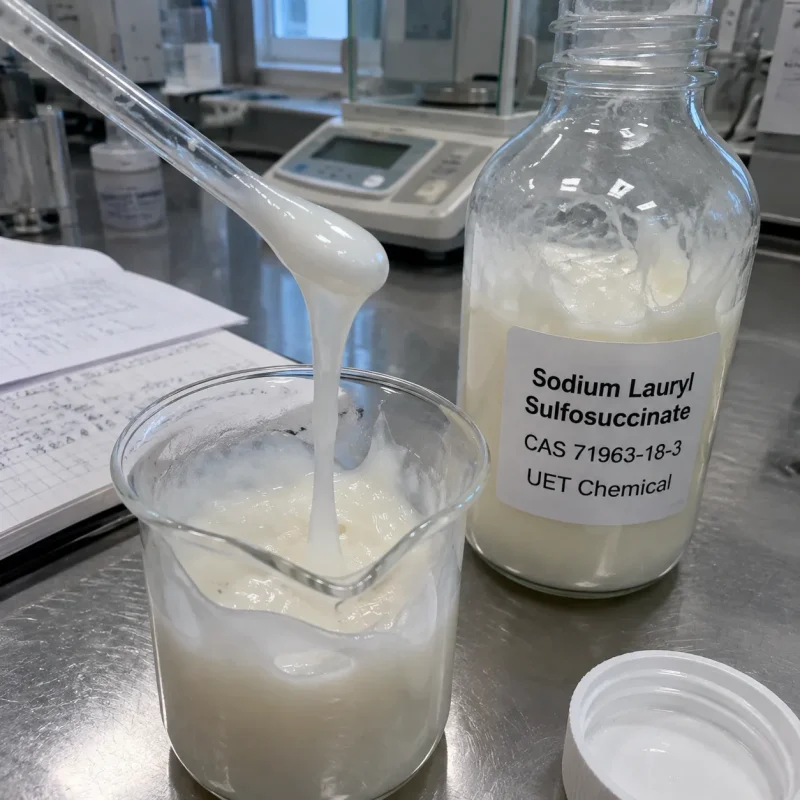
Sodium Lauryl Sulfosuccinate is a mild anionic surfactant featuring a C12 lauryl tail esterified to a bulky sulfosuccinate head. Supplied as a white powder or viscous paste (30–40% or ≥90% active), it acts as a primary foaming agent in sulfate-free shampoos, baby washes, and hard-surface cleaners. The large head group prevents deep skin penetration, delivering high foam with minimal irritation. Zero ethoxylation means no 1,4-dioxane risk. Each shipment includes COA, TDS, and SDS.
- CAS No.: 71963-18-3
- Synonyms: Disodium Lauryl Sulfosuccinate; DLS; Sodium C-dodecyl hydrogen sulphonatosuccinate
- EINECS: 275-822-7
- Molecular Formula: C₁₆H₂₈Na₂O₇S
- Molecular Weight: 398.44 g/mol
- Appearance: White to off-white powder or viscous aqueous paste
- Active Content: ≥90% (powder) / 30–40% (paste)
- pH (10% aq.): 5.5–7.0
- Solubility: Readily soluble in water
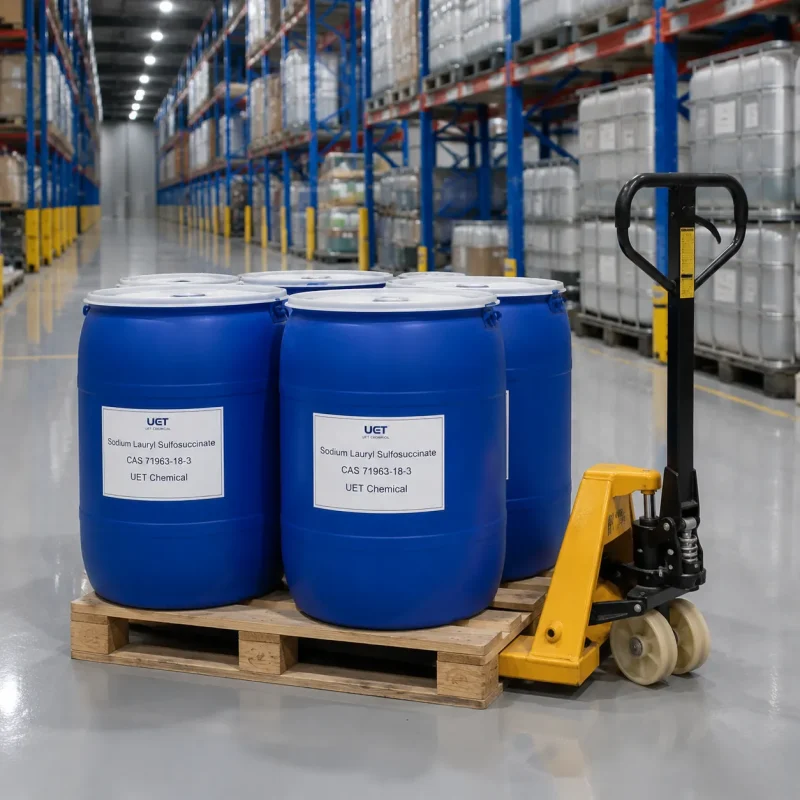
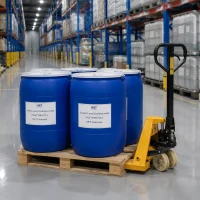
- Packaging: 25 kg fibre drum / 200 kg HDPE drum. Custom packaging available upon request.
- Main Applications: Sulfate-free personal care; baby cleansers; hard-surface cleaners; textile wetting agents
Introduction to Sodium Lauryl Sulfosuccinate
Sodium Lauryl Sulfosuccinate is a mild anionic surfactant featuring a C12 lauryl tail esterified to a bulky sulfosuccinate hydrophilic head. Supplied as a white powder or viscous aqueous paste, it functions as a primary foaming and cleansing agent in sulfate-free personal care and hard-surface cleaners. The large sulfonate-succinate head group restricts deep skin penetration, delivering high foam volume with minimal stratum corneum disruption.
The sulfonate group maintains full surface activity and foam stability in hard water (>300 ppm CaCO3) and high-electrolyte environments, avoiding the precipitation seen with standard alkyl sulfates. One practical caution: the ester bond linking the lauryl chain to the succinate ring hydrolyses rapidly above pH 9 or below pH 4, releasing free fatty alcohol and destroying foam capacity; finished formulations must be buffered strictly between pH 5.5 and 7.5.
Key Features of Sodium Lauryl Sulfosuccinate
- Bulky hydrophilic head. The sulfosuccinate moiety is significantly larger than standard sulfate heads, preventing deep insertion into lipid bilayers and yielding a very low irritation profile in patch tests.
- Hard-water tolerance. The direct carbon-sulfur bond in the sulfonate group resists calcium and magnesium binding. Foam height and lather density remain stable even in 400 ppm hard water without added chelators.
- Zero ethoxylation. Synthesised via direct esterification of lauryl alcohol with maleic anhydride followed by sulfonation. No ethylene oxide is used, eliminating 1,4-dioxane and PEG residue concerns entirely.
- Synergistic foam boosting. When blended with amphoteric betaines or glucosides, it increases overall foam volume by 20–30% and creates a denser, creamier lather structure compared to single-surfactant systems.
Sodium Lauryl Sulfosuccinate Chemical & Physical Properties
| Property | Value |
|---|---|
| Molecular Formula | C₁₆H₂₈Na₂O₇S |
| Molecular Weight | 398.44 g/mol |
| Appearance | White to off-white powder or viscous paste |
| Active Content | ≥90% (powder) / 30–40% (paste) |
| pH (10% aq. solution) | 5.5–7.0 |
| Solubility | Readily soluble in water; dispersible in polar organics |
| Surface Tension (1% aq.) | ~32 mN/m |
| Critical Micelle Concentration | ~1.5 g/L |
| Heavy Metals | ≤10 ppm |
Applications of Sodium Lauryl Sulfosuccinate
Sulfate-free shampoos and body washes: Used at 5–15% active. The bulky head group cleanses sebum without stripping scalp lipids. Formulators pair it with 3–5% cocamidopropyl betaine to thicken the system, as it does not respond well to salt thickening alone.
Baby and intimate-care cleansers: Dosed at 3–8% active. The low skin-penetration depth keeps the irritation index near zero in 48-hour occluded patch tests. Final formula pH must be locked at 5.5 to match skin physiology and prevent ester hydrolysis.
Hard-surface and industrial cleaners: Added at 2–10% active. The sulfonate group prevents scum formation in hard water, allowing the surfactant to maintain wetting and grease-emulsification on glass and ceramic tiles without leaving streaks.
Textile and leather wetting agents: Used at 0.5–2% in scouring and dyeing baths. Rapidly lowers surface tension below 30 mN/m, driving uniform chemical penetration into dense cotton or leather matrices without forming insoluble calcium soaps.
Storage & Safety Precautions for Sodium Lauryl Sulfosuccinate
Storage conditions. Store in sealed drums at 5–35 °C. The ester bond is sensitive to extreme pH and prolonged heat. Do not store near strong acids or alkalis. If the paste form freezes below 0 °C, thaw at room temperature and stir gently; do not apply direct high heat, which causes localized ester hydrolysis and separates the fatty alcohol.
Safety and PPE. GHS: Eye Irrit. 2 (H319). Mild to eyes but non-irritating to skin. Wear safety goggles and standard nitrile gloves during drum transfers. Spills create extremely slippery floors; contain with sand, collect, and wash the area with copious water.
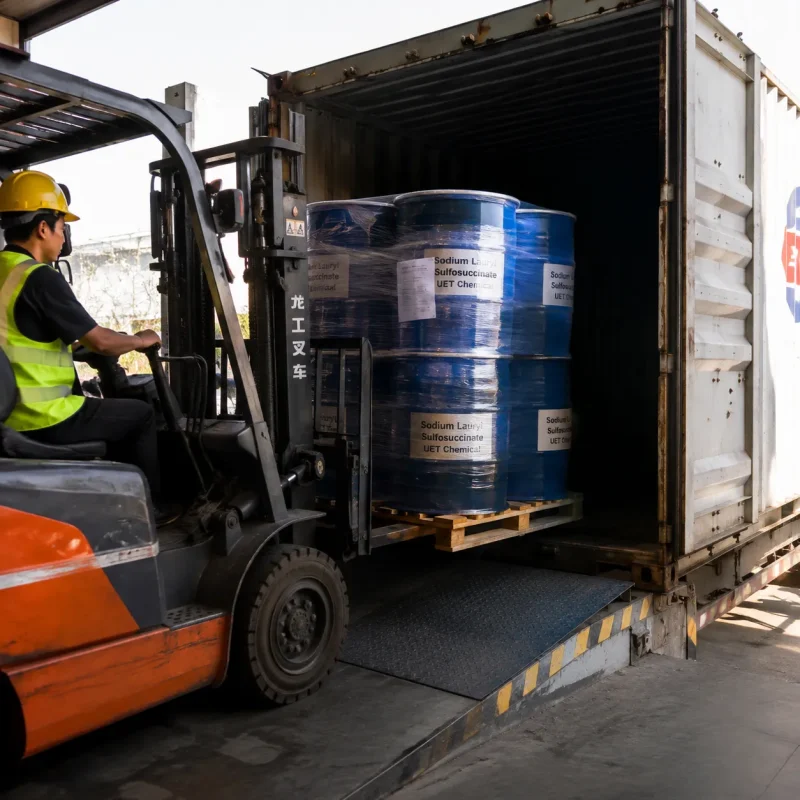
Transport classification. Non-DG. Not regulated under IMDG, IATA, or ADR. Ship as standard general cargo.
Practitioner note: When thickening a Sodium Lauryl Sulfosuccinate-based body wash, adding NaCl alone will not work—the molecule lacks the ethoxylate spacer needed for salt-induced micelle elongation. Use PEG-150 distearate, a PEG-free associative thickener, or increase the betaine ratio to 1:1 to build viscosity.
Sodium Lauryl Sulfosuccinate FAQ
Q: How do I thicken a formula based on Sodium Lauryl Sulfosuccinate (CAS 71963-18-3)?
A: Salt (NaCl) thickening fails because the molecule lacks an ethoxylate spacer. Use PEG-150 distearate at 1–2%, a PEG-free associative thickener like hydroxypropyl guar, or increase your amphoteric betaine ratio to 1:1. Expect a longer mixing time to reach peak viscosity.
Q: Why did my clear shampoo turn cloudy and separate after a month?
A: Ester hydrolysis. If the formula pH drifted below 4 or above 9, the ester bond broke, releasing free lauryl alcohol. The free alcohol crystallizes, causing cloudiness and phase separation. Always buffer the final product strictly between pH 5.5 and 7.0, and check pH stability at 45 °C for 30 days.
Q: Does it perform well in hard water compared to standard sulfates?
A: Yes. The sulfonate group binds calcium and magnesium much weaker than sulfate groups. It maintains full foam volume and prevents soap-scum precipitation in water hardness up to 400 ppm CaCO3, eliminating the need for high doses of EDTA or citrates.
Related products
Manufacturer & Exporter Since 2006
Get Tailored Chemical Raw Material Solutions — Reply Within 1 Hour
Factory-direct pricing, stable high-purity supply and complete compliance documentation for your industrial formulations.
- 1000+Products
- 200+QC Protocols
- 7–15Days Delivery
- Factory-Direct Pricing
- COA / TDS / SDS Included
- Free Samples for Testing
- 40+ Export Countries
Request a Free Quote
Our engineers reply within 1 hour during GMT+8 business hours.
Please include in your inquiry:
- Product name or CAS number
- Required quantity
- Destination country or port
- Preferred packaging